. 2014 Nov 6;95(5):477-89.
doi: 10.1016/j.ajhg.2014.09.009. Epub 2014 Oct 9.

Structural architecture of SNP effects on complex traits

Affiliations

Structural architecture of SNP effects on complex traits

Eric R Gamazon et al. Am J Hum Genet. .

Abstract

Despite the discovery of copy-number variation (CNV) across the genome nearly 10 years ago, current SNP-based analysis methodologies continue to collapse the homozygous (i.e., A/A), hemizygous (i.e., A/0), and duplicative (i.e., A/A/A) genotype states, treating the genotype variable as irreducible or unaltered by other colocalizing forms of genetic (e.g., structural) variation. Our understanding of common, genome-wide CNVs suggests that the canonical genotype construct might belie the enormous complexity of the genome. Here we present multiple analyses of several phenotypes and provide methods supporting a conceptual shift that embraces the structural dimension of genotype. We comprehensively investigate the impact of the structural dimension of genotype on (1) GWAS methods, (2) interpretation of rare LOF variants, (3) characterization of genomic architecture, and (4) implications for mapping loci involved in complex disease. Taken together, these results argue for the inclusion of a structural dimension and suggest that some portion of the "missing" heritability might be recovered through integration of the structural dimension of SNP effects on complex traits.


Figures

Figure 1
Figure 1
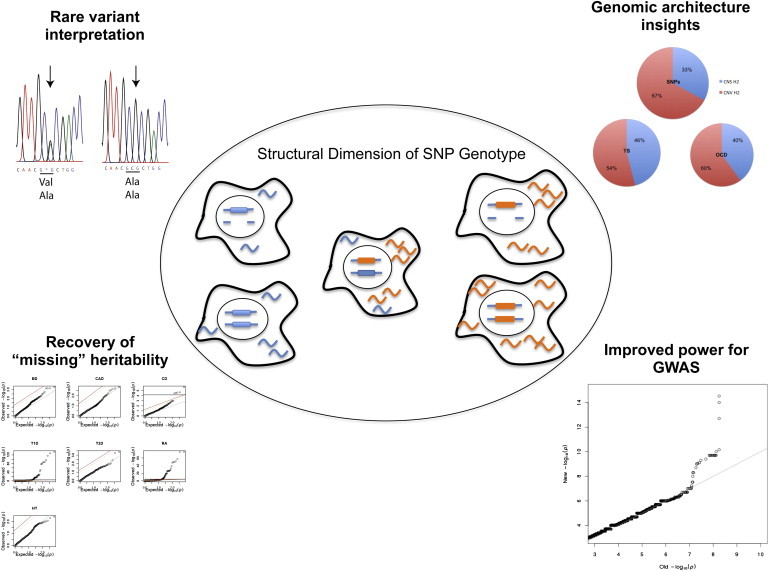
Schematic Diagram of the Analytic Approach We developed an approach that incorporates structural information to identify regulatory variants hidden from standard GWASs. The central figure displays a cartoon image of two alleles (orange and blue) each associated with a specific level of transcriptional efficiency and each represented with multiple structural variations. The remaining panels of the figure illustrate the focus of analyses presented in the paper including GWAS methods, interpretation of rare LOF variants, characterization of genomic architecture, and implications for mapping loci involved in complex disease.
Figure 2
Figure 2
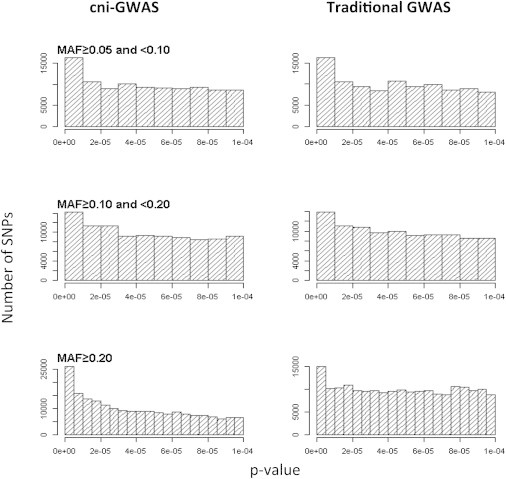
p Value Distribution of SNP-Gene Associations by MAF Bins under cni-GWAS and Traditional GWAS An analysis of the SNP-gene association p value distribution in separate MAF bins showed no difference between cni-GWAS and standard GWAS in the low-frequency (≥5% and <10%) and mid-frequency (≥10% and <20%) range, but revealed a substantial gain for cni-GWAS in low p values among common variants (≥20%).
Figure 3
Figure 3
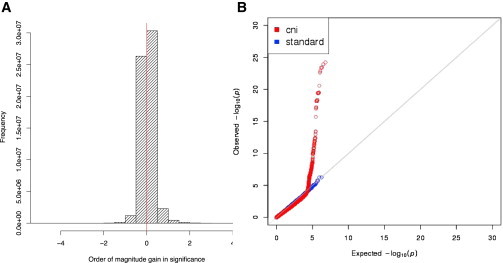
Evaluation of Association Results under cni-GWAS (A) A histogram of the change in significance (in log10 scale) for the SNPs found to be associated with gene expression at p < 0.01 under cni-GWAS. The mean gain was 1.35, which indicates a gain of at least one order of magnitude. 20% of these SNP-gene associations identified by cni-GWAS showed an improvement of nearly two orders of magnitude. The red line indicates no change in significance between cni-GWAS and standard GWAS. All results to the right of the red line represent an increase in significance and results to the left represent a decrease in significance. (B) SNPs in CNV regions drive eSNP enrichment (in LCLs) among NHGRI trait-associated SNPs and their LD proxies. cni-GWAS eSNPs showed a significant excess of low p values with gene expression under cni-GWAS (red). Furthermore, when we excluded the SNPs in CNVs and their LD proxies from the NHGRI catalog, this excess of low p values with gene expression for these trait-associated SNPs was no longer present (blue), suggesting that the observed eSNP enrichment among the trait-associated SNPs was driven by this special class of SNPs.
Figure 4
Figure 4
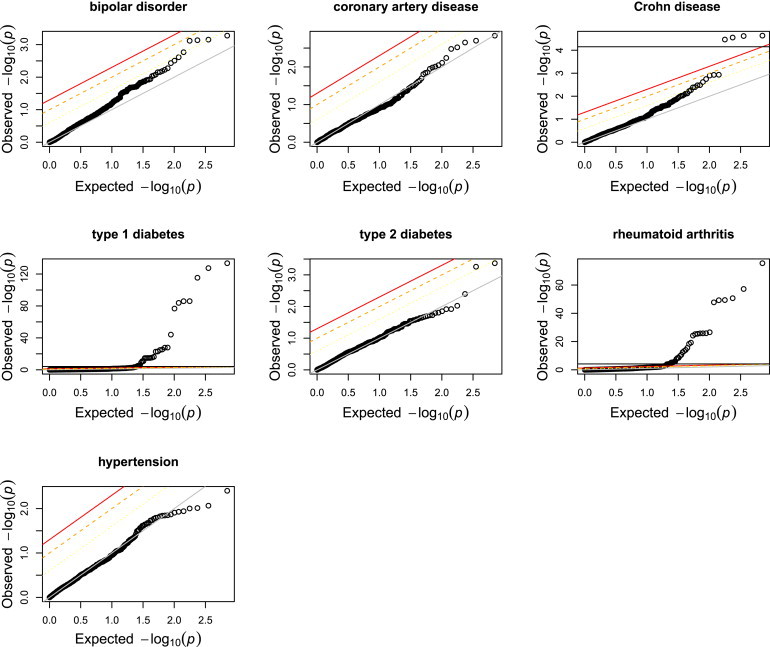
cni-GWAS eSNPs and Association with Disease Shown here are the Q-Q plots of the distribution of p values for association with disease from each of the seven WTCCC phenotypes for those eSNPs identified by cni-GWAS. Note the enrichment for trait associations with autoimmune disorders. Furthermore, several of the cni-GWAS eSNPs attained FDR < 0.25 with bipolar disorder, in contrast to the full GWAS SNPs. The leftward shifts corresponding to FDR < 0.05, FDR < 0.10, and FDR < 0.25 are shown as red, orange, and yellow lines, respectively (in relation to the diagonal gray line of perfect concordance between observed and expected p value). A horizontal black line representing Bonferroni correction is also shown whenever the eSNPs meet this threshold.

References

    1. Szatmari P., Paterson A.D., Zwaigenbaum L., Roberts W., Brian J., Liu X.Q., Vincent J.B., Skaug J.L., Thompson A.P., Senman L., Autism Genome Project Consortium Mapping autism risk loci using genetic linkage and chromosomal rearrangements. Nat. Genet. 2007;39:319–328. - PMC - PubMed
    1. Xu B., Roos J.L., Levy S., van Rensburg E.J., Gogos J.A., Karayiorgou M. Strong association of de novo copy number mutations with sporadic schizophrenia. Nat. Genet. 2008;40:880–885. - PubMed
    1. Davis L.K., Meyer K.J., Rudd D.S., Librant A.L., Epping E.A., Sheffield V.C., Wassink T.H. Novel copy number variants in children with autism and additional developmental anomalies. J. Neurodev. Disord. 2009;1:292–301. - PMC - PubMed
    1. Elia J., Gai X., Xie H.M., Perin J.C., Geiger E., Glessner J.T., D’arcy M., deBerardinis R., Frackelton E., Kim C. Rare structural variants found in attention-deficit hyperactivity disorder are preferentially associated with neurodevelopmental genes. Mol. Psychiatry. 2010;15:637–646. - PMC - PubMed
    1. Glessner J.T., Reilly M.P., Kim C.E., Takahashi N., Albano A., Hou C., Bradfield J.P., Zhang H., Sleiman P.M., Flory J.H. Strong synaptic transmission impact by copy number variations in schizophrenia. Proc. Natl. Acad. Sci. USA. 2010;107:10584–10589. - PMC - PubMed

Publication types

MeSH terms

LinkOut - more resources