. 2014 Dec;184(12):3405-14.
doi: 10.1016/j.ajpath.2014.08.015. Epub 2014 Oct 7.

The neurotensin-HIF-1α-VEGFα axis orchestrates hypoxia, colonic inflammation, and intestinal angiogenesis

Affiliations

The neurotensin-HIF-1α-VEGFα axis orchestrates hypoxia, colonic inflammation, and intestinal angiogenesis

Kyriaki Bakirtzi et al. Am J Pathol. 2014 Dec.

Abstract

The expression of neurotensin (NT) and its receptor (NTR1) is up-regulated in experimental colitis and inflammatory bowel disease; NT/NTR1 interactions regulate gut inflammation. During active inflammation, metabolic shifts toward hypoxia lead to the activation of hypoxia-inducible factor (HIF)-1, which enhances vascular endothelial growth factor (VEGF) expression, promoting angiogenesis. We hypothesized that NT/NTR1 signaling regulates intestinal manifestations of hypoxia and angiogenesis by promoting HIF-1 transcriptional activity and VEGFα expression in experimental colitis. We studied NTR1 signaling in colitis-associated angiogenesis using 2,4,6-trinitrobenzenesulfonic acid-treated wild-type and NTR1-knockout mice. The effects of NT on HIF-1α and VEGFα were assessed on human colonic epithelial cells overexpressing NTR1 (NCM460-NTR1) and human intestinal microvascular-endothelial cells. NTR1-knockout mice had reduced microvascular density and mucosal integrity score compared with wild-type mice after 2,4,6-trinitrobenzenesulfonic acid treatment. VEGFα mRNA levels were increased in NCM460-NTR1 cells treated with 10(-7) mol/L NT, at 1 and 6 hours post-treatment. NT exposure in NCM460-NTR1 cells caused stabilization, nuclear translocation, and transcriptional activity of HIF-1α in a diacylglycerol kinase-dependent manner. NT did not stimulate tube formation in isolated human intestinal macrovascular endothelial cells but did so in human intestinal macrovascular endothelial cells cocultured with NCM460-NTR1 cells. Our results demonstrate the importance of an NTR1-HIF-1α-VEGFα axis in intestinal angiogenic responses and in the pathophysiology of colitis and inflammatory bowel disease.


Figures

Figure 1
Figure 1
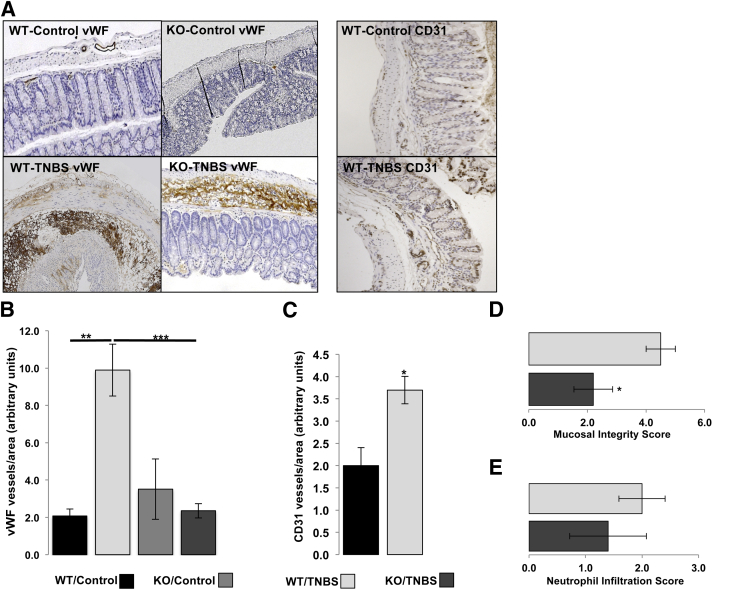
NTR1-KO mice or WT littermates received (or did not receive) intracolonic enema of TNBS (250 mg/kg). Forty-eight hours later. mice were sacrificed; colon tissues were collected, fixed in formalin, and embedded in paraffin; and endothelial cells were stained with von Willebrand factor (vWF) antibody or CD31 antibody. A: Representative microphotographs of vWF- and CD31-stained colon tissues. B: Relative vWF+ cells (endothelial cells/mm2) in colon tissues. C: Relative CD31+ cells (endothelial cells/mm2) in colon tissues. Comparison between mucosal integrity (D) and neutrophil infiltration scores (E) given for TNBS-treated NTR1-KO mice or WT littermates. Results are representative or two separate experiments. Data are expressed as means ± SEM (B–E). n = 8 mice per group. P < 0.05, ∗∗P < 0.01, and ∗∗∗P < 0.001 (Student's t-test). Original magnification, ×5 (A).
Figure 2
Figure 2
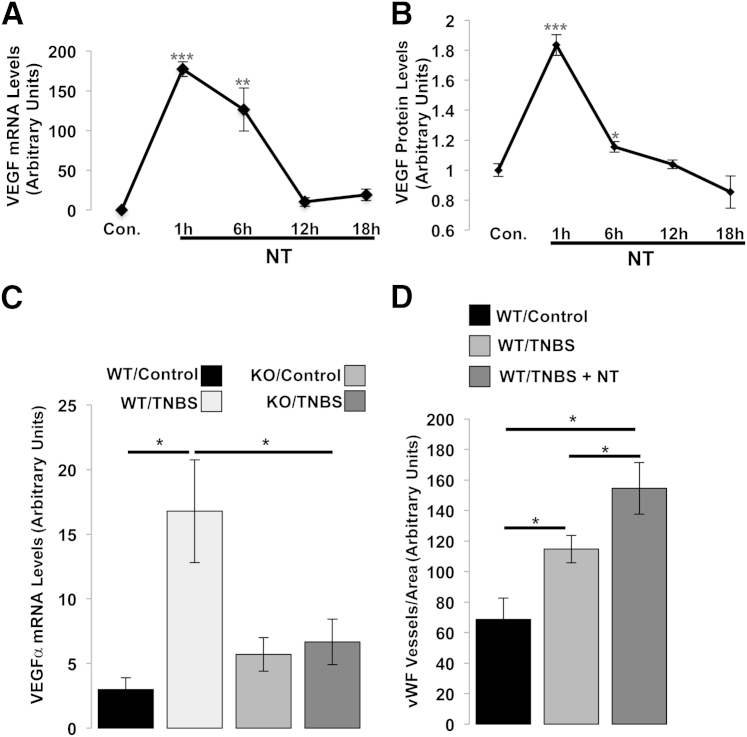
A: NT/NTR1 signaling promotes the expression of VEGF. NCM460-NTR1 cells were treated as indicated with 10−7-mol/L NT. VEGF mRNA levels were assessed by qPCR. Results are representative of two separate experiments. B: VEGF protein levels were assessed at indicated time points by enzyme-linked immunosorbent assay. C: NTR1-KO mice or WT littermates received as indicated intracolonic enema of TNBS (250 mg/kg). Forty-eight hours later, mice were sacrificed and colon tissues were collected for RNA isolation. The levels of VEGFα expression were detected by qPCR. Results are representative of two separate experiments. D: C57BL6J mice received intracolonic enema of 250 mg/kg TNBS, and 48 hours later mice received intracolonic enema of 300 μg/kg NT twice a day (8 hours apart) for the following 4 days. Mice were sacrificed on the 6th day, colon tissues were isolated, and VEGF mRNA levels in colon samples were assessed by qPCR. Results are representative of two separate experiments. Data are expressed as means ± SEM. n = 3 (A); n = 6 (B); n = 8 per group (C and D). P < 0.05, ∗∗P < 0.01, and ∗∗∗P < 0.001 (Student's t-test).
Figure 3
Figure 3
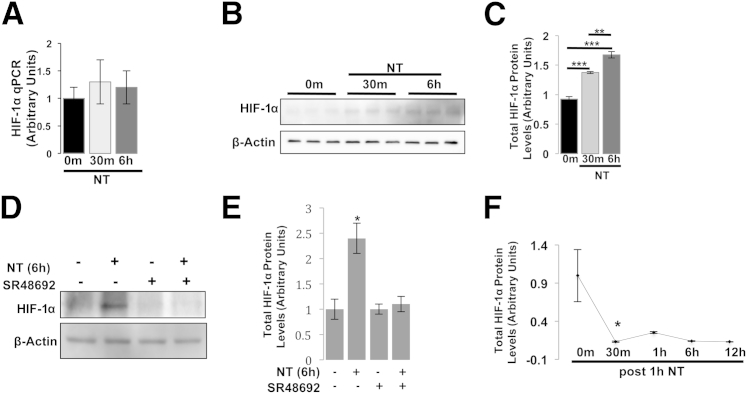
NT promotes HIF-1α protein stabilization. NCM460-NTR1 cells were treated as indicated with 10−7-mol/L NT. A: HIF-1α mRNA levels were assessed by qPCR. HIF-1α protein levels were assessed by Western blot analysis (B) and band densitometry (C). D: NCM460-NTR1 cells were pretreated as indicated with 10−7 mol/L NTR1 inhibitor SR48692 (30 minutes) and/or 10−7 mol/L NT, and HIF-1α protein levels were assessed using WB analysis and band densitometry (E). F: NCM460-NTR1 cells were treated with 10−7 mol/L NT for 1 hour, stimulus was removed by switching to complete media without NT, and HIF-1α protein levels were assessed at indicated time points by enzyme-linked immunosorbent assay. Results are representative of two separate experiments. Data are expressed as means ± SEM. n = 3. P < 0.05, ∗∗P < 0.01, and ∗∗∗P < 0.001 (Student's t-test).
Figure 4
Figure 4
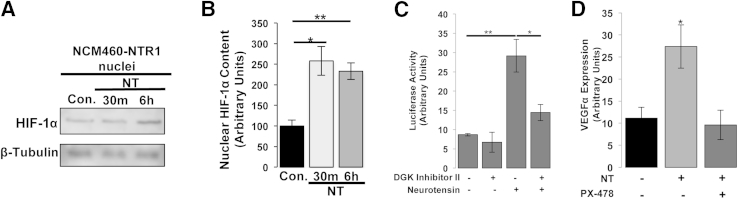
NT promotes HIF-1α protein activation, nuclear translocation, and transcriptional activity. NCM460-NTR1 cells were treated as indicated with 10−7 mol/L NT, and HIF-1α protein levels in isolated nuclei were assessed by WB analysis (A) and band densitometry (B). C: NCM460-NTR1 cells were transfected with HRE-luciferase reporter plasmid, treated as indicated with 3 × 10−6 DGK inhibitor II and/or 10−7 mol/L NT (6 hours), and luciferase activity was assessed using the Dual Luciferase Reporter Assay System. D: NCM460-NTR1 cells were treated as indicated with 10−7 mol/L NT (6 hours), with or without 18hour pretreatment with 40 × 10−6 mol/L HIF-1α inhibitor PX-478, and the expression of VEGFα was assessed by qPCR. Results are representative of three separate experiments. Data are expressed as means ± SEM (B–D). n = 3. P < 0.05 and ∗∗P < 0.01 (Student's t-test).
Figure 5
Figure 5
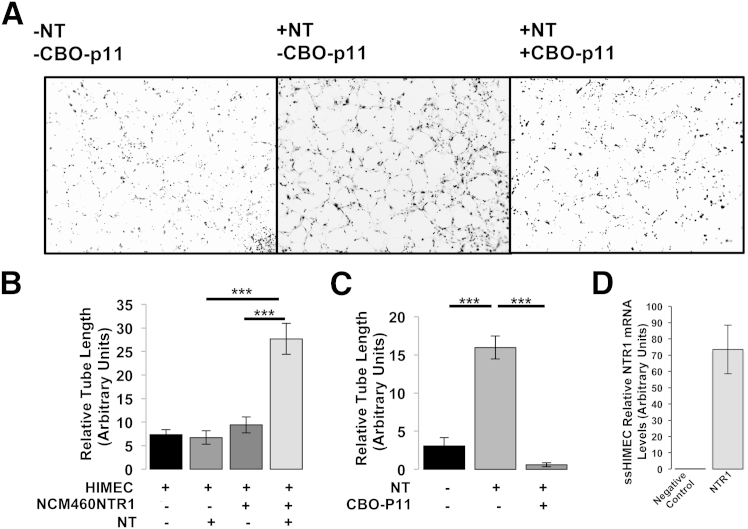
Human intestinal microvascular-endothelial cells (HIMECs) were subjected to Matrigel tube formation assay in coculture with NCM460-NTR1 cells and treated as indicated with 10−7 mol/L NT and 7 × 10−7 mol/L VEGFα inhibitor CBO-P11. Representative microphotographs of randomly selected fields (A) were used to calculate total tube length per area unit (pixel/pixel2) using ImageJ software (B and C). D: Negative control (adiponectin) and NTR1 mRNA levels were assessed by qPCR. Results are representative of four separate experiments. Data are expressed as means ± SEM (B–D). n = 3. ∗∗∗P < 0.001 (Student's t-test). Original magnification, ×10 (A).
Figure 6
Figure 6
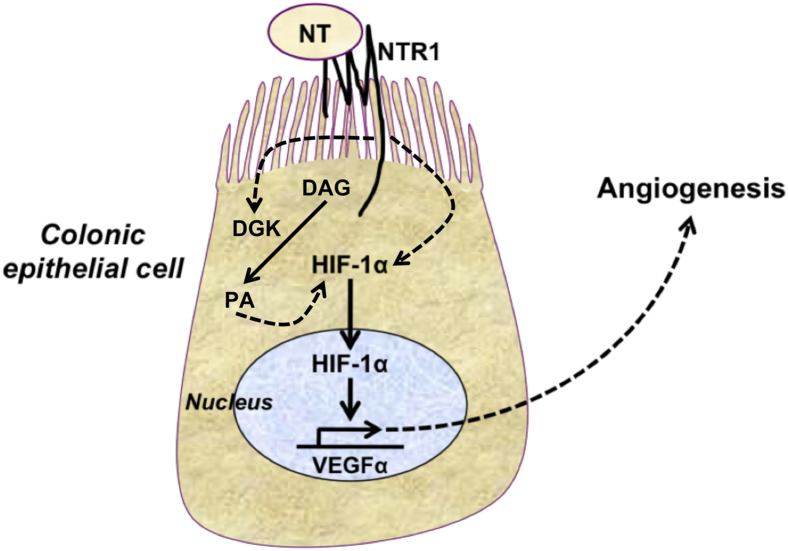
Schematic representation of NT-NTR1 interactions in intestinal epithelial cells leading to stimulation of intracellular signaling pathways during colitis and involving the transcription factor HIF-1α and VEGFα and angiogenesis. NTR1 signaling activates HIF-1α transcriptional activity via pathways that at least in part involve the activation of DGK, an enzyme that catalyzes the conversion of diacylglycerol (DAG) to phosphatidic acid (PA). The accumulation of PA leads to increased expression of HIF-1α, promoting HIF-1α–dependent pathways. Solid arrows represent direct interactions. Dotted arrows represent indirect and hypothetical interactions based on the available evidence.

References

    1. Sands B.E. Inflammatory bowel disease: past, present, and future. J Gastroenterol. 2007;42:16–25. - PMC - PubMed
    1. Castagliuolo I., Wang C.C., Valenick L., Pasha A., Nikulasson S., Carraway R.E., Pothoulakis C. Neurotensin is a proinflammatory neuropeptide in colonic inflammation. J Clin Invest. 1999;103:843–849. - PMC - PubMed
    1. Koon H.W., Kim Y.S., Xu H., Kumar A., Zhao D., Karagiannides I., Dobner P.R., Pothoulakis C. Neurotensin induces IL-6 secretion in mouse preadipocytes and adipose tissues during 2,4,6,-trinitrobenzensulphonic acid-induced colitis. Proc Natl Acad Sci U S A. 2009;106:8766–8771. - PMC - PubMed
    1. Carraway R., Leeman S.E. The isolation of a new hypotensive peptide, neurotensin, from bovine hypothalami. J Biol Chem. 1973;248:6854–6861. - PubMed
    1. Uhl G.R., Goodman R.R., Snyder S.H. Neurotensin-containing cell bodies, fibers and nerve terminals in the brain stem of the rat: immunohistochemical mapping. Brain Res. 1979;167:77–91. - PubMed

Publication types

MeSH terms

Substances