. 2014 Oct 13:5:5191.
doi: 10.1038/ncomms6191.

Germline variants in the SEMA4A gene predispose to familial colorectal cancer type X

Affiliations

Germline variants in the SEMA4A gene predispose to familial colorectal cancer type X

Eduard Schulz et al. Nat Commun. .

Abstract

Familial colorectal cancer type X (FCCTX) is characterized by clinical features of hereditary non-polyposis colorectal cancer with a yet undefined genetic background. Here we identify the SEMA4A p.Val78Met germline mutation in an Austrian kindred with FCCTX, using an integrative genomics strategy. Compared with wild-type protein, SEMA4A(V78M) demonstrates significantly increased MAPK/Erk and PI3K/Akt signalling as well as cell cycle progression of SEMA4A-deficient HCT-116 colorectal cancer cells. In a cohort of 53 patients with FCCTX, we depict two further SEMA4A mutations, p.Gly484Ala and p.Ser326Phe and the single-nucleotide polymorphism (SNP) p.Pro682Ser. This SNP is highly associated with the FCCTX phenotype exhibiting increased risk for colorectal cancer (OR 6.79, 95% CI 2.63 to 17.52). Our study shows previously unidentified germline variants in SEMA4A predisposing to FCCTX, which has implications for surveillance strategies of patients and their families.


Figures
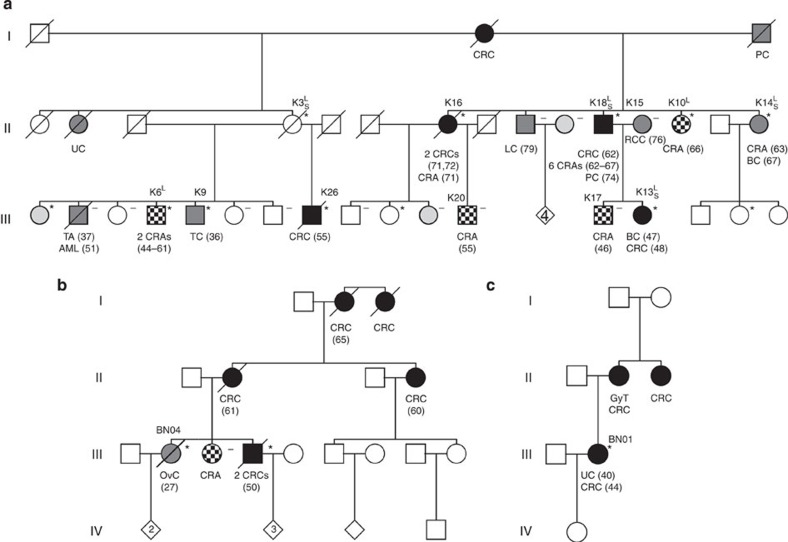
Figure 1
Figure 1. Pedigrees of families with germline SEMA4A mutations.
Families with V78M (a), G484A (b) and S326F (c) mutations are shown. L, individual included in LA; S, individual included in WES; asterisk, SEMA4A mutation carrier; minus, SEMA4A wild type; black symbol, CRC; checkered symbol, colorectal adenoma; dark grey, malignant neoplasm; light grey, benign neoplasm; number in symbol, number of unspecified offspring. AML, acute myeloid leukaemia; BC, breast cancer; CRA, colorectal adenoma; GyT, gynaecologic tumour; OvC, ovarian cancer; PC, prostate cancer; TA, thyroid adenoma; TC, testicular cancer; UC; uterine cancer; UT, uterine tumour. Results of mutational analyses are indicated in tested individuals only. Age at diagnosis (years) is given in parentheses. For multiple colorectal adenomas, age at first presentation or at screening colonoscopy is indicated. An extended pedigree of the family with the V78M mutation including age of the individuals is shown in Supplementary Fig. 1, histopathological characteristics of their colorectal neoplasms are summarized in Table 1.
Figure 2
Figure 2. Localization of germline and somatic CRC SEMA4A mutations at the protein level.
(a) Germline mutations found in this study are illustrated in red, the SNP in orange, germline mutations associated with eye diseases in blue and somatic CRC mutations in black, respectively. Multiple sequence alignments of SEMA4As of selected species are shown below. Note that class 4 semaphorins can only be found in vertebrates. (b) SEMA and PSI domains (55–527, yellow) of human SEMA4A were modelled primarily to SEMA4D (1OLZ). Eye disease-associated residues D345 and F350 are located in the back of the protein below the plexin binding sites (magenta). V78 and G484 have no contact to the surface, are spatially distinct from D345 and F350 but are located in juxtaposition in β-propellers 1 and 7, respectively. S326 is part of the homodimer interface (cyan) having surface contact.
Figure 3
Figure 3. LOH in CRCs of patients K16 and K26.
(a) Array-based comparative genomic hybridization of three CRCs from Family K with germline SEMA4A V78M mutation. A gain in the SEMA4A locus is marked with an arrow. (b) Sanger sequencing. (c) Quantitative dPCR using fluorophore-coupled (VIC, FAM) TaqMan probes specific for wild-type (V78) or mutant (M78) SEMA4A nucleotide variants. Each dot represents a single well on a 20K chip. The performance of this assay was tested with specific oligonucleotide templates. The confidence level was set to 95% and the desired precision value was 10%. NTC, no template control.
Figure 4
Figure 4. SEMA4AV78M shows normal surface expression and leads to cell cycle changes in HCT-116 cells.
(a) ARPE-19 cells were transfected with the plasmid constructs expressing Sema4AWT-EGFP or Sema4AV78M-EGFP proteins, incubated for 48 h and stained with phalloidin. Green, Sema4A-EGFP; red, phalloidin (actin). Representative images obtained by confocal microscopy are shown. The size of the scale bar is 20 μm. (b,c) Representative density plots and statistical analysis of GFP-positive SEMA4A-transfected HCT-116 cells stained by 7-AAD and APC anti-BrdU antibodies for cell cycle analysis. Cells were analysed 48 h after transfection. Significantly, more SEMA4AV78M than SEMA4AWT-transfected cells are in S phase and significantly less in G2/M phase, respectively (mean±s.e.m.; n=3 per group; two-tailed paired Student's t-test; *P<0.05 compared with WT). Cell cycle phase: Sub-G1 (R1), G1/G0 (R2), S (R3), G2/M (R4). (d,e) Representative immunoblots and statistical analysis of SEMA4A-transfected HCT-116 cells (whole-cell lysates) lyzed 48 h after transfection. SEMA4AV78M-transfected cells show increased phosphorylation of Akt and Erk (mean±s.e.m.; n=6 per group; two-tailed paired Student's t-test; *P<0.05 compared with WT). (p-)GSK3β and (active) β-catenin proteins were blotted on a separate membrane in this experiment. No effects on GSK3β and β-catenin phosphorylation were seen in repeated experiments.

Comment in

  • Correspondence: Reply to 'SEMA4A variation and risk of colorectal cancer'.
    Sill H, Schulz E, Steinke-Lange V, Boland CR. Sill H, et al. Nat Commun. 2016 Mar 10;7:10695. doi: 10.1038/ncomms10695. Nat Commun. 2016. PMID: 26960273 Free PMC article. No abstract available.
  • Correspondence: SEMA4A variation and risk of colorectal cancer.
    Kinnersley B, Chubb D, Dobbins SE, Frampton M, Buch S, Timofeeva MN, Castellví-Bel S, Farrington SM, Forsti A, Hampe J, Hemminki K, Hofstra RM, Northwood E, Palles C, Pinheiro M, Ruiz-Ponte C, Schafmayer C, Teixeira MR, Westers H, van Wezel T, Timothy Bishop D, Tomlinson I, Dunlop MG, Houlston RS. Kinnersley B, et al. Nat Commun. 2016 Mar 10;7:10611. doi: 10.1038/ncomms10611. Nat Commun. 2016. PMID: 26961734 Free PMC article. No abstract available.

References

    1. Siegel R., Desantis C. & Jemal A. Colorectal cancer statistics, 2014. CA-Cancer. J. Clin. 64, 104–117 (2014). - PubMed
    1. Jasperson K. W., Tuohy T. M., Neklason D. W. & Burt R. W. Hereditary and familial colon cancer. Gastroenterology 138, 2044–2058 (2010). - PMC - PubMed
    1. Lynch H. T. et al. Review of the Lynch syndrome: history, molecular genetics, screening, differential diagnosis, and medicolegal ramifications. Clin. Genet. 76, 1–18 (2009). - PMC - PubMed
    1. Umar A., Risinger J. I., Hawk E. T. & Barrett J. C. Testing guidelines for hereditary non-polyposis colorectal cancer. Nat. Rev. Cancer 4, 153–158 (2004). - PubMed
    1. Lindor N. M. et al. Lower cancer incidence in Amsterdam-I criteria families without mismatch repair deficiency: familial colorectal cancer type X. JAMA 293, 1979–1985 (2005). - PMC - PubMed

Publication types
