. 1981 Dec 1;143(4):527-539.
doi: 10.1007/BF00609919.

Development of the Mouse Circadian Pacemaker: Independence from Environmental Cycles

Affiliations

Development of the Mouse Circadian Pacemaker: Independence from Environmental Cycles

Fred C Davis et al. J Comp Physiol. .

Abstract

The freerunning period (τ) of the circadian pacemaker underlying the wheel-running activity rhythm of Mus musculus was found to be unaffected by the periods of environmental cycles (maternal and light/dark) under which the mice are raised. Mice born to mothers entrained to periods (T) of 28 or 20 h (ratio of light to dark of 14/10) and maintained on those cycle until beyond puberty showed only a temporary difference in freerunning period when placed into constant darkness. Such temporary 'after-effects ' of entrainment were shown, as had been previously, to occur in animals exposed to non-24-h cycles as adults only.After-effects on the ratio of activity to rest (α/ρ) were not even temporarily different in animals raised on T = 28 or T = 20.Rearing on T = 28 or T = 20 did not affect the abilities of animals to entrain to these cycles later in life.Measurements from young and old animals as well as remeasurement of the young animals later in their lives revealed several effects of age on the pacemaker: a) After-effects on freerunning period after T = 28 or T = 20 are not greater but last longer in older animals; b) Freerunning period is shorter in younger animals; and c) The ratio of activity to rest changes over time in constant darkness and is greater in young animals. Together these suggest that pacemaker 'plasticity' reflected in changes in τ and α/ρ over time in constant darkness decreases with age.The length of gestation measured in 'real' time was the same in mice entrained to T = 28 or T = 20, demonstrating that gestation is not measured in circadian cycles.


Figures
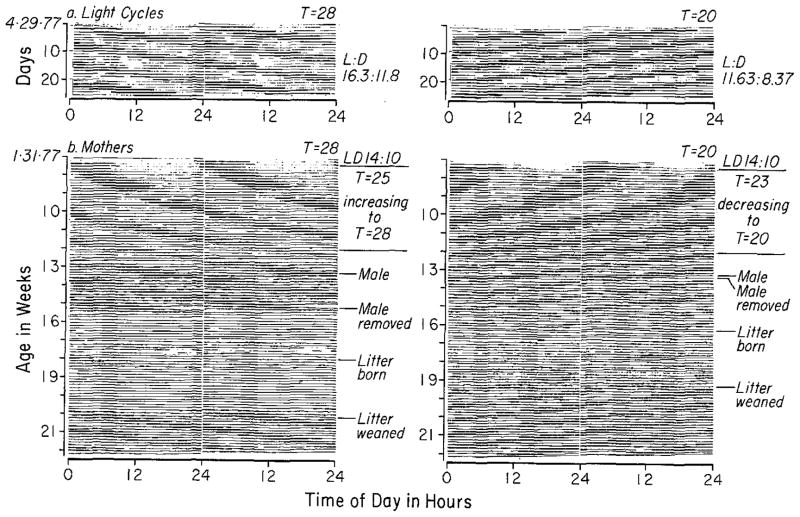
Fig. 1
Fig. 1
a Records of the non-24-h light/dark cycles to which mothers, fathers, and their progeny were exposed (LD1 of Figs 2 and 6). Records are double-plotted, dark bars indicate times when lights were off. b Activity records of two mothers, one entrained to T = 28 and one to T = 20. A male was with each of them during the days indicated, and all pups were taken from each mother at the time of weaning. Both records are double-plotted
Fig. 2
Fig. 2
Activity records of two mice raised on T = 28 and two mice raised on T = 20. Except for the changes in lighting conditions indicated and for food and water replenishment, the animals were left undisturbed for the duration of the records. Constant darkness indicated by DD; the T = 28, T = 20, and T = 24 cycles are described in the text. All records are double-plotted
Fig. 2
Fig. 2
Activity records of two mice raised on T = 28 and two mice raised on T = 20. Except for the changes in lighting conditions indicated and for food and water replenishment, the animals were left undisturbed for the duration of the records. Constant darkness indicated by DD; the T = 28, T = 20, and T = 24 cycles are described in the text. All records are double-plotted
Fig. 3
Fig. 3
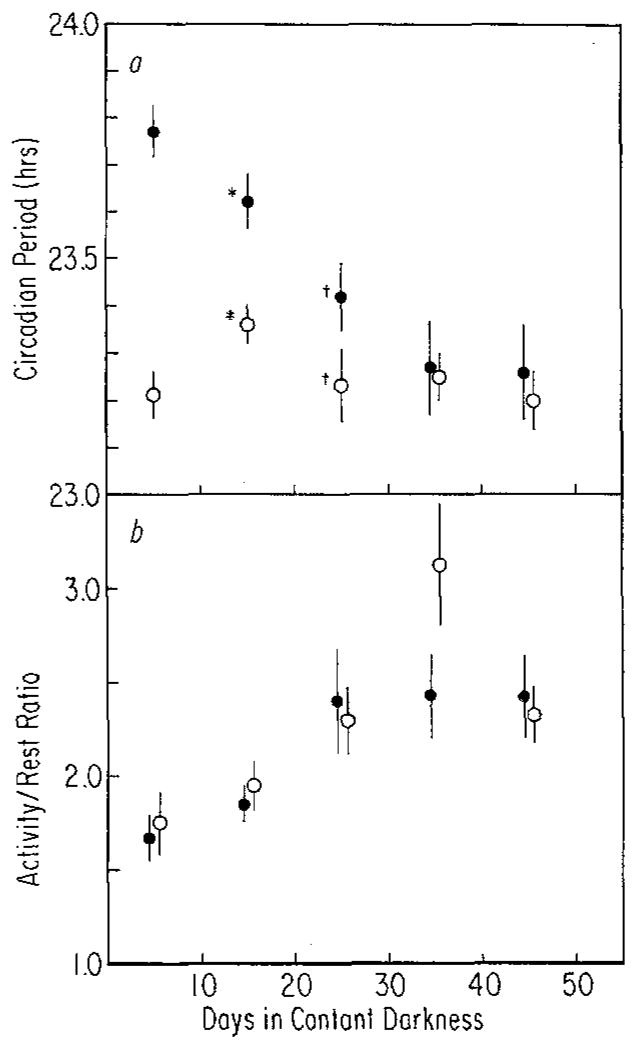
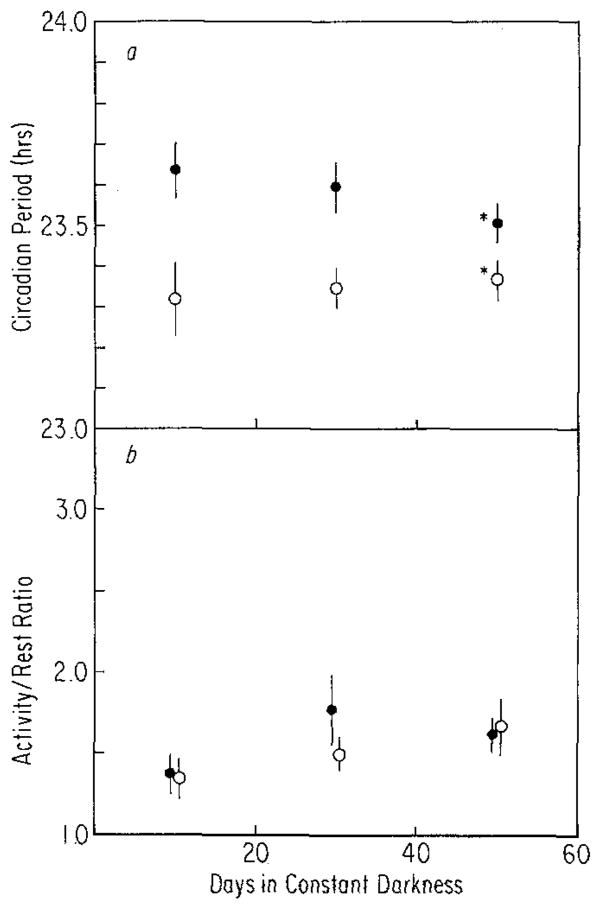
a After-effects on period (τ) measured over 10-day intervals for 50 days in constant darkness in mice raised on T = 28 (●, n = 17) or T = 20 (○, n = 16). Vertical lines: standard errors of the means (SEM). Both main effects (T and time in constant darkness) and their interaction were significant (P <0.01) by ANOVA (*P <0.01, †0.01 > P >0.05, t-test), b After-effects on activity/rest ratio (α/ρ) measured over 10-day intervals for 50 days in constant darkness in mice raised on T = 28 (●, n = 16) or T = 20 (○, n = 16). Vertical lines: SEM. Only the main effect of time in constant darkness was significant (P <0.001)
Fig. 4
Fig. 4
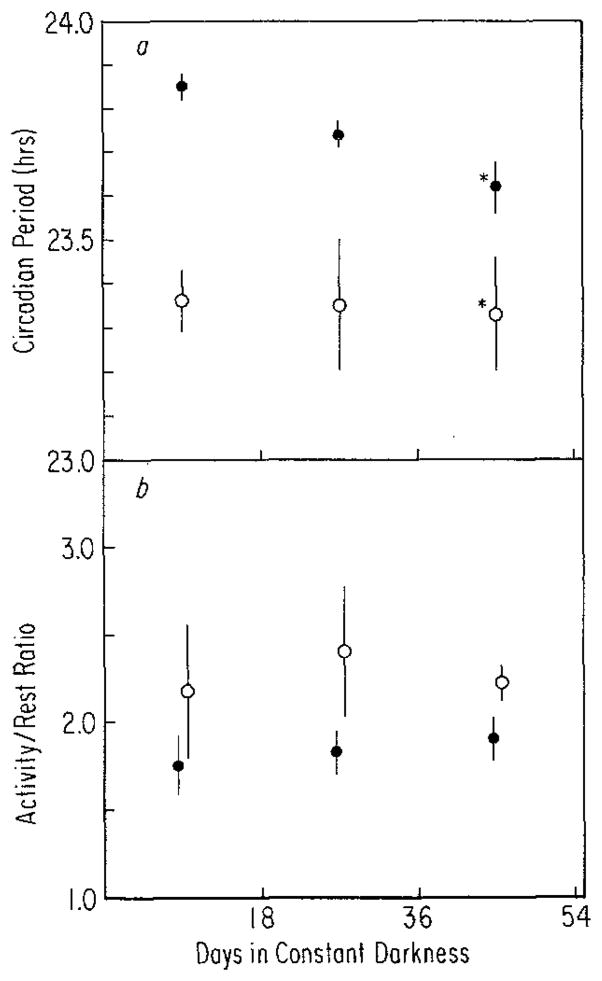
a After-effects on period (τ) measured over 18-day intervals for 54 days in constant darkness in mice (the fathers) exposed to T = 28 (●, n = 8) or T = 20 (○, n = 5) as adults. The large measurement intervals (compared to Fig. 3) were used because several records were too sloppy immediately following release into constant darkness to obtain reliable period estimates with smaller intervals. Vertical lines: SEM. The main effects of T (P <0.001) and time in constant darkness (P <0.025) were significant by ANOVA (*0.01 > P >0.05, t-test). b After-effects on activity/rest ratio (α/ρ) measured over 18-day intervals for 54 days in constant darkness in mice (the fathers) exposed to T = 28 (●, n = 8) or T = 20 (○, n = 5) as adults. Vertical lines: SEM. In neither group does α/ρ change with time. Neither main effects or their interaction were significant by ANOVA
Fig. 5
Fig. 5
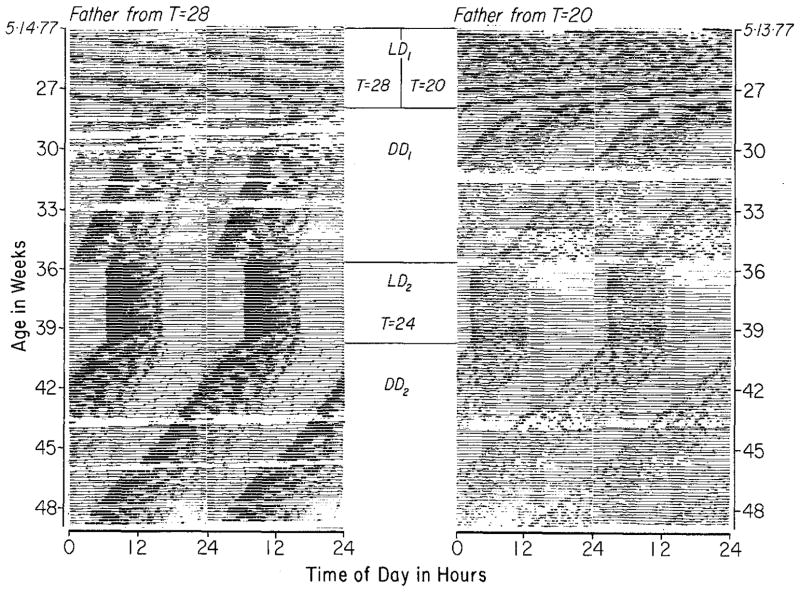
Activity records of two adult mice (fathers), one initially entrained to T = 28 and the other to T = 20. Except for the indicated changes in lighting conditions and regular replenishment of food and water, the animals were undisturbed for the duration of the records. Both records are double plotted
Fig. 6
Fig. 6
a After-effects on period (τ) measured over 20-day intervals for 80 days in constant darkness following entrainment to T = 24 in mice raised on T = 28 (●, n = 17) or T = 20 (○, n = 17). Vertical lines SEM. Both main effects (T and time in constant darkness) and their interaction were significant (P <0.05) by ANOVA (*0.10 > P > 0.05, t-test). b After-effects on activity/rest ratio (α/ρ) measured over 20-day intervals for 80 days in constant darkness following entrainment to T = 24 in animals raised on T = 28 (●, n = 17) or T = 20 (○, n = 17). Vertical lines: SEM. The main effect of T was not significant (P >0.05) although the effects of time in constant darkness and its interaction with T were significant (P <0.01) by ANOVA (*P <0.05, t-test)
Fig. 7
Fig. 7
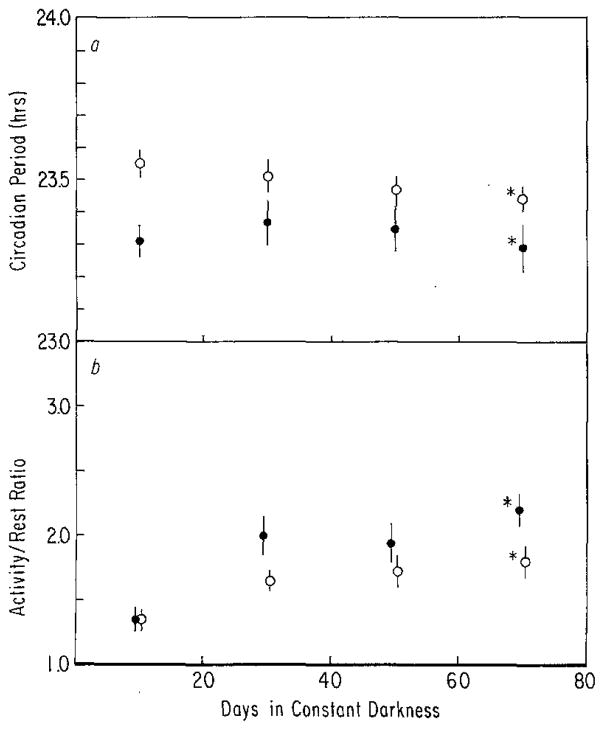
a After-effects on period (τ) measured over 20-day intervals for 60 days in constant darkness following entrainment to T = 24 in mice (the fathers) exposed to T = 28 (●, n = 9) or T = 20 (○, n = 5) as adults. Vertical lines: SEM. Main effect of T and its interaction with the main effect of time in constant darkness were significant (P <0.05) by ANOVA (*0.01 > P >0.05, t-test), b After effect on activity/rest ratio (α/ρ) measured over 20-day intervals for 60 days in constant darkness following entrainment to T = 24 in mice (the fathers) exposed to T = 28 (●, n = 7) or T = 20 (○, n = 4) as adults. Vertical lines: SEM
Fig. 8
Fig. 8
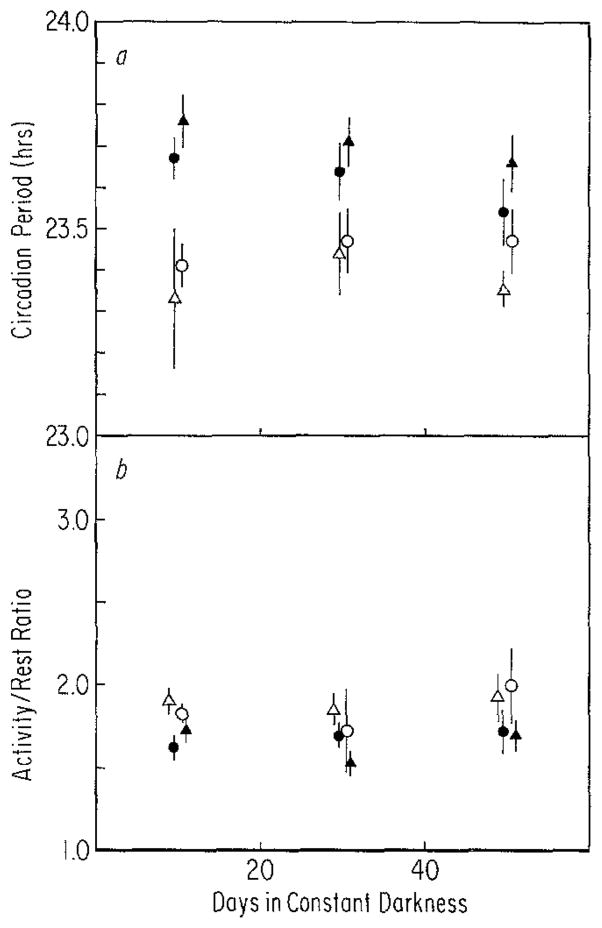
a After-effects on period (τ) measured over 20-day intervals for 60 days in constant darkness following entrainment to T =28 (closed symbols) or T = 20 (open symbols). Triangles (▲, n = 9 and △, n = 6) represent animals raised on T = 28. Circles (●, n = 9 and ○, n = 2) represent animals raised on T = 20. Vertical lines: SEM. ANOVA indicates that the animals raised on different cycles are not different from each other following entrainment to either T = 28 or T = 20 at any time, i.e., the main effect of rearing condition was not significant (P>0.10). Main effects of T and time in constant darkness as well as their interaction were significant (P< 0.01). b After-effects on activity/rest (α/ρ) measured over 20-day intervals for 60 days in constant darkness following entrainment to T = 28 or T = 20. Symbols and sample size are the same as in Fig. 8a. Irrespective of rearing conditions, mean α/ρ of animals from T = 20 was greater than that of animals from T = 28, i.e., only the main effect of T is significant (P<0.05)
Fig. 9
Fig. 9
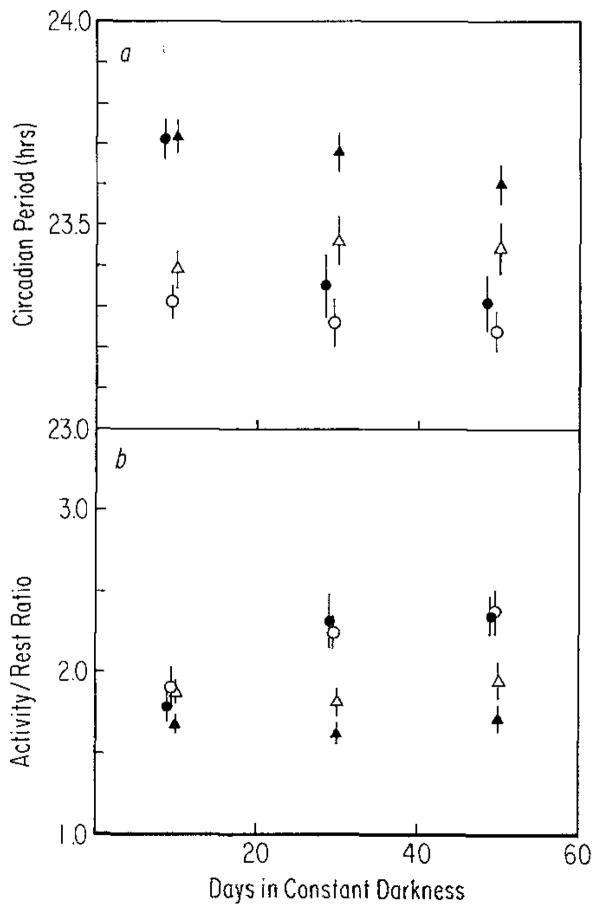
a After-effects on period (τ) following entrainment to T = 28 (closed symbols) or T = 20 (open symbols) in mice 10 weeks of age (●, n = 17 and ○, n = 16) or 41 weeks of age (▲, n = 18 and △, n = 8). Measurements were made over either 18-day (circles) or 20-day (triangles) intervals. Vertical lines: SEM. ANOVA performed on these data utilized slightly smaller sample sizes than indicated in order to include only those animals for which measurements were available both when they were young and older. The main effect of age (triangles versus circles) is significant (P< 0.005). b After-effects on activity/rest ratio (α/ρ) following entrainment to T = 28 (closed symbols) or T = 20 (open symbols) in mice 10 weeks of age (●, n = 18 and ○, n = 16) or 41 weeks of age (▲, n = 18 and △, n = 8). Vertical lines: SEM. The main effect of age (circles versus triangles) is significant (P< 0.001)

References

    1. Aschoff J. Exogenous and endogenous components in circadian rhythms. Cold Spring Harbor Symp Quant Biol. 1960;25:11–28. - PubMed
    1. Aschoff J, Meyer-Lohman J. Angeborene 24-Stunden-Perio-dik beim Küken. Pflügers Arch. 1954;260:170–176. - PubMed
    1. Aschoff J, Gerecke U, Wever R. Desynchronization of human circadian rhythms. Jpn J Physiol. 1967;17:450–457. - PubMed
    1. Barr M. Prenatal growth of Wistar rats: circadian periodicity of fetal growth late in gestation. Teratology. 1973;7:283–287. - PubMed
    1. Browman LG. Artificial sixteen-hour day activity rhythms in the white rat. Am J Physiol. 1952;168:694–697. - PubMed

LinkOut - more resources