


Medical intensive care unit clinician attitudes and perceived barriers towards early mobilization of critically ill patients: a cross-sectional survey study
- PMID: 25309124
- PMCID: PMC4192294
- DOI: 10.1186/1471-2253-14-84
Medical intensive care unit clinician attitudes and perceived barriers towards early mobilization of critically ill patients: a cross-sectional survey study
Abstract
Background: Early mobilization (EM) of patients on mechanical ventilation (MV) is shown to improve outcomes after critical illness. Little is known regarding clinician knowledge of EM or multi-disciplinary barriers to use of EM in the intensive care unit (ICU). The goal of this study was to assess clinician knowledge regarding EM and identify barriers to its provision.
Methods: Simultaneous cross-sectional surveys of medical ICU (MICU) nurses (RN)/physical therapists (PT) respondents and physician (MD) respondents in a single MICU at an academic hospital in Seattle, WA in 2010-2011. Responses were indicated on a 5 point Likert scale and reported as proportion of respondents agreeing or disagreeing. Chi-square testing and Fisher's exact testing was performed to determine whether responses differed by duration of employment or prior EM experience.
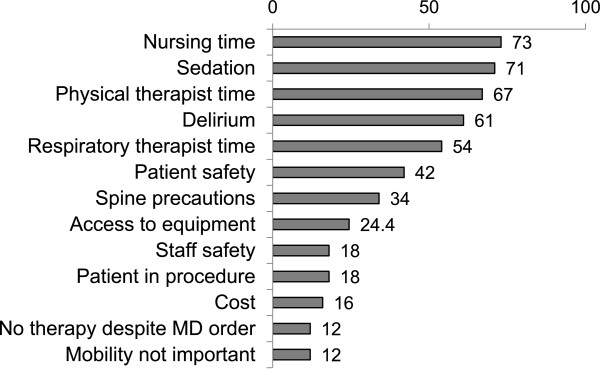
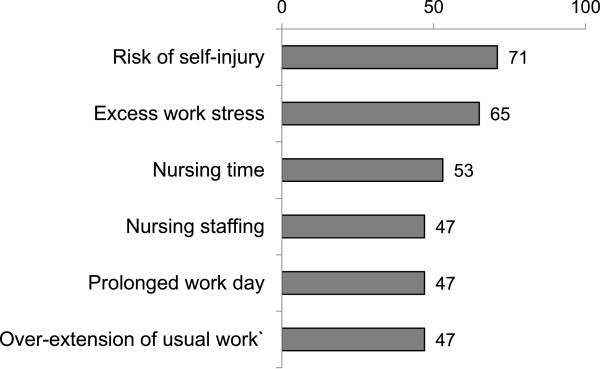
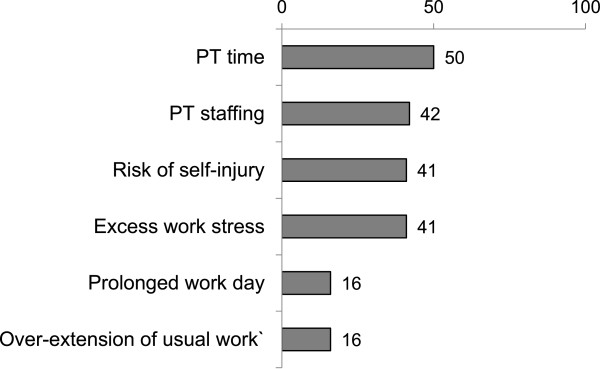
Results: A total of 120 clinicians responded to the survey (91 MDs (response rate 82% (91/111)), 17 RNs (response rate 22%, (17/78)), and 12 PTs (response rate 86%, (12/14)), overall response rate 86%). Most clinicians indicated knowledge regarding benefits of EM. More attending physicians reported knowledge of EM benefits, but also that risks of EM outweigh the benefits compared to trainees (p = 0.02 and 0.01). Clinicians across disciplines reported near universal agreement to use of EM for patients on MV, while the minority reported agreement to EM for patients on vasoactive agents. The most frequently reported cross-disciplinary barriers to EM were staffing and time. Risk of self-injury and excess work stress were indicated as barriers by RN and PT respondents.
Conclusions: MICU clinicians, at our institution, reported knowledge of EM in the ICU. Staffing and clinician time were frequently identified cross-disciplinary barriers. Risk of self-injury and excess work stress were frequently reported RN and PT barriers.
Keywords: Early mobilization; ICU acquired weakness; ICU mobility.
Figures
References
-
- De Jonghe B, Sharshar T, Lefaucheur JP, Authier FJ, Durand-Zaleski I, Boussarsar M, Cerf C, Renaud E, Mesrati F, Carlet J, Raphael JC, Outin H, Bastuji-Garin S. Paresis acquired in the intensive care unit: a prospective multicenter study. JAMA. 2002;288(22):2859–2867. doi: 10.1001/jama.288.22.2859. - DOI - PubMed
-
- Herridge MS, Tansey CM, Matte A, Tomlinson G, Diaz-Granados N, Cooper A, Guest CB, Mazer CD, Mehta S, Stewart TE, Kudlow P, Cook D, Slutsky AS, Cheung AM. Functional disability 5 years after acute respiratory distress syndrome. N Engl J Med. 2011;364(14):1293–1304. doi: 10.1056/NEJMoa1011802. - DOI - PubMed
Pre-publication history
-
- The pre-publication history for this paper can be accessed here:http://www.biomedcentral.com/1471-2253/14/84/prepub
MeSH terms
Grants and funding
LinkOut - more resources
Full Text Sources
Other Literature Sources
Medical
Research Materials
Miscellaneous
