. 2014 Sep 12:8:312.
doi: 10.3389/fnbeh.2014.00312. eCollection 2014.

The GPCR membrane receptor, DopEcR, mediates the actions of both dopamine and ecdysone to control sex pheromone perception in an insect

Affiliations

The GPCR membrane receptor, DopEcR, mediates the actions of both dopamine and ecdysone to control sex pheromone perception in an insect

Antoine Abrieux et al. Front Behav Neurosci. .

Abstract

Olfactory information mediating sexual behavior is crucial for reproduction in many animals, including insects. In male moths, the macroglomerular complex (MGC) of the primary olfactory center, the antennal lobe (AL) is specialized in the treatment of information on the female-emitted sex pheromone. Evidence is accumulating that modulation of behavioral pheromone responses occurs through neuronal plasticity via the action of hormones and/or catecholamines. We recently showed that a G-protein-coupled receptor (GPCR), AipsDopEcR, with its homologue known in Drosophila for its double affinity to the main insect steroid hormone 20-hydroxyecdysone (20E), and dopamine (DA), present in the ALs, is involved in the behavioral response to pheromone in the moth, Agrotis ipsilon. Here we tested the role of AipsDopEcR as compared to nuclear 20E receptors in central pheromone processing combining receptor inhibition with intracellular recordings of AL neurons. We show that the sensitivity of AL neurons for the pheromone in males decreases strongly after AipsDopEcR-dsRNA injection but also after inhibition of nuclear 20E receptors. Moreover we tested the involvement of 20E and DA in the receptor-mediated behavioral modulation in wind tunnel experiments, using ligand applications and receptor inhibition treatments. We show that both ligands are necessary and act on AipsDopEcR-mediated behavior. Altogether these results indicate that the GPCR membrane receptor, AipsDopEcR, controls sex pheromone perception through the action of both 20E and DA in the central nervous system, probably in concert with 20E action through nuclear receptors.

Keywords: GPCR; antennal lobe; dopamine; ecdysone; insect; wind tunnel.


Figures
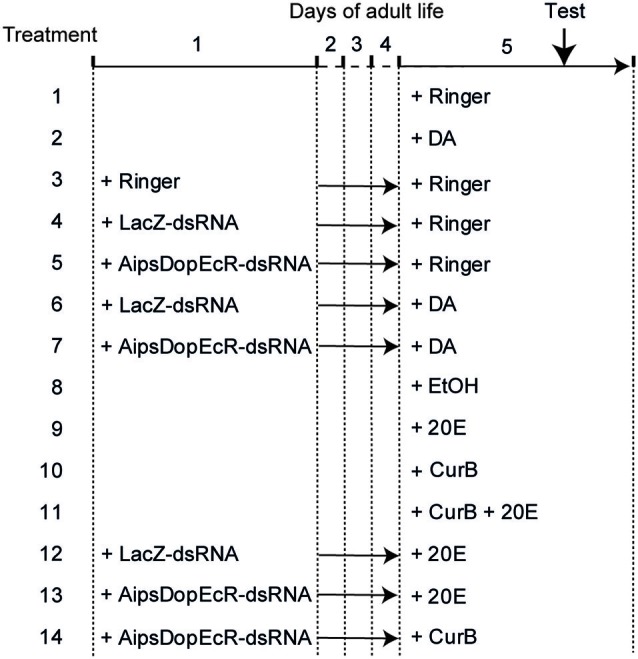
Figure 1
Figure 1
Design of experiments. Treatments were performed on 1-day-old and 5-day-old A. ipsilon males. Test: behavioral test in wind tunnel. DA: Dopamine; 20E: 20-hydroxyecdysone; CurB: cucurbitacine.
Figure 2
Figure 2
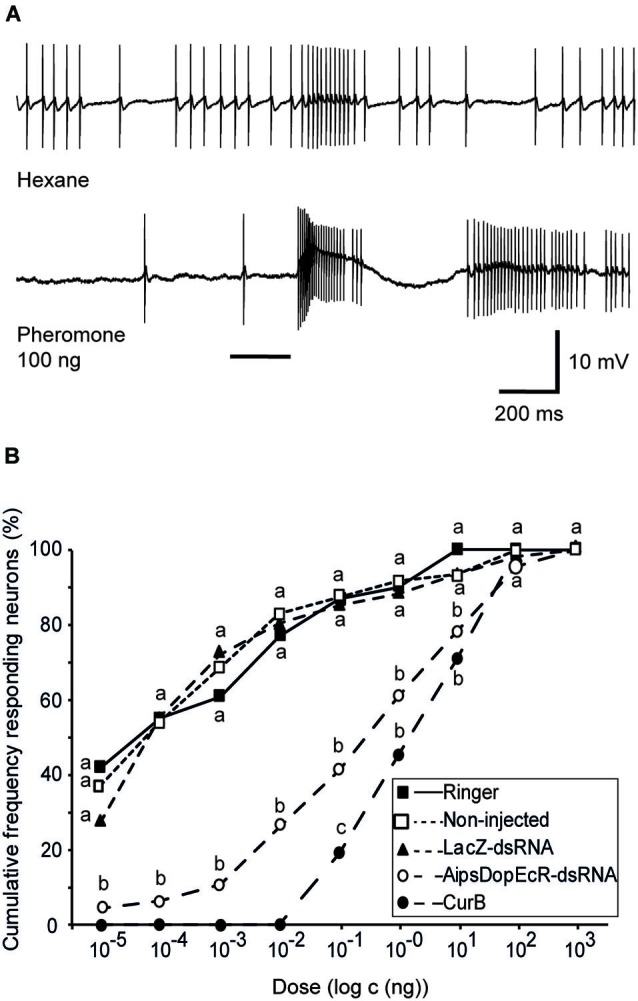
Effects of AipsDopEcR-dsRNA and CurB injection on response thresholds of AL neurons in 5-day old A. ipsilon males. (A) Example of intracellular recording traces of an AL neuron from an AipsDopEcR-injected male stimulated with hexane and the sex pheromone. Note the excitatory response followed by inhibition. Bar beneath recording indicates stimulus duration (200 ms). (B) Cumulative percentage of tested AL neurons responding to the pheromone blend at different thresholds. N = 31, 49, 63, 46, and 42 neurons for Ringer-, non-injected, LacZ-dsRNA-, CurB-, and AipsDopEcR-dsRNA-injected males respectively. Values with the same letters are not significantly different between treatments (G-test, P < 0.05). CurB: cucurbitacine.
Figure 3
Figure 3
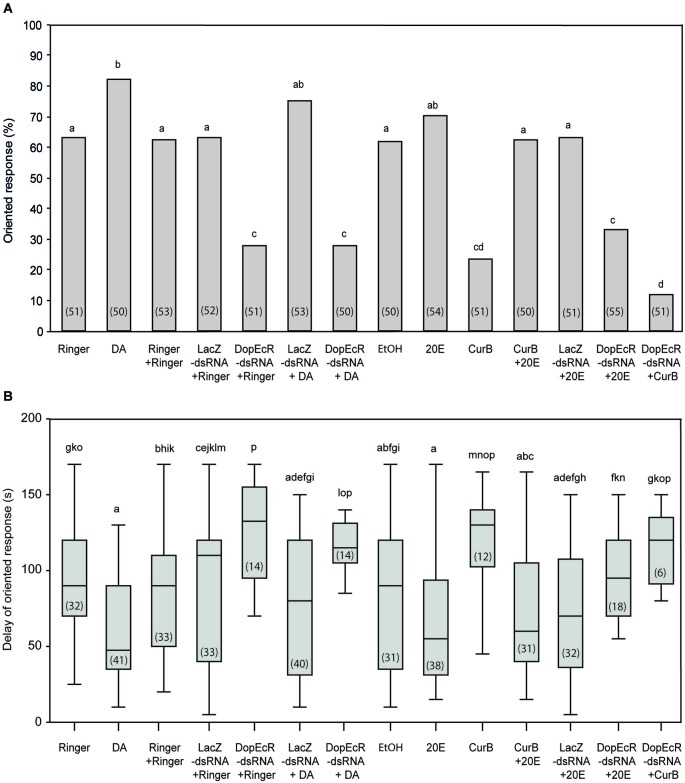
Effects of individual or combined DA, 20E, AipsDopEcR-dsRNA, and CurB treatments on upwind flight behavior of A. ipsilon males to the sex pheromone in a wind tunnel. (A) Oriented response. (B) Delay of response for males that performed an oriented response (means ± SD). DA: Dopamine; 20E: 20-hydroxyecdysone; CurB: cucurbitacine. Bars with same letters are not significantly different (A: G-test; B: Kruskal-Wallis test followed by a Mann-Whitney test for pairwise comparisons; P < 0.05). Numbers in brackets indicate numbers of tested males (A) and males that performed an oriented response (B).

References

    1. Abrieux A., Debernard S., Maria A., Gaertner C., Anton S., Gadenne C., et al. (2013). Involvement of the G-protein-coupled dopamine/ecdysteroid receptor dopecr in the behavioral response to sex pheromone in an insect. PLoS One 8:e72785 10.1371/journal.pone.0072785 - DOI - PMC - PubMed
    1. Anton S., Dufour M.-C., Gadenne C. (2007). Plasticity of olfactory-guided behaviour and its neurobiological basis: lessons from moths and locusts. Entomol. Exp. Appl. 123, 1–11 10.1111/j.1570-7458.2007.00516.x - DOI
    1. Anton S., Gadenne C. (1999). Effect of juvenile hormone on the central nervous processing of sex pheromone in an insect. Proc. Natl. Acad. Sci. U S A 96, 5764–5767 10.1073/pnas.96.10.5764 - DOI - PMC - PubMed
    1. Barrozo R. B., Gadenne C., Anton S. (2010). Switching attraction to inhibition: mating-induced reversed role of sex pheromone in an insect. J. Exp. Biol. 213, 2933–2939 10.1242/jeb.043430 - DOI - PubMed
    1. Bigot L., Shaik H. A., Bozzolan F., Party V., Lucas P., Debernard S., et al. (2012). Peripheral regulation by ecdysteroids of olfactory responsiveness in male Egyptian cotton leaf worms, Spodoptera littoralis. Insect Biochem. Mol. Biol. 42, 22–31 10.1016/j.ibmb.2011.10.003 - DOI - PubMed

LinkOut - more resources