


Macrophage polarization in obesity and type 2 diabetes: weighing down our understanding of macrophage function?
- PMID: 25309549
- PMCID: PMC4176397
- DOI: 10.3389/fimmu.2014.00470
Macrophage polarization in obesity and type 2 diabetes: weighing down our understanding of macrophage function?
Abstract
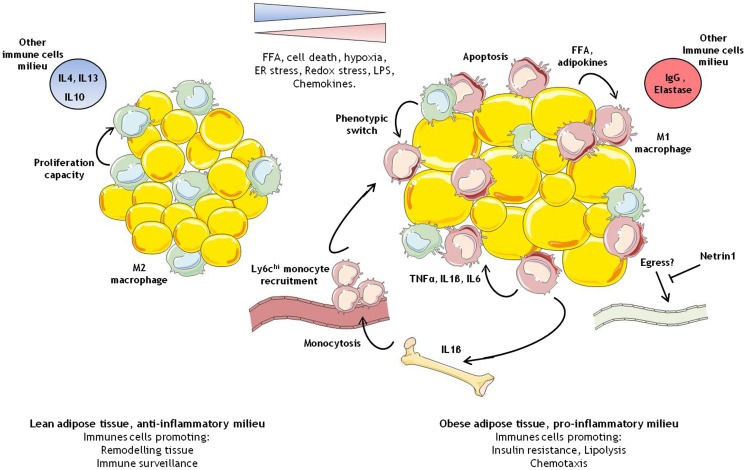
Obesity and type 2 diabetes are now recognized as chronic pro-inflammatory diseases. In the last decade, the role of the macrophage in particular has become increasingly implicated in their pathogenesis. Abundant literature now establishes that monocytes get recruited to peripheral tissues (i.e., pancreas, liver, and adipose tissue) to become resident macrophages and contribute to local inflammation, development of insulin resistance, or even pancreatic dysfunction. Furthermore, an accumulation of evidence has established an important role for macrophage polarization in the development of metabolic diseases. The general view in obesity is that there is an imbalance in the ratio of M1/M2 macrophages, with M1 "pro-inflammatory" macrophages being enhanced compared with M2 "anti-inflammatory" macrophages being down-regulated, leading to chronic inflammation and the propagation of metabolic dysfunction. However, there is emerging evidence revealing a more complex scenario with the spectrum of macrophage states exceeding well beyond the M1/M2 binary classification and confused further by human and animal models exhibiting different macrophage profiles. In this review, we will discuss the recent findings regarding macrophage polarization in obesity and type 2 diabetes.
Keywords: M1/M2; inflammation; macrophage; obesity; polarization; type 2 diabetes.
Figures
References
Publication types
LinkOut - more resources
Full Text Sources
Other Literature Sources
