


Addressing sexual dysfunction after risk-reducing salpingo-oophorectomy: effects of a brief, psychosexual intervention
- PMID: 25311333
- PMCID: PMC4304978
- DOI: 10.1111/jsm.12713
Addressing sexual dysfunction after risk-reducing salpingo-oophorectomy: effects of a brief, psychosexual intervention
Abstract
Introduction: Women at high risk for ovarian cancer due to BRCA1 or BRCA2 mutation or family history are recommended to undergo risk-reducing salpingo-oophorectomy (RRSO) after age 35 or completion of childbearing. This potentially life-saving surgery leads to premature menopause, frequently resulting in distressing and unaddressed sexual dysfunction.
Aim: To pilot a novel sexual health intervention for women with BRCA1/2 mutations who previously underwent RRSO a using a single-arm trial. Feasibility and primary outcomes including sexual dysfunction and psychological distress were assessed.
Methods: This single-arm trial included a one-time, half-day educational session comprised of targeted sexual health education, body awareness and relaxation training, and mindfulness-based cognitive therapy strategies, followed by two sessions of tailored telephone counseling. Assessments were completed at baseline and 2 months postintervention.
Main outcome measure: Study end points include feasibility and effectiveness as reported by the participant.
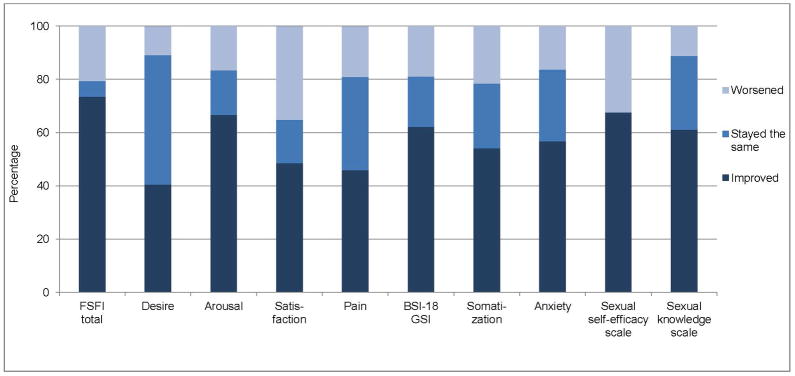
Results: Thirty-seven women completed baseline and postintervention assessments. At baseline, participants had a mean age of 44.4 (standard deviation [SD] = 3.9) years and mean duration of 3.8 (SD = 2.7) years since RRSO. Overall sexual functioning (P = 0.018), as well as desire (P = 0.003), arousal (P = 0.003), satisfaction (P = 0.028), and pain (P = 0.018), improved significantly. There were significant reductions in somatization (P = 0.029) and anxiety scores (P < 0.001), and, overall, for the Global Severity Index (P < 0.001) of the Brief Symptom Inventory. Sexual self-efficacy and sexual knowledge also improved significantly from baseline to postintervention (both P < 0.001). Women were highly satisfied with the intervention content and reported utilizing new skills to manage sexual dysfunction.
Conclusions: This intervention integrates elements of cognitive behavioral therapy with sexual health education to address a much-neglected problem after RRSO. Results from this promising single-arm study provide preliminary data to move toward conducting a randomized, controlled trial.
Keywords: Quality of Life and Cancer; Risk-Reducing Salpingo-Oophorectomy and Sexual Dysfunction; Sexual Health and Cancer.
© 2014 International Society for Sexual Medicine.
Conflict of interest statement
Figures
References
-
- American Cancer Society. Cancer facts & figures 2013. Atlanta, GA: American Cancer Society, Inc; 2013.
-
- National Comprehensive Cancer Network. Genetic/familial high-risk assessment: breast and ovarian cancer (v 1.2014) National Comprehensive Cancer Network; 2014. - PubMed
-
- Kauff ND, Domchek SM, Friebel TM, Robson ME, Lee J, Garber JE, et al. Risk-reducing salpingo-oophorectomy for the prevention of BRCA1- and BRCA2-associated breast and gynecologic cancer: a multicenter, prospective study. J Clin Oncol. 2008;26:1331–7. doi: 10.1200/JCO.2007.13.9626. - DOI - PMC - PubMed
-
- Robson M, Hensley M, Barakat R, Brown C, Chi D, Poynor E, et al. Quality of life in women at risk for ovarian cancer who have undergone risk-reducing oophorectomy. Gynecol Oncol. 2003;89:281–7. S0090825803000726 [pii] - PubMed
Publication types
MeSH terms
Substances
Grants and funding
LinkOut - more resources
Full Text Sources
Other Literature Sources
Medical
Miscellaneous
