


Tea consumption is inversely related to 5-year blood pressure change among adults in Jiangsu, China: a cross-sectional study
- PMID: 25311544
- PMCID: PMC4209085
- DOI: 10.1186/1475-2891-13-98
Tea consumption is inversely related to 5-year blood pressure change among adults in Jiangsu, China: a cross-sectional study
Abstract
Background: Data relating to the association between tea consumption and blood pressure change are inconsistent. The aim of this analysis was to investigate the association between tea consumption and the change in blood pressure (BP) in Chinese adults over a 5-year period.
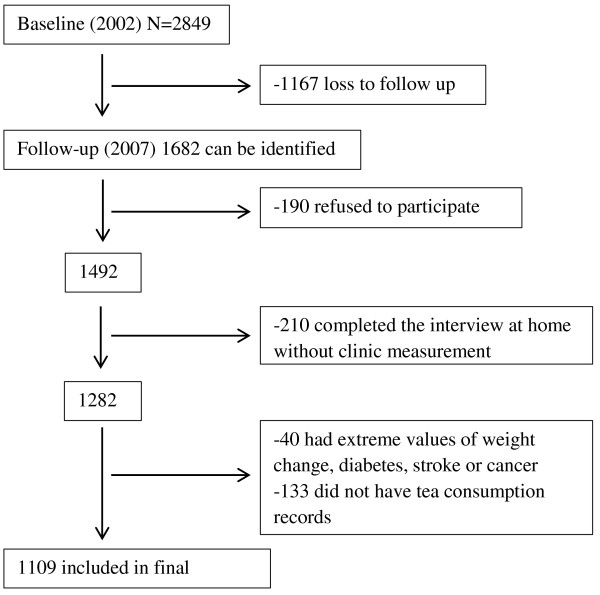
Methods: Data from 1109 Chinese men (N= 472) and women (N= 637) who participated in the Jiangsu Nutrition Study (JIN) were analysed. BP was measured in 2002 and 2007. Tea (green, black and total tea) consumption was quantitatively assessed at the follow-up survey in 2007.
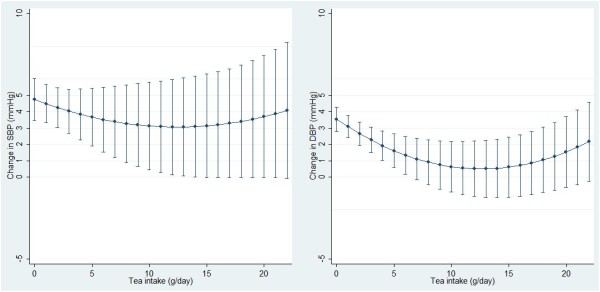
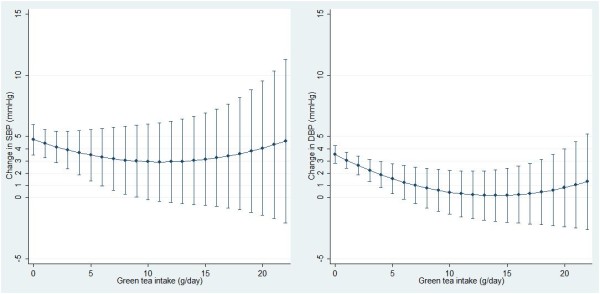
Results: Total tea and green tea consumption were inversely associated with 5-year diastolic BP (DBP) but not systolic BP (SBP) change. In the multivariable analysis, compared with no consumption of tea, those with daily total tea/green tea consumption of at least10 g had 2.41 mmHg and 3.68 mmHg smaller increase of DBP respectively. There was a significant interaction between smoking and total tea/green tea consumption and DBP change. The inverse association between total tea/green tea consumption and DBP change was significant only in non-smokers. Green tea consumption was inversely associated with SBP change only in non-smokers and those without central obesity.
Conclusion: The consumption of green tea is inversely associated with 5-year BP change among Chinese adults, an effect abrogated by smoking.
Figures
References
-
- Word Health Organisation . World Health Statistics 2012. Geneva: WHO; 2012.
-
- Li YC, Wang LM, Jiang Y, Li XY, Zhang M, Hu N. Prevalence of hypertension among Chinese adults in 2010. Zhonghua Yu Fang Yi Xue Za Zhi. 2012;46:409–413. - PubMed
Publication types
MeSH terms
Substances
LinkOut - more resources
Full Text Sources
Other Literature Sources
