


Role of in vivo vascular redox in resistance arteries
- PMID: 25312439
- PMCID: PMC4268237
- DOI: 10.1161/HYPERTENSIONAHA.114.04473
Role of in vivo vascular redox in resistance arteries
Abstract
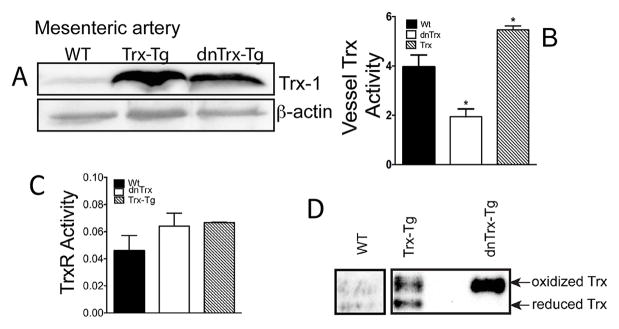
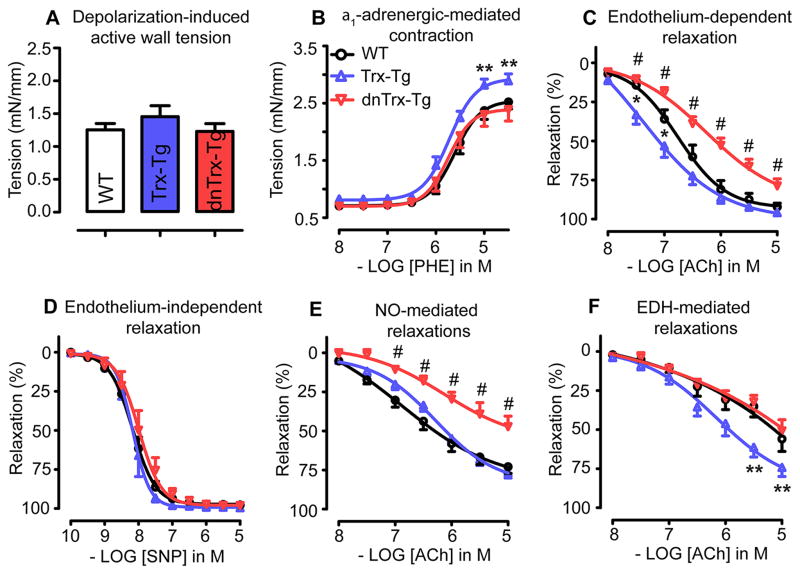
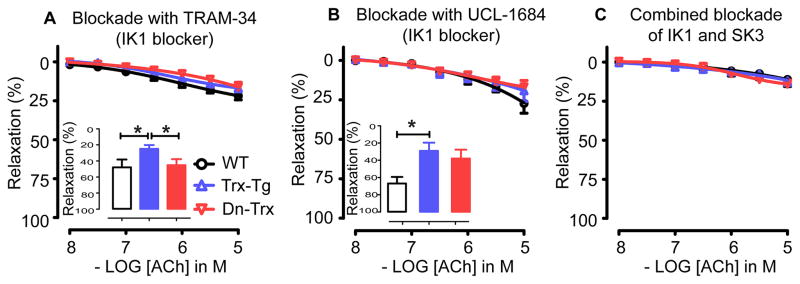
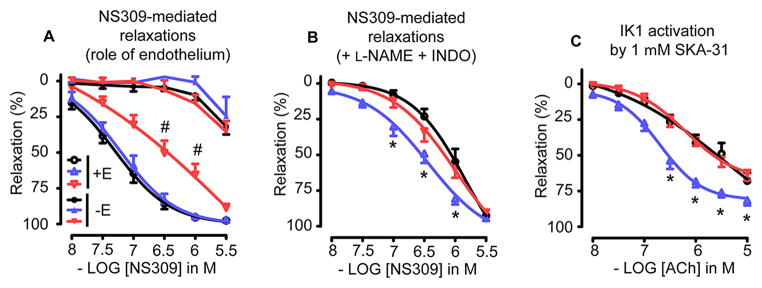
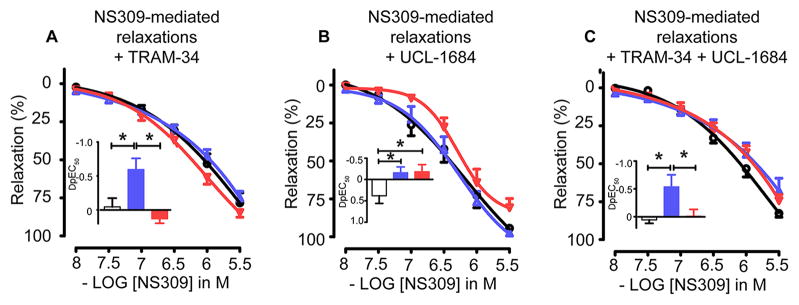
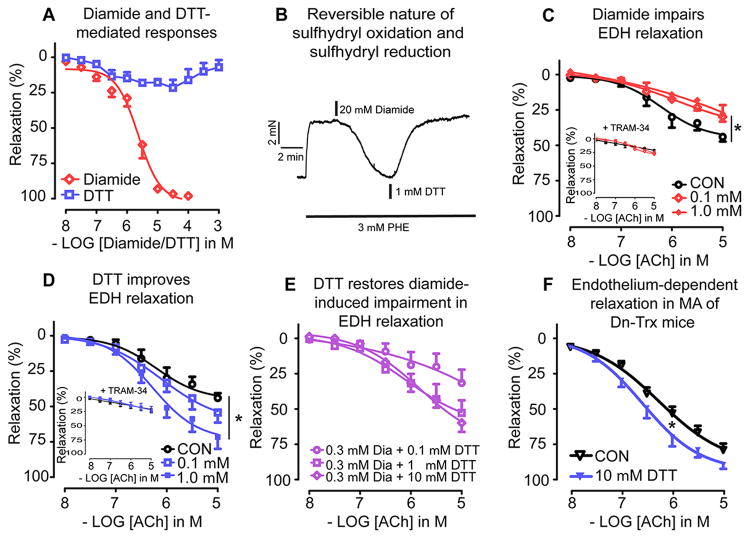
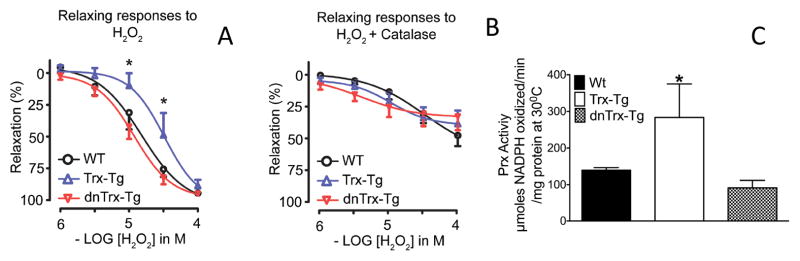
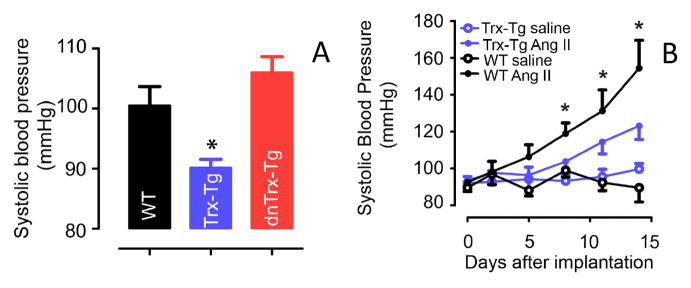
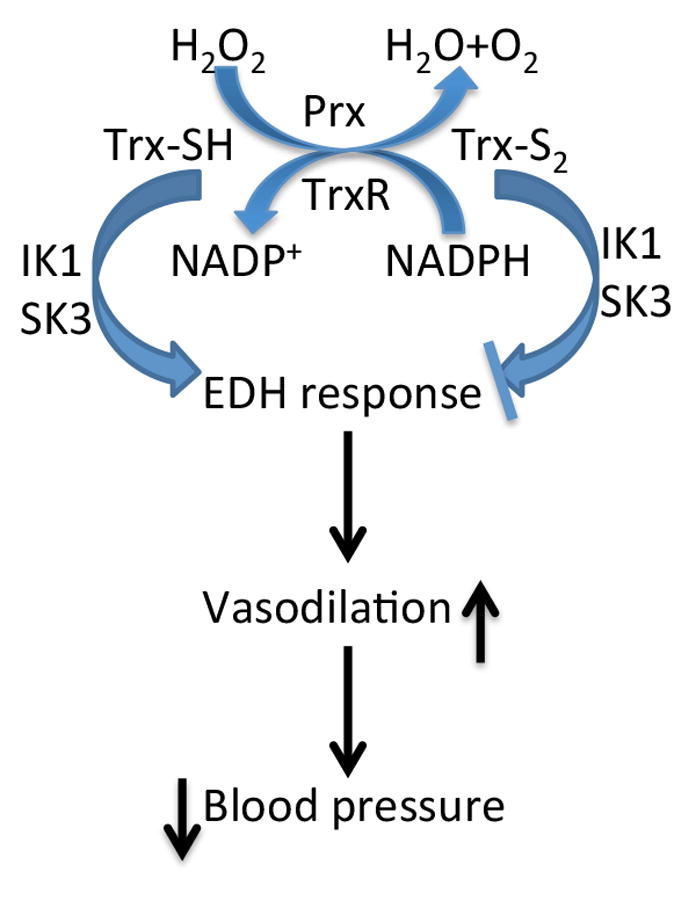
Vascular thiol redox state has been shown to modulate vasodilator functions in large conductance Ca2+ -activated K+ channels and other related channels. However, the role of vascular redox in small resistance arteries is unknown. To determine how in vivo modulation of thiol redox state affects small resistance arteries relaxation, we generated a transgenic mouse strain that overexpresses thioredoxin, a small redox protein (Trx-Tg), and another strain that is thioredoxin-deficient (dnTrx-Tg). The redox state of the mesenteric arteries (MAs) in Trx-Tg mice is found to be predominantly in reduced state; in contrast, MAs from dnTrx-Tg mice remain in oxidized state. Thus, we created an in vivo redox system of mice and isolated the second-order branches of the main superior MAs from wild-type, Trx-Tg, or dnTrx-Tg mice to assess endothelium-dependent relaxing responses in a wire myograph. In MAs isolated from Trx-Tg mice, we observed an enhanced intermediate-conductance Ca2+ -activated potassium channel contribution resulting in a larger endothelium-dependent hyperpolarizing (EDH) relaxation in response to indirect (acetylcholine) and direct (NS309) opening of endothelial calcium-activated potassium channels. MAs derived from dnTrx-Tg mice showed both blunted nitric oxide-mediated and EDH-mediated relaxation compared with Trx-Tg mice. In a control study, diamide decreased EDH relaxations in MAs of wild-type mice, whereas dithiothreitol improved EDH relaxations and was able to restore the diamide-induced impairment in EDH response. Furthermore, the basal or angiotensin II-mediated systolic blood pressure remained significantly lower in Trx-Tg mice compared with wild-type or dnTrx-Tg mice, thus directly establishing redox-mediated EDH in blood pressure control.
Keywords: endothelium; mesenteric arteries; relaxation; thioredoxins.
© 2014 American Heart Association, Inc.
Figures
References
-
- Thomas SR, Witting PK, Drummond GR. Redox control of endothelial function and dysfunction: Molecular mechanisms and therapeutic opportunities. Antioxid Redox Signal. 2008;10:1713–1765. - PubMed
-
- Vanhoutte PM, Shimokawa H, Tang EH, Feletou M. Endothelial dysfunction and vascular disease. Acta Physiol (Oxf) 2009;196:193–222. - PubMed
-
- Shimokawa H, Yasutake H, Fujii K, Owada MK, Nakaike R, Fukumoto Y, Takayanagi T, Nagao T, Egashira K, Fujishima M, Takeshita A. The importance of the hyperpolarizing mechanism increases as the vessel size decreases in endothelium-dependent relaxations in rat mesenteric circulation. J Cardiovasc Pharmacol. 1996;28:703–711. - PubMed
-
- Hilgers RH, Todd J, Jr, Webb RC. Regional heterogeneity in acetylcholine-induced relaxation in rat vascular bed: Role of calcium-activated k+ channels. Am J Physiol Heart Circ Physiol. 2006;291:H216–222. - PubMed
Publication types
MeSH terms
Substances
Grants and funding
LinkOut - more resources
Full Text Sources
Medical
Molecular Biology Databases
Miscellaneous
