doi: 10.15252/embr.201439593.
Epub 2014 Oct 13.
Reawakening anaesthesia research
Affiliations
- PMID: 25312808
- PMCID: PMC4253484
- DOI: 10.15252/embr.201439593
Item in Clipboard
Reawakening anaesthesia research
EMBO Rep.
2014 Nov.
No abstract available
Figures

Allis’ Ether Inhaler: a circular apparatus, slotted to accept a weave of fabric and fitted with an outer covering, is placed over a reclining patient’s nose and mouth; ether is being administered from a bottle, a few drops at a time onto the fabric. Allis’ instrument can be considered as a development of the original Morton’s inhaler (see main text). Wood engraving, published in Artificial anaesthesia. A manual of anaesthetic agents and their employment in the treatment of disease, by Laurence Turnbull, Blakiston, Philadelphia, 1896. Credit: US National Library of Medicine, History of Medicine Division.
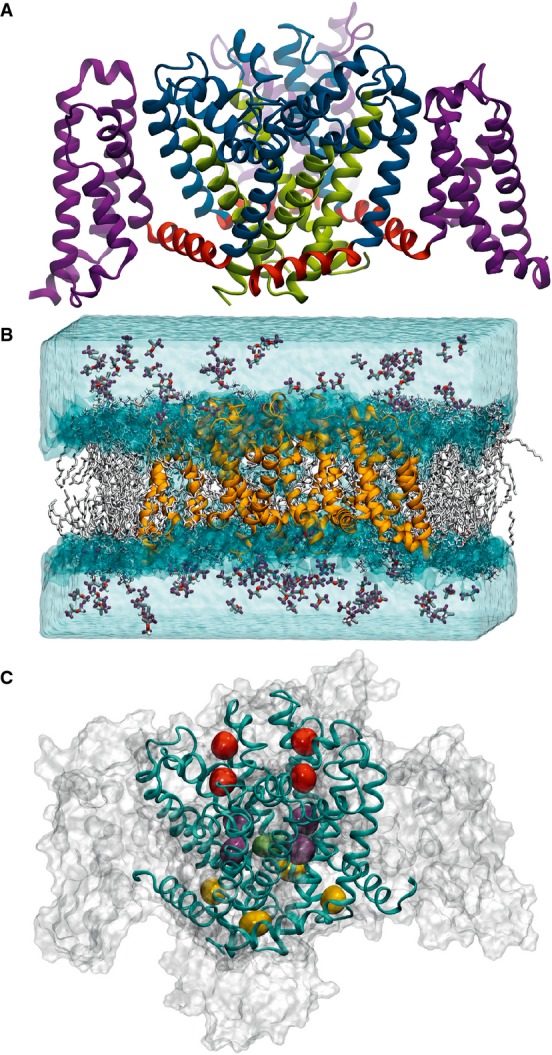
(A) Structural domains of NaChBac showing the voltage-sensing domain (purple), connected through the S4–S5 linkers (red) to the pore domain (blue/green) with the S6 helices highlighted in green. (B) Isoflurane flooding simulation system initial set-up showing the NaChBac protein (orange) in the lipid bilayer (white) with isoflurane molecules in the aqueous phase. (C) The three binding sites identified by clustering analysis: extracellular site (red), linker site (yellow) and cavity site (purple/green). From . Reproduced with permission.
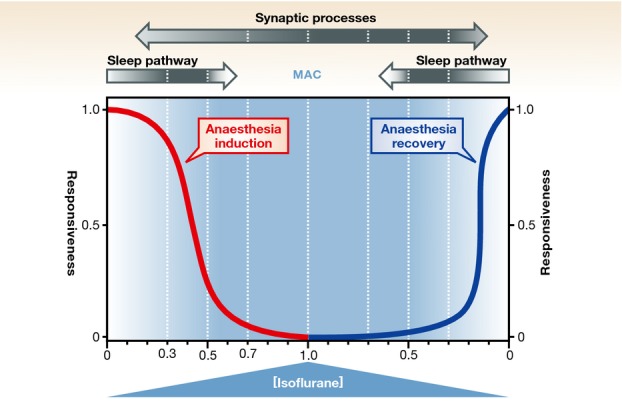
Induction of isoflurane anaesthesia (red curve) might involve potentiation of an endogenous sleep pathway first, at lower drug concentrations (“Sleep pathway” arrow, darkness intensity represents maximal anaesthetic effect, e.g. 0.3–0.5 vol% isoflurane), followed by non-specific attenuation of synaptic neurotransmission across the entire brain, at surgical (e.g. 0.7–1.0 vol% isoflurane) concentrations (“Synaptic processes” arrow, darkness intensity represents maximal anaesthetic effect). Recovery from general anaesthesia (blue curve) would first require recovery of synaptic coordination across the brain prior to awakening. These distinct effects on synaptic processes and sleep pathways could explain the inertia that is typically observed during recovery from general anaesthesia. MAC, minimum alveolar concentration required for performing surgery. Adapted from . Reproduced with permission.
References
-
- Robinson DH, Toledo AH. Historical development of modern anesthesia. J Invest Surg. 2012;25:141–149. - PubMed
-
- Pauling L. A molecular theory of general anesthesia. Science. 1961;134:15–21. - PubMed
-
- Franks NP. The unfolding story of how general anaesthetics act. In: Eger EI II, Saidman LJ, Westhorpe RN, editors. The Wondrous Story of Anesthesia. New York: Springer; 2014. pp. 597–608.
Publication types
MeSH terms
Substances
LinkOut - more resources
Full Text Sources
Other Literature Sources