


Spread and impact of the Schmallenberg virus epidemic in France in 2012-2013
- PMID: 25312811
- PMCID: PMC4210488
- DOI: 10.1186/s12917-014-0248-x
Spread and impact of the Schmallenberg virus epidemic in France in 2012-2013
Abstract
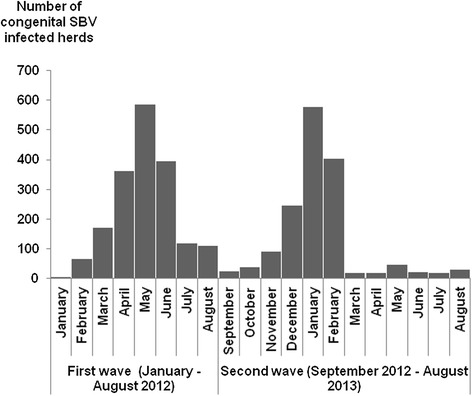
Background: The Schmallenberg virus (SBV) emerged in Europe in 2011 and caused a widespread epidemic in ruminants.In France, SBV emergence was monitored through a national multi-stakeholder surveillance and investigation system. Based on the monitoring data collected from January 2012 to August 2013, we describe the spread of SBV in France during two seasons of dissemination (vector seasons 2011 and 2012) and we provide a large-scale assessment of the impact of this new disease in ruminants.
Results: SBV impact in infected herds was primarily due to the birth of stillborns or deformed foetuses and neonates. Congenital SBV morbidity level was on average moderate, although higher in sheep than in other ruminant species. On average, 8% of lambs, 3% of calves and 2% of kids born in SBV-infected herds showed typical congenital SBV deformities. In addition, in infected herds, farmers reported retrospectively a lower prolificacy during the vector season, suggesting a potential impact of acute SBV infection during mating and early stages of gestation.
Conclusions: Due to the lack of available control and prevention measures, SBV spread quickly in the naive ruminant population. France continues to monitor for SBV, and updated information is made available online on a regular basis [http://www.plateforme-esa.fr/]. Outbreaks of congenital SBV are expected to occur sporadically from now on, but further epidemics may also occur if immunity at population level declines.
Figures




References
-
- Hoffmann B, Scheuch M, Höper D, Jungblut R, Holsteg M, Schirrmeier H, Eschbaumer M, Goller KV, Wernike K, Fischer M, Breithaupt A, Mettenleiter TC, Beer M: Novel orthobunyavirus in cattle, Europe, 2011.Emerg Inf Dis 2012, 18(2). http://dx.doi.org/10.3201/eid1803.111905. - DOI - PMC - PubMed
-
- Conraths FJ, Peters M, Beer M: Schmallenberg virus, a novel orthobunyavirus infection in ruminants in Europe: Potential for global impact and preventive measures.New Zeal Vet J 2013. doi:10.1080/00480169.2012.738403. - PubMed
-
- Scholte EJ, Mars MH, Braks M, Den Hartog W, Ibañez-Justicia A, Koopmans M, Koenraadt JCM, De Vries A, Reusken C: No evidence for the persistence of Schmallenberg virus in overwintering mosquitoes.Med Vet Entomol 2013. Epub. - PubMed
-
- Wernike S, Hoffmann B, Bréard E, Botnerc A, Ponsart C, Zientara S, Lohsec L, Pozzid N, Viarouge C, Sarradine P, Leroux-Barce C, Rioue M, Laloy E, Breithauptf A, Beer M. Schmallenberg virus experimental infection of sheep. Vet Microbiol. 2013;166(3–4):461–466. doi: 10.1016/j.vetmic.2013.06.030. - DOI - PubMed
MeSH terms
LinkOut - more resources
Full Text Sources
Other Literature Sources
