


Impact of nonlinear interactions of pharmacokinetics and MICs on sputum bacillary kill rates as a marker of sterilizing effect in tuberculosis
- PMID: 25313213
- PMCID: PMC4291375
- DOI: 10.1128/AAC.03931-14
Impact of nonlinear interactions of pharmacokinetics and MICs on sputum bacillary kill rates as a marker of sterilizing effect in tuberculosis
Abstract
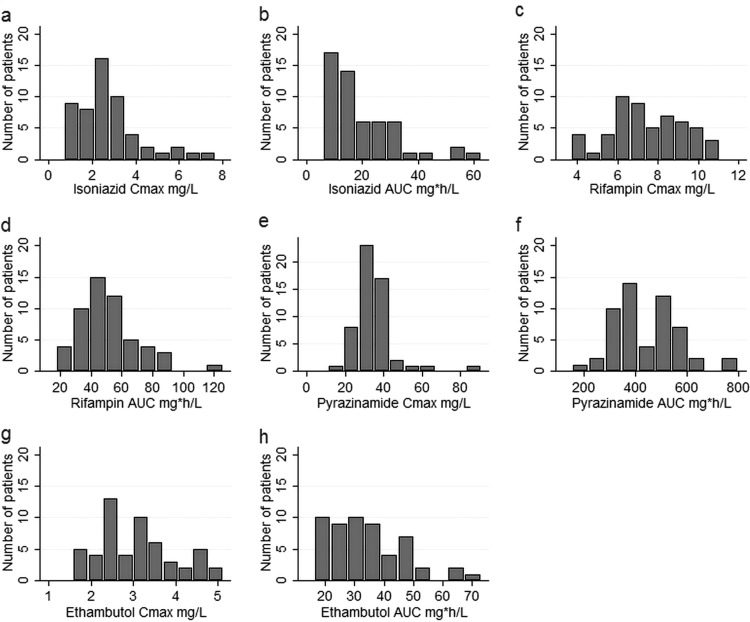
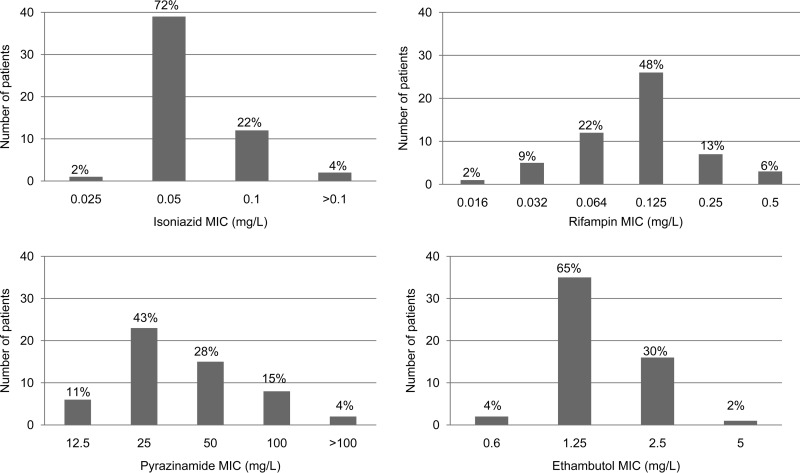
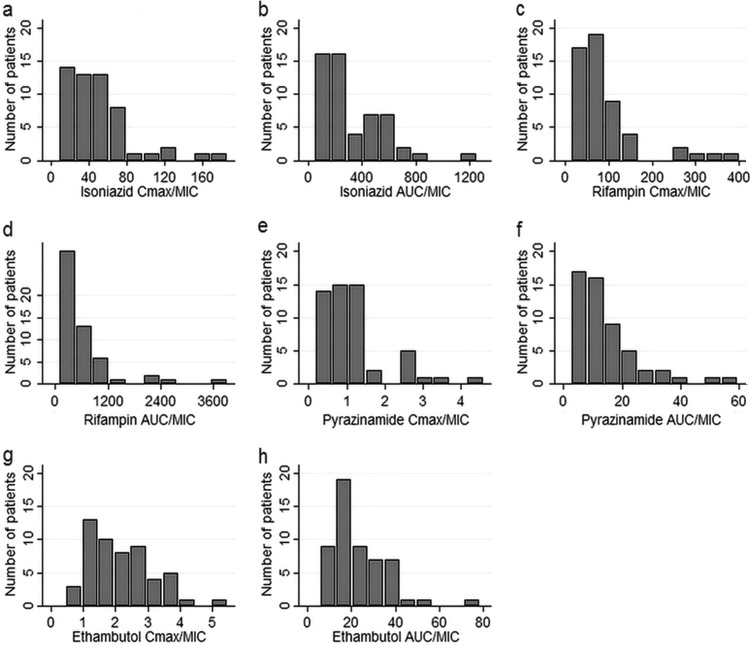
The relationships between antituberculosis drug exposure and treatment effects on humans receiving multidrug therapy are complex and nonlinear. In patients on treatment, an analysis of the rate of decline in the sputum bacillary burden reveals two slopes. The first is the α-slope, which is thought to reflect bactericidal effect, followed by a β-slope, which is thought to reflect sterilizing activity. We sought to characterize the effects of standard first-line treatment on sterilizing activity. Fifty-four patients receiving combination therapy for pulmonary tuberculosis in a clinical trial had drug concentrations measured and Mycobacterium tuberculosis isolates available for MIC identification. Sputum sample cultures were performed at baseline and weekly for 8 weeks. A time-to-event model based on the days to positivity in the liquid cultures was used to estimate the β-slope. The pharmacokinetic parameters of rifampin, isoniazid, ethambutol, and pyrazinamide were determined for each patient. Multivariate adaptive regression splines analyses, which simultaneously perform linear and nonlinear analyses, were used to identify the relationships between the predictors and the β-slope. The potential predictors examined included HIV status, lung cavitation, 24-h area under the concentration-time curve (AUC), peak drug concentration (Cmax), AUC/MIC ratio, Cmax/MIC ratio, and the time that that concentration persisted above MIC. A rifampin Cmax of >8.2 mg/liter and a pyrazinamide AUC/MIC of >11.3 were key predictors of the β-slope and interacted positively to increase the β-slope. In patients with a rifampin AUC of <35.4 mg · h/liter, an increase in the pyrazinamide AUC/MIC and/or ethambutol Cmax/MIC increased the β-slope, while increasing isoniazid Cmax decreased it, suggesting isoniazid antagonism. Antibiotic concentrations and MICs interact in a nonlinear fashion as the main drivers of a sterilizing effect. The results suggest that faster speeds of sterilizing effect might be achieved by omitting isoniazid and by increasing rifampin, pyrazinamide, and ethambutol exposures. However, isoniazid and ethambutol exposures may only be of importance when rifampin exposure is low. These findings need confirmation in larger studies. (This study has been registered at controlled-trials.com under registration no. ISRCTN80852505.).
Copyright © 2015, American Society for Microbiology. All Rights Reserved.
Figures
References
-
- Blumberg HM, Burman WJ, Chaisson RE, Daley CL, Etkind SC, Friedman LN, Fujiwara P, Grzemska M, Hopewell PC, Iseman MD, Jasmer RM, Koppaka V, Menzies RI, O'Brien RJ, Reves RR, Reichman LB, Simone PM, Starke JR, Vernon AA, American Thoracic Society, Centers for Disease Control and Prevention, Infectious Diseases Society . 2003. American Thoracic Society/Centers for Disease Control and Prevention/Infectious Diseases Society of America: treatment of tuberculosis. Am J Respir Crit Care Med 167:603–662. doi:10.1164/rccm.167.4.603. - DOI - PubMed
-
- Canetti G, Grumbach F, Grosset J. 1960. Studies of bacillary populations in experimental tuberculosis of mice treated by isoniazid. Am Rev Respir Dis 82:295–313. - PubMed
Publication types
MeSH terms
Substances
Associated data
Grants and funding
LinkOut - more resources
Full Text Sources
Other Literature Sources
Medical
