


The impact of vaccination and antiviral therapy on hepatitis B and hepatitis D epidemiology
- PMID: 25313681
- PMCID: PMC4196970
- DOI: 10.1371/journal.pone.0110143
The impact of vaccination and antiviral therapy on hepatitis B and hepatitis D epidemiology
Abstract
The major cause of liver cancer around the globe is hepatitis B virus (HBV), which also contributes to a large number of deaths due to liver failure alone. Hepatitis delta virus (HDV) is as potentially alarming as HBV since life threatening cases are 10 times more likely with HBV-HDV dual infection compared to HBV monoinfection. So far, there is no established effective treatment against HDV and the only preventive action suggested by the World Health Organization is to introduce HBV vaccination for children immediately after birth (newborns) and thus reduce the available pool for HDV infection. Here the main objective is to understand the complex dynamics of HBV-HDV infection in a human population that can inform public health policy makers on the level of different preventive measures required to eliminate HBV and HDV infections. Model simulations suggest that HBV vertical transmission and HBV vaccination rates for newborns are instrumental in determining HBV and HDV prevalence. A decrease in HBV prevalence is observed as vaccination coverage increases and it is possible to eradicate both HBV and HDV using high vaccination coverage of ≥80% in the long term. We further found that HDV presence results in lower HBV prevalence. An application of our model to China revealed that vaccinating every newborn in China will further prevent 1.69 million new infections by 2028 as compared to the current 90% vaccination coverage. Although, higher vaccination coverage of newborns should eliminate both HBV and HDV over a long time period, any short term strategy to eradicate HDV must include additional preventive measures such as HBV adult vaccination. Implementation of HBV adult vaccination programs at a rate of 10% per year over 15 years will further prevent 39 thousand new HDV infections in China by 2028 as compared to HBV vaccination programs solely for newborns.
Conflict of interest statement
Figures
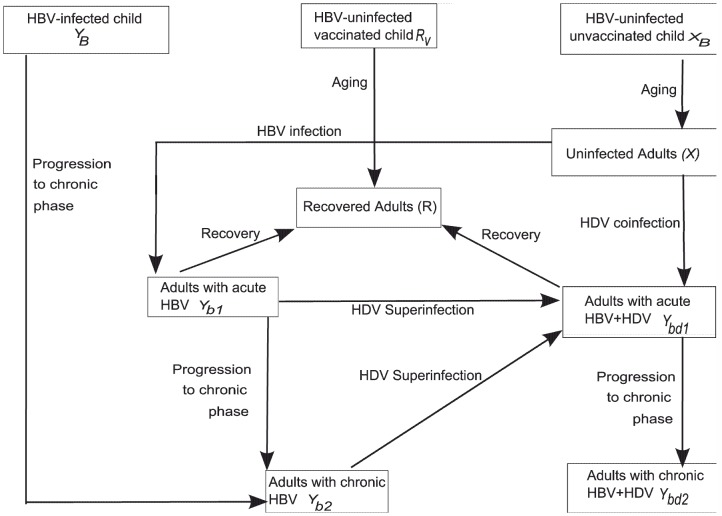
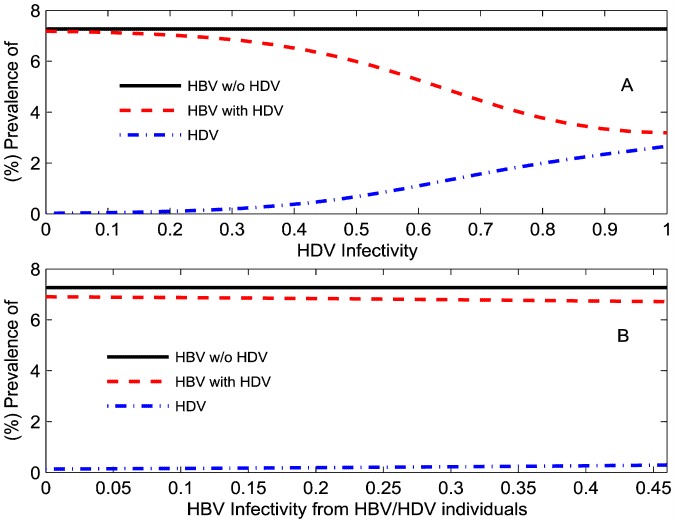
 years relative to: (A) values of infectivity of acute HDV infection (
 ) on the x-axis with
  also varying as
  ; (B) levels of suppression by HDV on the transmission of HBV in those dually infected individuals (
 ) on the x-axis with
  also varying as
  .
.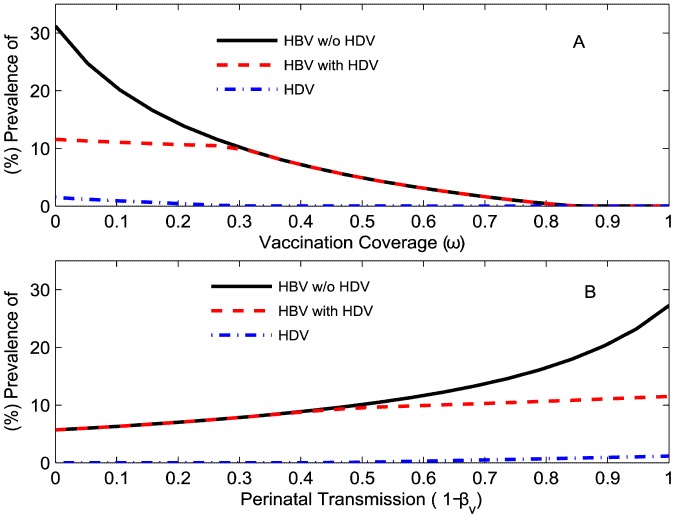
 ; (B) perinatal transmission rate at 10% vaccination coverage (
 ).
).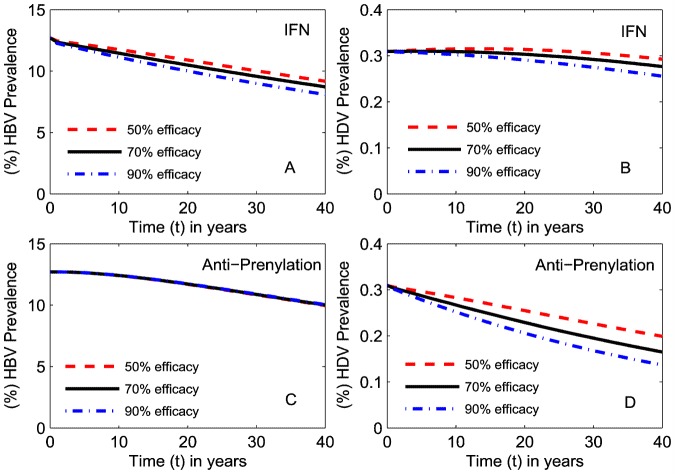
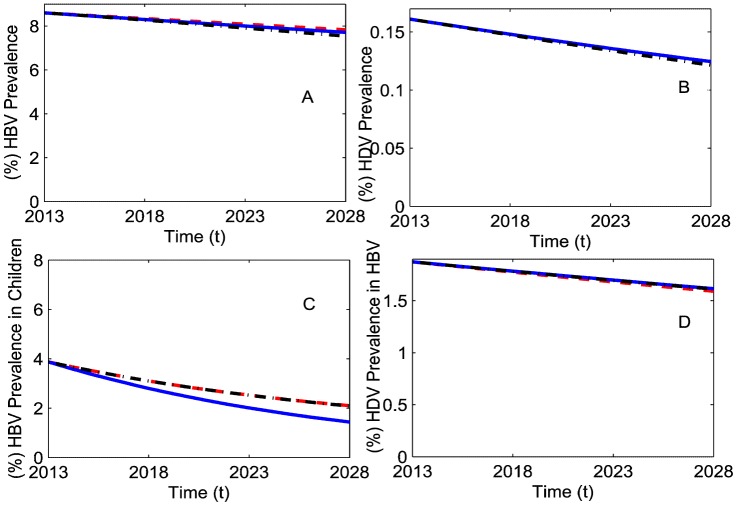
 in the simulation: (C)-(D) prenylation inhibitor therapy reducing HDV infectivity alone when introduced at time
  (% efficacy of a treatment is equivalent to the % reduction in infectivity).
References
-
- Lavanchy D (2005) Worldwide epidemiology of HBV infection, disease burden, and vaccine prevention. J Clin Virol 34 Suppl 1: S1–3. - PubMed
-
- Lavanchy D (2004) Hepatitis B virus epidemiology, disease burden, treatment, and current and emerging prevention and control measures. J Viral Hepat 11: 97–107. - PubMed
-
- Fitzsimons D, Francois G, Hall A, McMahon B, Meheus A, et al. (2005) Long-term efficacy of hepatitis B vaccine, booster policy, and impact of hepatitis B virus mutants. Vaccine 23: 4158–4166. - PubMed
-
- Perz JF, Elm JL Jr, Fiore AE, Huggler JI, Kuhnert WL, et al. (2006) Near elimination of hepatitis B virus infections among Hawaii elementary school children after universal infant hepatitis B vaccination. Pediatrics 118: 1403–1408. - PubMed
-
- Parkin DM, Bray F, Ferlay J, Pisani P (2001) Estimating the world cancer burden: Globocan 2000. Int J Cancer 94: 153–156. - PubMed
MeSH terms
Substances
LinkOut - more resources
Full Text Sources
Other Literature Sources
Medical
