


A novel atherothrombotic model of ischemic stroke induced by injection of collagen into the cerebral vasculature
- PMID: 25314906
- PMCID: PMC5425937
- DOI: 10.1016/j.jneumeth.2014.10.001
A novel atherothrombotic model of ischemic stroke induced by injection of collagen into the cerebral vasculature
Abstract
Background: Most ischemic strokes in humans are caused by ruptured arterial atheroma, which activate platelets and produce thrombi that occlude cerebral vessels.
Methods: To simulate these events, we threaded a catheter through the internal carotid artery toward the middle cerebral artery (MCA) orifice and injected collagen directly into the cerebral circulation of male C57Bl/6 mice and Wistar rats.
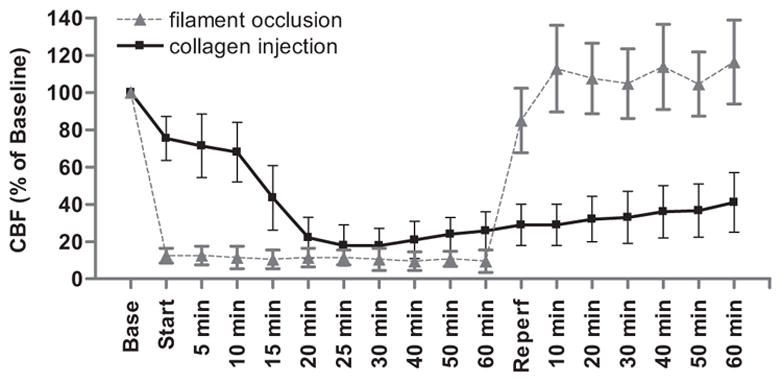
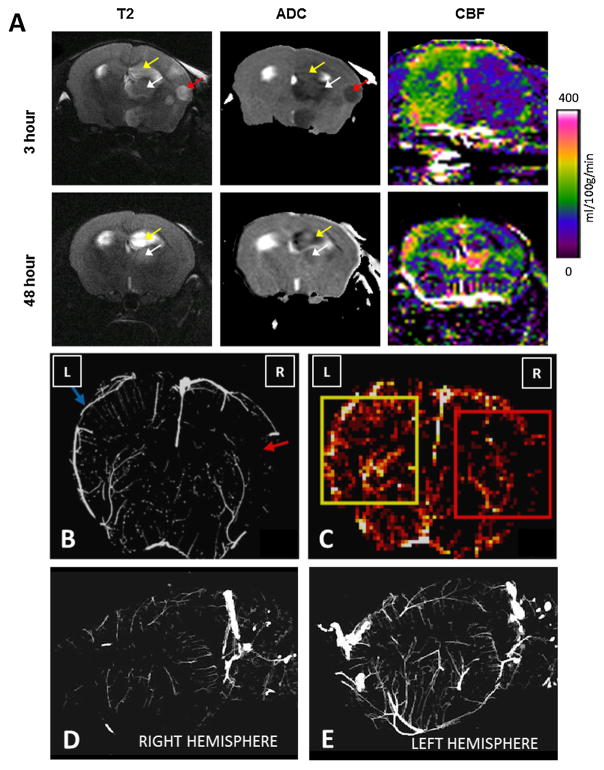
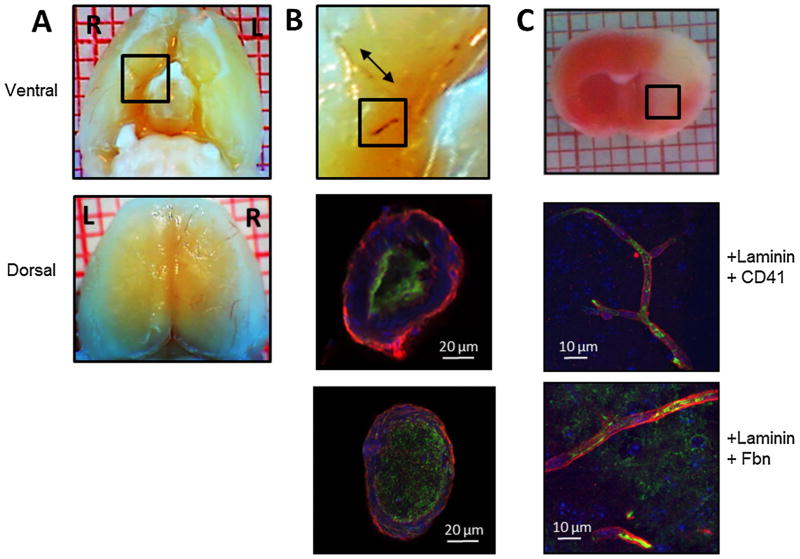
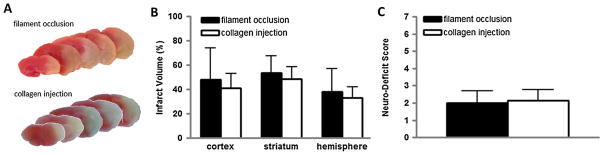
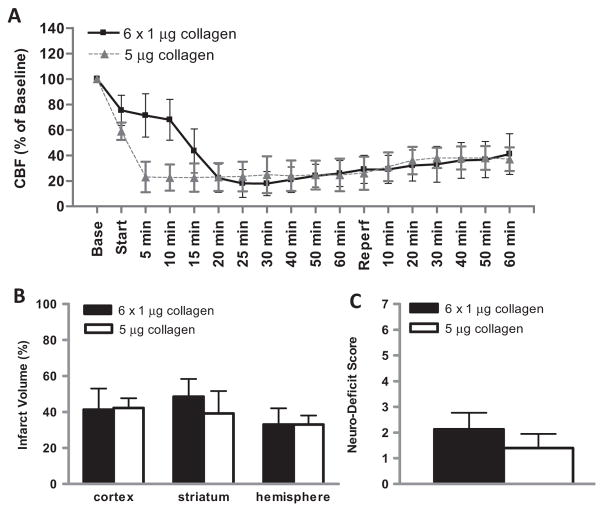
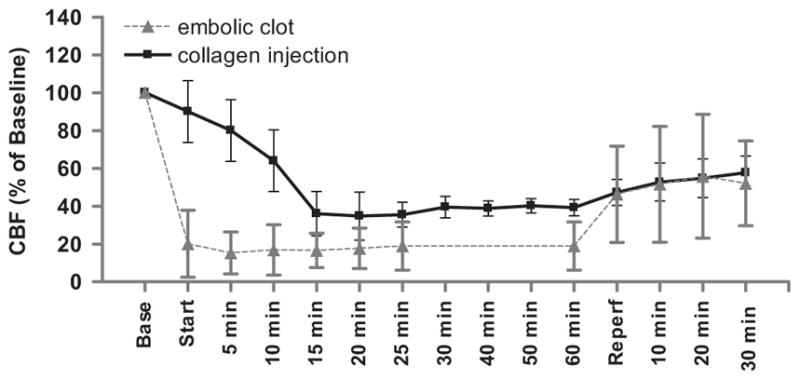
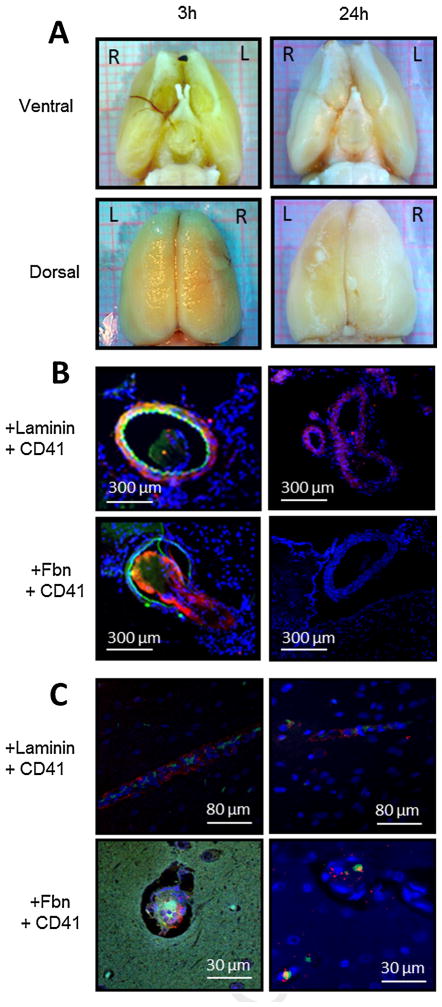
Results: Laser-Doppler flowmetry demonstrated reductions in cerebral blood flow (CBF) of ∼80% in mice and ∼60% in rats. CBF spontaneously increased but remained depressed after catheter withdrawal. Magnetic resonance imaging showed that ipsilateral CBF was reduced at 3h after collagen injection and markedly improved at 48 h. Micro-computed tomography revealed reduced blood vessel density in the ipsilateral MCA territory at 3 h. Gross examination of excised brains revealed thrombi within ipsilateral cerebral arteries at 3 h, but not 24 h, after collagen injection. Immunofluorescence microscopy confirmed that platelets and fibrinogen/fibrin were major components of these thrombi at both macrovascular and microvascular levels. Cerebral infarcts comprising ∼30% of hemispheric volume and neurobehavioral deficits were observed 48 h after ischemic injury in both mice and rats.
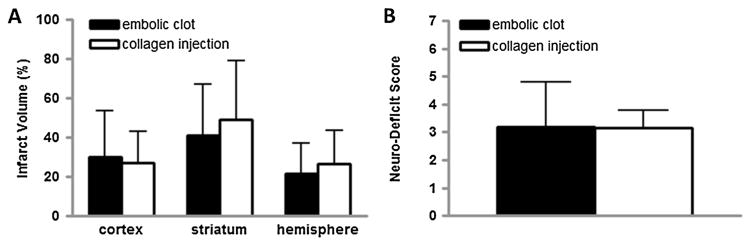
Comparison with existing methods: Collagen injection caused brain injury that was similar in magnitude and variability to mechanical MCA occlusion or injection of a pre-formed clot; however, alterations in CBF and the mechanism of vascular occlusion were more consistent with clinical ischemic stroke.
Conclusion: This novel rodent model of ischemic stroke has pathophysiologic characteristics consistent with clinical atherothrombotic stroke, is technically feasible, and creates reproducible brain injury.
Keywords: Atherothrombosis; Collagen; Ischemic stroke; Mouse; Platelet; Rat.
Copyright © 2014 Elsevier B.V. All rights reserved.
Figures
References
-
- Alkayed NJ, Harukuni I, Kimes AS, London ED, Traystman RJ, Hurn PD. Gender-linked brain injury in experimental stroke. Stroke. 1998;29:159–65. discussion 166. - PubMed
-
- Badimon L, Vilahur G. Platelets, arterial thrombosis and cerebral ischemia. Cerebrovasc Dis. 2007;24(Suppl 1):30–9. - PubMed
-
- Basser PJ, Mattiello J, LeBihan D. Estimation of the effective self-diffusion tensor from the NMR spin echo. J Magn Reson B. 1994;103:247–54. - PubMed
-
- Basser PJ, Pierpaoli C. Microstructural and physiological features of tissues elucidated by quantitative-diffusion-tensor MRI. J Magn Reson B. 1996;111:209–19. - PubMed
-
- Bederson JB, Pitts LH, Tsuji M, Nishimura MC, Davis RL, Bartkowski H. Rat middle cerebral artery occlusion: evaluation of the model and development of a neurologic examination. Stroke. 1986;17:472–6. - PubMed
Publication types
MeSH terms
Substances
Grants and funding
LinkOut - more resources
Full Text Sources
Other Literature Sources
Medical
