


Neural circuitry for rat recognition memory
- PMID: 25315129
- PMCID: PMC4383363
- DOI: 10.1016/j.bbr.2014.09.050
Neural circuitry for rat recognition memory
Abstract
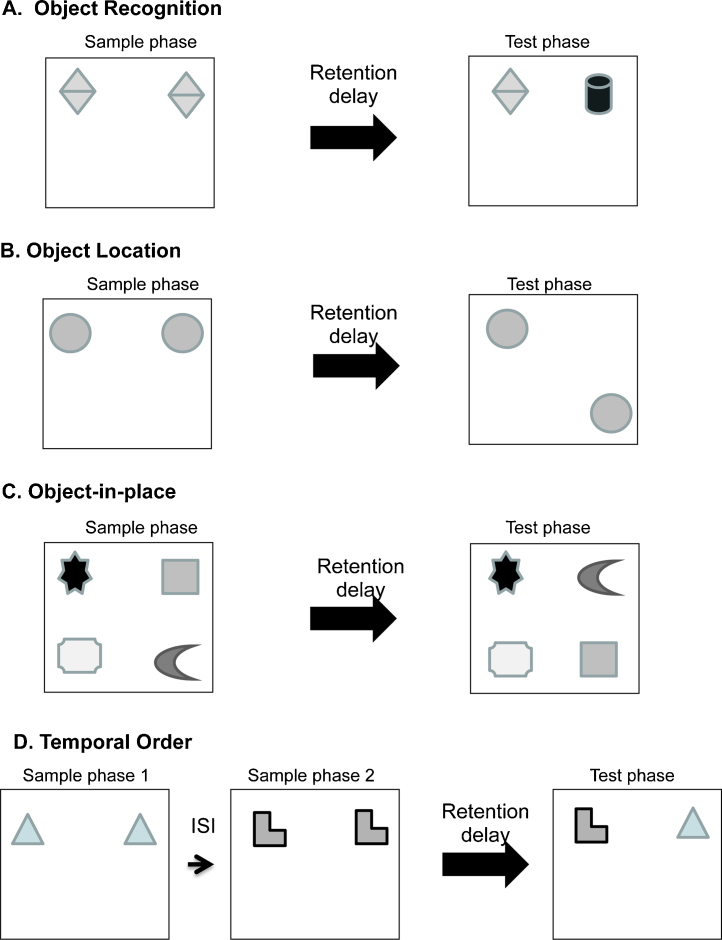
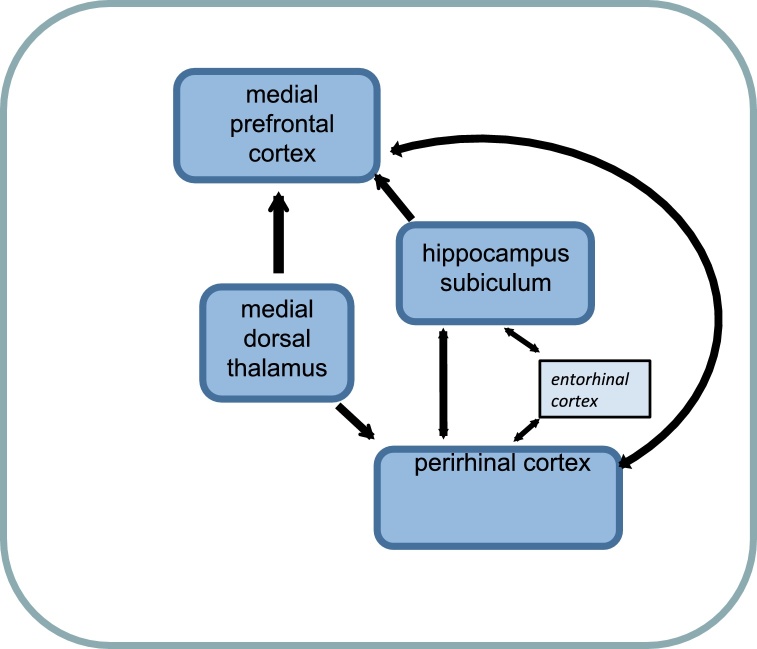
Information concerning the roles of different brain regions in recognition memory processes is reviewed. The review concentrates on findings from spontaneous recognition memory tasks performed by rats, including memory for single objects, locations, object-location associations and temporal order. Particular emphasis is given to the potential roles of different regions in the circuit of interacting structures involving the perirhinal cortex, hippocampus, medial prefrontal cortex and medial dorsal thalamus in recognition memory for the association of objects and places. It is concluded that while all structures in this circuit play roles critical to such memory, these roles can potentially be differentiated and differences in the underlying synaptic and biochemical processes involved in each region are beginning to be uncovered.
Keywords: Hippocampus; Medial prefrontal cortex; Neural circuit; Object recognition memory; Perirhinal cortex.
Copyright © 2014 The Authors. Published by Elsevier B.V. All rights reserved.
Figures
References
-
- Warburton E.C., Brown M.W. Findings from animals concerning when interactions between perirhinal cortex, hippocampus and medial prefrontal cortex are necessary for recognition memory. Neuropsychologia. 2010;48:2262–2272. - PubMed
-
- Dix S.L., Aggleton J.P. Extending the spontaneous preference test of recognition: evidence of object-location and object-context recognition. Behav Brain Res. 1999;99:191–200. - PubMed
-
- Good M.A., Barnes P., Staal V., McGregor A., Honey R.C. Context-but not familiarity-dependent forms of object recognition are impaired following excitotoxic hippocampal lesions in rats. Behav Neurosci. 2007;121:218–223. - PubMed
-
- Ennaceur A., Neave N., Aggleton J.P. Neurotoxic lesions of the perirhinal cortex do not mimic the behavioural effects of fornix transection in the rat. Behav Brain Res. 1996;80:9–25. - PubMed
Publication types
MeSH terms
Grants and funding
- BB/E010407/1/BB_/Biotechnology and Biological Sciences Research Council/United Kingdom
- WT087855/WT_/Wellcome Trust/United Kingdom
- BB7/S18861/BB_/Biotechnology and Biological Sciences Research Council/United Kingdom
- BB100310X1/BB_/Biotechnology and Biological Sciences Research Council/United Kingdom
- WT_/Wellcome Trust/United Kingdom
LinkOut - more resources
Full Text Sources
Other Literature Sources
