


Genetic control of gene expression at novel and established chronic obstructive pulmonary disease loci
- PMID: 25315895
- PMCID: PMC4806382
- DOI: 10.1093/hmg/ddu525
Genetic control of gene expression at novel and established chronic obstructive pulmonary disease loci
Abstract
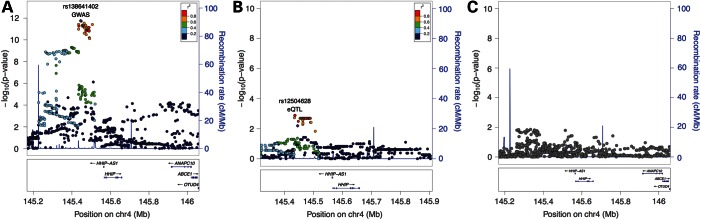
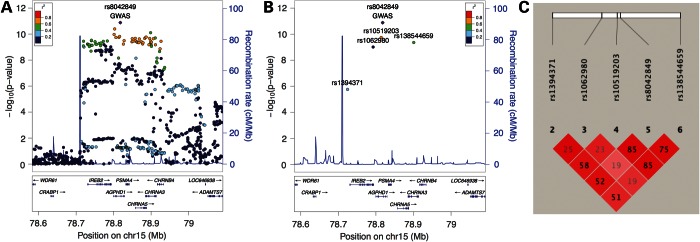
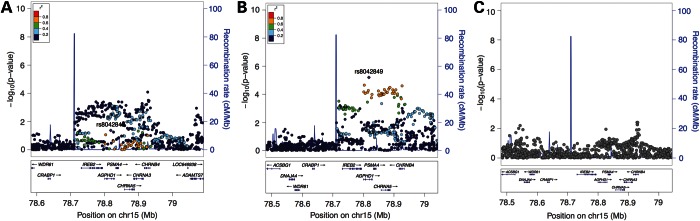
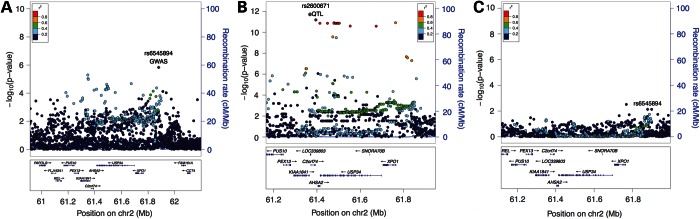
Genetic risk loci have been identified for a wide range of diseases through genome-wide association studies (GWAS), but the relevant functional mechanisms have been identified for only a small proportion of these GWAS-identified loci. By integrating results from the largest current GWAS of chronic obstructive disease (COPD) with expression quantitative trait locus (eQTL) analysis in whole blood and sputum from 121 subjects with COPD from the ECLIPSE Study, this analysis identifies loci that are simultaneously associated with COPD and the expression of nearby genes (COPD eQTLs). After integrative analysis, 19 COPD eQTLs were identified, including all four previously identified genome-wide significant loci near HHIP, FAM13A, and the 15q25 and 19q13 loci. For each COPD eQTL, fine mapping and colocalization analysis to identify causal shared eQTL and GWAS variants identified a subset of sites with moderate-to-strong evidence of harboring at least one shared variant responsible for both the eQTL and GWAS signals. Transcription factor binding site (TFBS) analysis confirms that multiple COPD eQTL lead SNPs disrupt TFBS, and enhancer enrichment analysis for loci with the strongest colocalization signals showed enrichment for blood-related cell types (CD3 and CD4+ T cells, lymphoblastoid cell lines). In summary, integrative eQTL and GWAS analysis confirms that genetic control of gene expression plays a key role in the genetic architecture of COPD and identifies specific blood-related cell types as likely participants in the functional pathway from GWAS-associated variant to disease phenotype.
© The Author 2014. Published by Oxford University Press. All rights reserved. For Permissions, please email: journals.permissions@oup.com.
Figures
References
Publication types
MeSH terms
Grants and funding
- K08 HL102265/HL/NHLBI NIH HHS/United States
- R01 HL089897/HL/NHLBI NIH HHS/United States
- R01HL089856/HL/NHLBI NIH HHS/United States
- R01HL124233/HL/NHLBI NIH HHS/United States
- K08 HL097029/HL/NHLBI NIH HHS/United States
- R01 HL089856/HL/NHLBI NIH HHS/United States
- R01 NR013377/NR/NINR NIH HHS/United States
- U01 HL089856/HL/NHLBI NIH HHS/United States
- K08HL097029/HL/NHLBI NIH HHS/United States
- P01 HL105339/HL/NHLBI NIH HHS/United States
- R01HL111759/HL/NHLBI NIH HHS/United States
- P01HL105339/HL/NHLBI NIH HHS/United States
- R01 HL124233/HL/NHLBI NIH HHS/United States
- R01 HL086601/HL/NHLBI NIH HHS/United States
- G0901786/MRC_/Medical Research Council/United Kingdom
- R01HL089897/HL/NHLBI NIH HHS/United States
- R01 HL111759/HL/NHLBI NIH HHS/United States
- U01 HL089897/HL/NHLBI NIH HHS/United States
- R01 HL094635/HL/NHLBI NIH HHS/United States
- R01HL094635/HL/NHLBI NIH HHS/United States
- K08HL102265/HL/NHLBI NIH HHS/United States
- R01HL086601/HL/NHLBI NIH HHS/United States
- R01NR013377/NR/NINR NIH HHS/United States
LinkOut - more resources
Full Text Sources
Other Literature Sources
Medical
Research Materials
