


Comparison of HOMA-IR, HOMA-β% and disposition index between US white men and Japanese men in Japan: the ERA JUMP study
- PMID: 25316435
- PMCID: PMC4289411
- DOI: 10.1007/s00125-014-3414-6
Comparison of HOMA-IR, HOMA-β% and disposition index between US white men and Japanese men in Japan: the ERA JUMP study
Abstract
Aims/hypothesis: At the same level of BMI, white people have less visceral adipose tissue (VAT) and are less susceptible to developing type 2 diabetes than Japanese people. No previous population-based studies have compared insulin resistance and insulin secretion between these two races in a standardised manner that accounts for VAT. We compared HOMA-IR, HOMA of beta cell function (HOMA-β%) and disposition index (DI) in US white men and Japanese men in Japan.
Methods: We conducted a population-based, cross-sectional study, comprising 298 white men and 294 Japanese men aged 40-49 years without diabetes. Insulin, glucose, VAT and other measurements were performed at the University of Pittsburgh. We used ANCOVA to compare geometric means of HOMA-IR, HOMA-β% and DI, adjusting for VAT and other covariates.
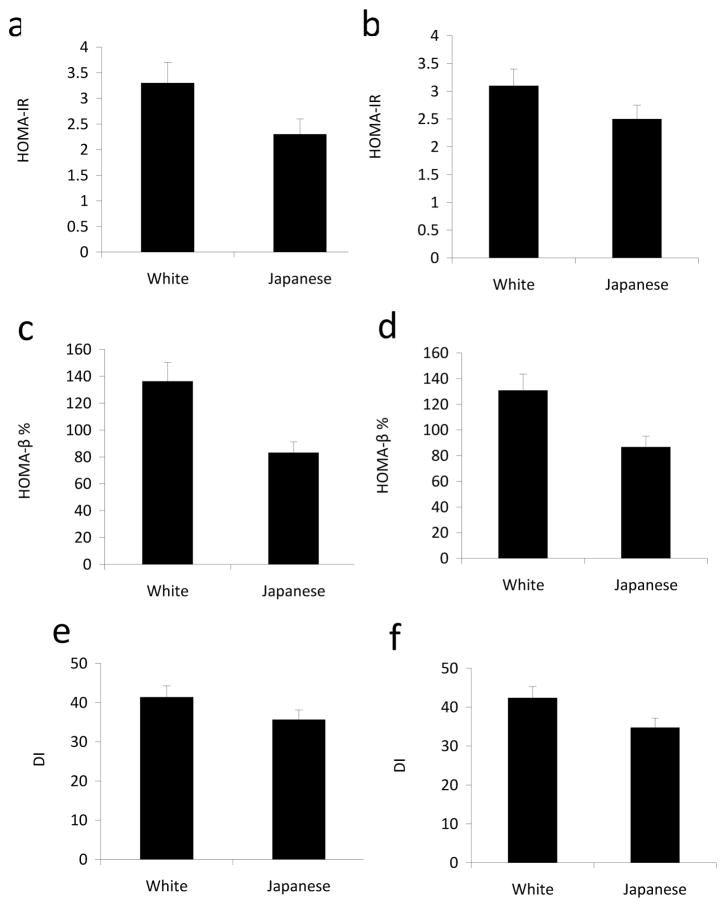
Results: White men had higher HOMA-IR, HOMA-β% and DI than Japanese men, and the difference remained significant (p < 0.01) after adjusting for VAT (geometric mean [95% CI]): 3.1 (2.9, 3.2) vs 2.5 (2.4, 2.6), 130.8 (124.6, 137.3) vs 86.7 (82.5, 91.0), and 42.4 (41.0, 44.0) vs 34.8 (33.6, 36.0), respectively. Moreover, HOMA-IR, HOMA-β% and DI were significantly higher in white men even after further adjustment for BMI, impaired fasting glucose and other risk factors.
Conclusions/interpretation: The higher VAT-adjusted DI in white men than Japanese men may partly explain lower susceptibility of white people than Japanese people to developing type 2 diabetes. The results, however, should be interpreted with caution because the assessment of insulin indices was made using fasting samples and adjustment was not made for baseline glucose tolerance. Further studies using formal methods to evaluate insulin indices are warranted.
Conflict of interest statement
The authors declare that there is no duality of interest associated with this manuscript.
Figures
Comment in
-
Surrogate measures of insulin resistance: does one size fit all?Diabetologia. 2015 Feb;58(2):207-10. doi: 10.1007/s00125-014-3454-y. Epub 2014 Nov 22. Diabetologia. 2015. PMID: 25413048
-
Comparison of HOMA-IR, HOMA-β% and disposition index between US white men and Japanese men in Japan in the ERA JUMP study: was the calculation of disposition index legitimate? Reply to Yamauchi K, Sato Y, Nakasone Y et al [letter].Diabetologia. 2015 Jul;58(7):1681-2. doi: 10.1007/s00125-015-3619-3. Epub 2015 May 10. Diabetologia. 2015. PMID: 25957232 Free PMC article. No abstract available.
-
Comparison of HOMA-IR, HOMA-β% and disposition index between US white men and Japanese men in Japan in the ERA JUMP study: was the calculation of disposition index legitimate?Diabetologia. 2015 Jul;58(7):1679-80. doi: 10.1007/s00125-015-3612-x. Epub 2015 May 14. Diabetologia. 2015. PMID: 25968987 No abstract available.
References
-
- Huxley R, James WP, Barzi F, et al. Ethnic comparisons of the cross-sectional relationships between measures of body size with diabetes and hypertension. Obesity reviews : an official journal of the International Association for the Study of Obesity. 2008;9(Suppl 1):53–61. - PubMed
-
- Kadowaki T, Sekikawa A, Murata K, et al. Japanese men have larger areas of visceral adipose tissue than White men in the same levels of waist circumference in a population-based study. International journal of obesity (2005) 2006;30:1163–1165. - PubMed
-
- Tchernof A, Despres JP. Pathophysiology of human visceral obesity: an update. Physiological reviews. 2013;93:359–404. - PubMed
-
- Jensen CC, Cnop M, Hull RL, Fujimoto WY, Kahn SE. Beta-cell function is a major contributor to oral glucose tolerance in high-risk relatives of four ethnic groups in the U.S. Diabetes. 2002;51:2170–2178. - PubMed
-
- Torrens JI, Skurnick J, Davidow AL, et al. Ethnic differences in insulin sensitivity and beta-cell function in premenopausal or early perimenopausal women without diabetes: the Study of Women’s Health Across the Nation (SWAN) Diabetes care. 2004;27:354–361. - PubMed
Publication types
MeSH terms
Substances
Grants and funding
LinkOut - more resources
Full Text Sources
Other Literature Sources
Medical
