Not salt taste perception but self-reported salt eating habit predicts actual salt intake
- PMID: 25317023
- PMCID: PMC4194290
- DOI: 10.3346/jkms.2014.29.S2.S91
Not salt taste perception but self-reported salt eating habit predicts actual salt intake
Abstract
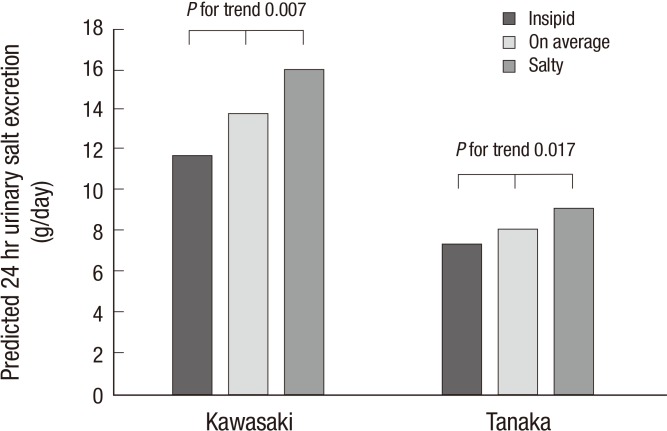
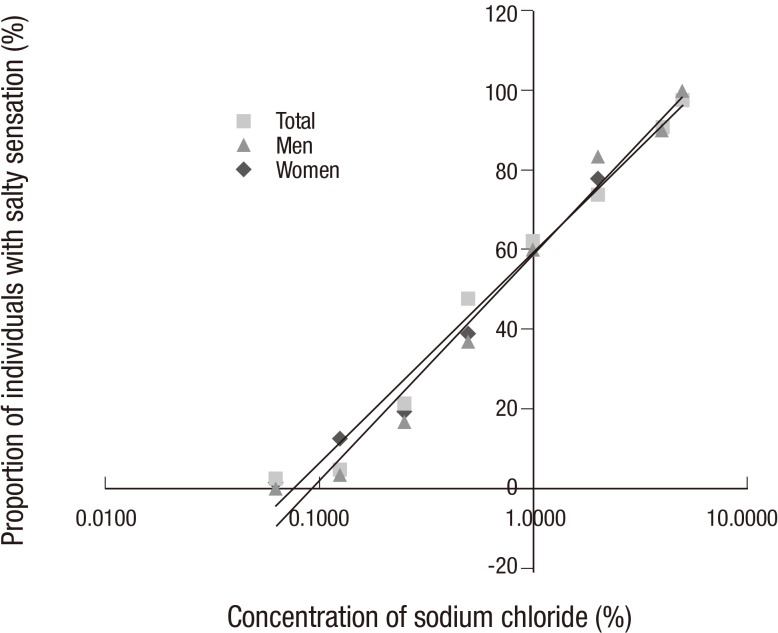
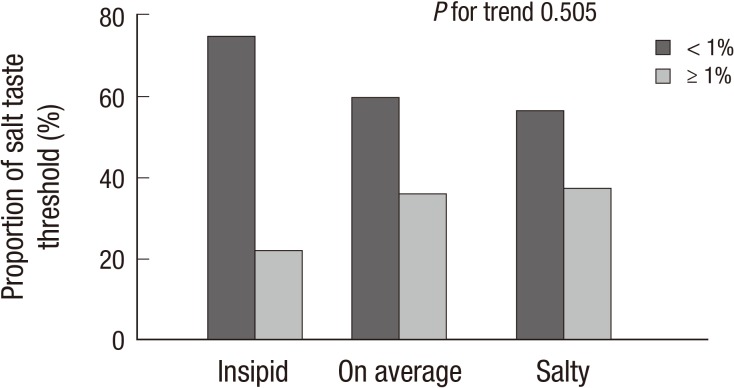
Excessive dietary salt intake is related to cardiovascular morbidity and mortality. Although dietary salt restriction is essential, it is difficult to achieve because of salt palatability. However, the association between salt perception or salt eating habit and actual salt intake remains uncertain. In this study, we recruited 74 healthy young individuals. We investigated their salt-eating habits by questionnaire and salt taste threshold through a rating scale that used serial dilution of a sodium chloride solution. Predicted 24-hr urinary salt excretions using Kawasaki's and Tanaka's equations estimated dietary salt intake. Participants' mean age was 35 yr, and 59.5% were male. Salt sense threshold did not show any relationship with actual salt intake and a salt-eating habit. However, those eating "salty" foods showed higher blood pressure (P for trend=0.048) and higher body mass index (BMI; P for trend=0.043). Moreover, a salty eating habit was a significant predictor for actual salt intake (regression coefficient [β] for Kawasaki's equation 1.35, 95% confidence interval [CI] 10-2.69, P=0.048; β for Tanaka's equation 0.66, 95% CI 0.01-1.31, P=0.047). In conclusion, a self-reported salt-eating habit, not salt taste threshold predicts actual salt intake.
Keywords: Salt Intake; Salt Taste Threshold; Salt-Eating Habit.
Conflict of interest statement
The authors have no conflicts of interest to disclose.
Figures
References
-
- Powles J, Fahimi S, Micha R, Khatibzadeh S, Shi P, Ezzati M, Engell RE, Lim SS, Danaei G, Mozaffarian D, et al. Global, regional and national sodium intakes in 1990 and 2010: a systematic analysis of 24 h urinary sodium excretion and dietary surveys worldwide. BMJ Open. 2013;3(12):e003733. - PMC - PubMed
-
- Lee SW, Kim YC, Oh SW, Koo HS, Na KY, Chae DW, Kim S, Chin HJ. Trends in the prevalence of chronic kidney disease, other chronic diseases and health-related behaviors in an adult Korean population: data from the Korean National Health and Nutrition Examination Survey (KNHANES) Nephrol Dial Transplant. 2011;26:3975–3980. - PubMed
MeSH terms
Substances
LinkOut - more resources
Full Text Sources
Other Literature Sources
Medical