


Constitutive PKA activity is essential for maintaining the excitability and contractility in guinea pig urinary bladder smooth muscle: role of the BK channel
- PMID: 25318105
- PMCID: PMC4269660
- DOI: 10.1152/ajpcell.00167.2014
Constitutive PKA activity is essential for maintaining the excitability and contractility in guinea pig urinary bladder smooth muscle: role of the BK channel
Abstract
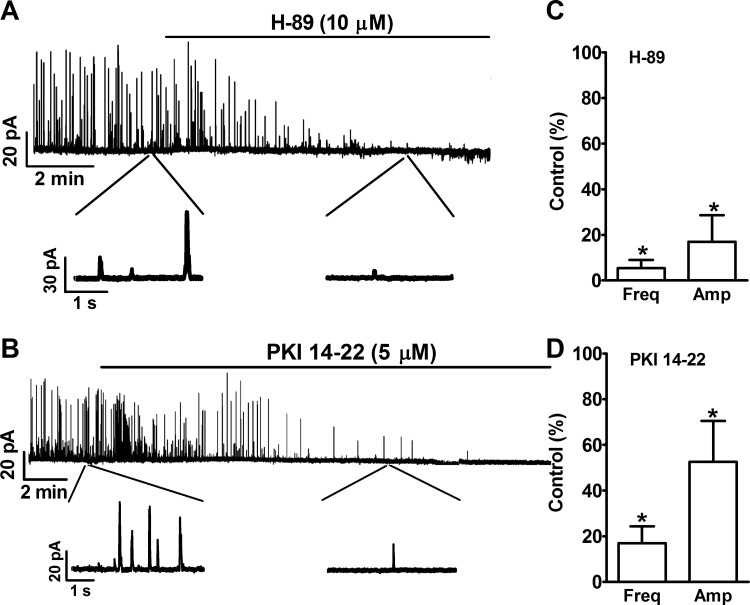
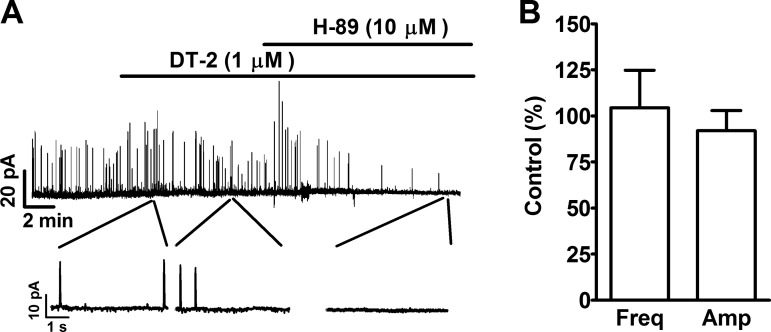
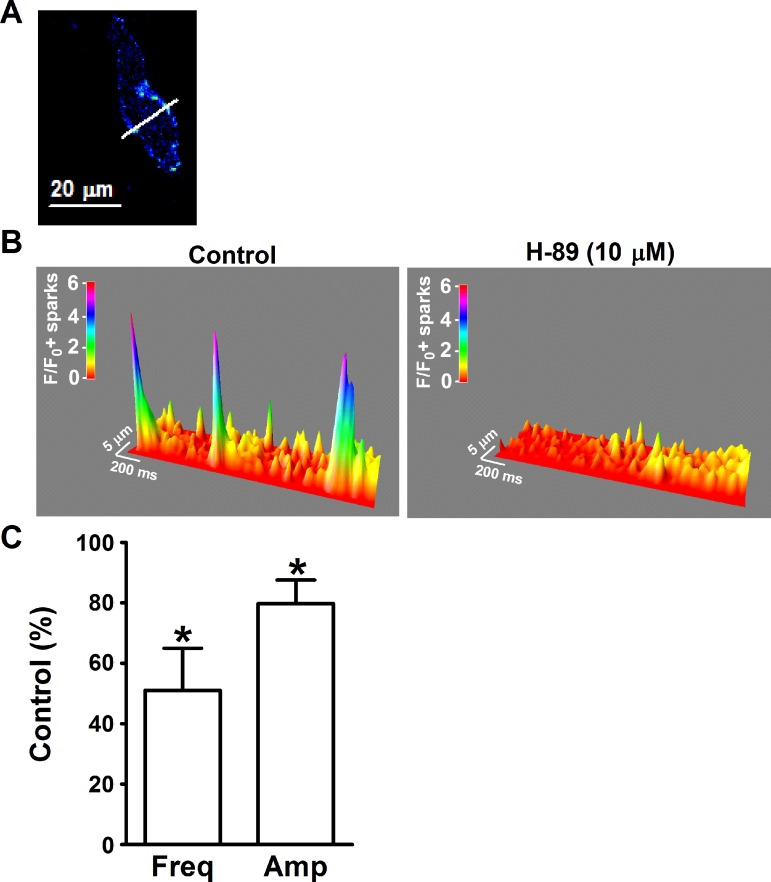
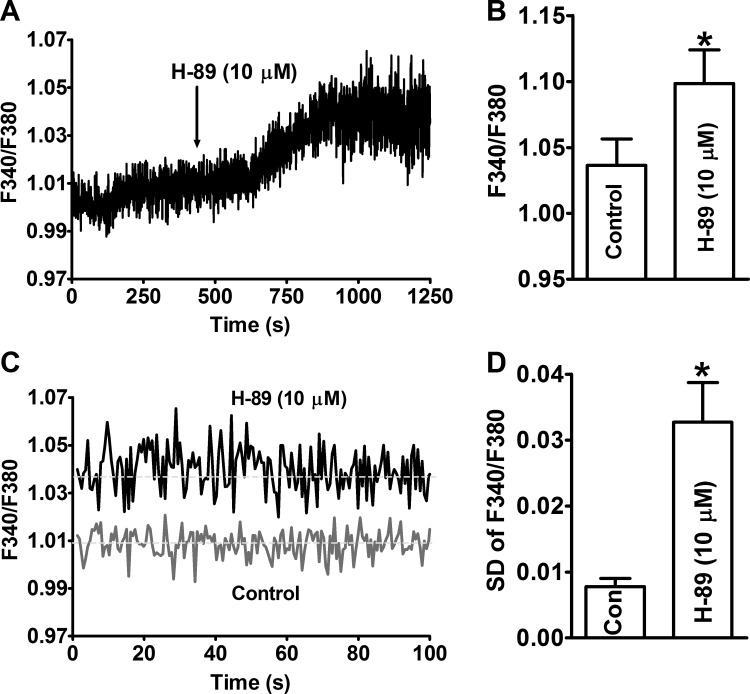
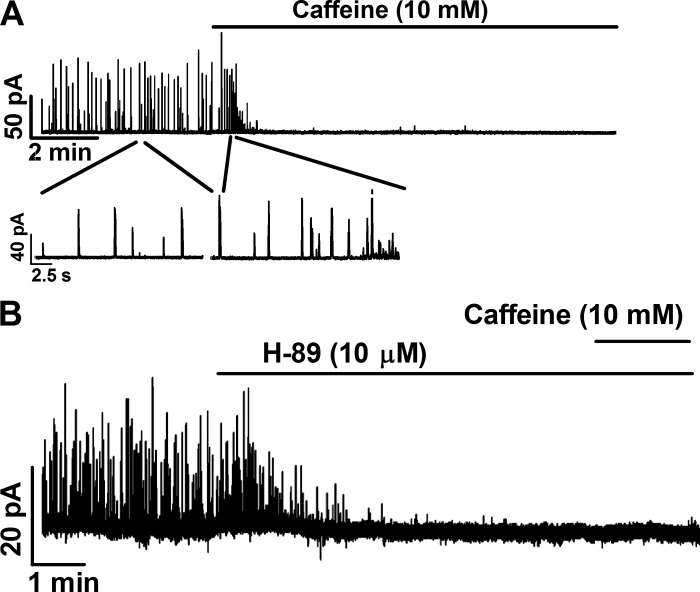
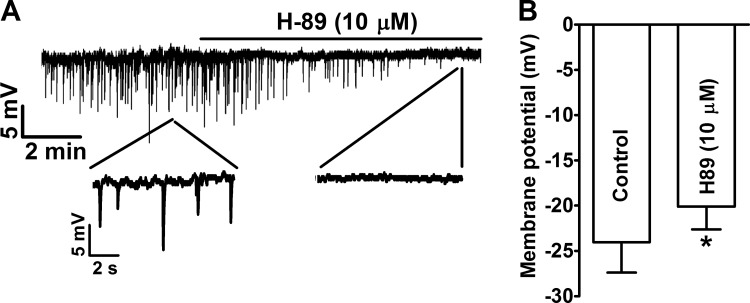
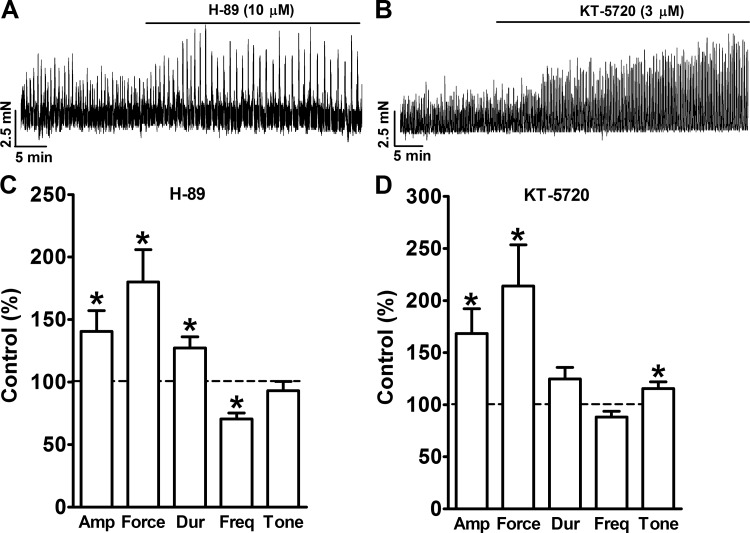
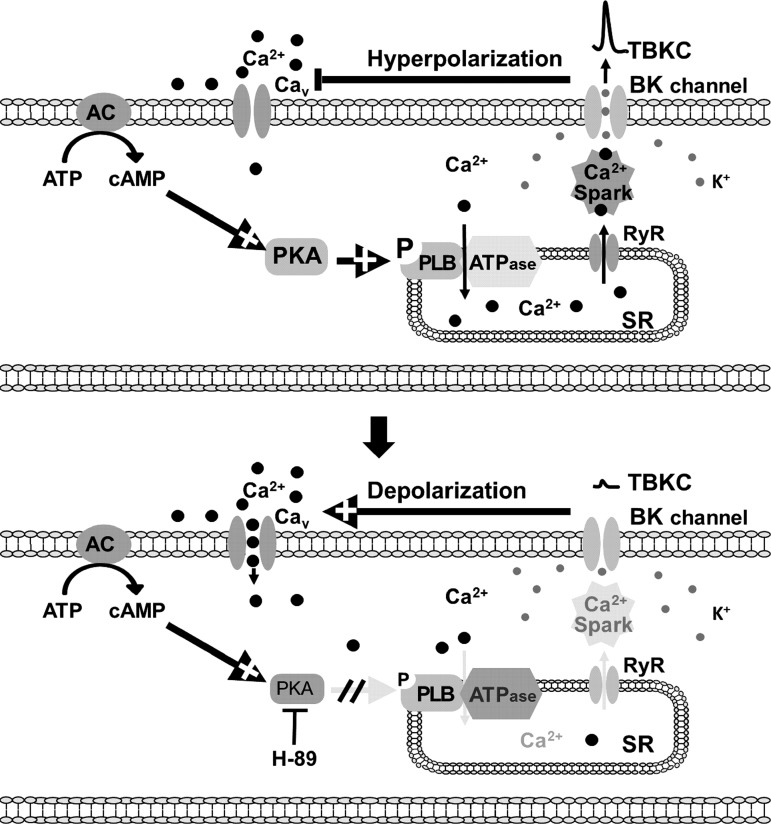
The elevation of protein kinase A (PKA) activity activates the large-conductance voltage- and Ca(2+)-activated K(+) (BK) channels in urinary bladder smooth muscle (UBSM) cells and consequently attenuates spontaneous phasic contractions of UBSM. However, the role of constitutive PKA activity in UBSM function has not been studied. Here, we tested the hypothesis that constitutive PKA activity is essential for controlling the excitability and contractility of UBSM. We used patch clamp electrophysiology, line-scanning confocal and ratiometric fluorescence microscopy on freshly isolated guinea pig UBSM cells, and isometric tension recordings on freshly isolated UBSM strips. Pharmacological inhibition of the constitutive PKA activity with H-89 or PKI 14-22 significantly reduced the frequency and amplitude of spontaneous transient BK channel currents (TBKCs) in UBSM cells. Confocal and ratiometric fluorescence microscopy studies revealed that inhibition of constitutive PKA activity with H-89 reduced the frequency and amplitude of the localized Ca(2+) sparks but increased global Ca(2+) levels and the magnitude of Ca(2+) oscillations in UBSM cells. H-89 abolished the spontaneous transient membrane hyperpolarizations and depolarized the membrane potential in UBSM cells. Inhibition of PKA with H-89 or KT-5720 also increased the amplitude and muscle force of UBSM spontaneous phasic contractions. This study reveals the novel concept that constitutive PKA activity is essential for controlling localized Ca(2+) signals generated by intracellular Ca(2+) stores and cytosolic Ca(2+) levels. Furthermore, constitutive PKA activity is critical for mediating the spontaneous TBKCs in UBSM cells, where it plays a key role in regulating spontaneous phasic contractions in UBSM.
Keywords: Ca2+ sparks; H-89; PKI 14–22; large-conductance voltage- and Ca2+-activated K+ channels; protein kinase A.
Copyright © 2014 the American Physiological Society.
Figures
References
-
- Andersson KE, Arner A. Urinary bladder contraction and relaxation: physiology and pathophysiology. Physiol Rev 84: 935–986, 2004. - PubMed
-
- Beca S, Ahmad F, Shen W, Liu J, Makary S, Polidovitch N, Sun J, Hockman S, Chung YW, Movsesian M, Murphy E, Manganiello V, Backx PH. Phosphodiesterase type 3A regulates basal myocardial contractility through interacting with sarcoplasmic reticulum calcium ATPase type 2a signaling complexes in mouse heart. Circ Res 112: 289–297, 2013. - PMC - PubMed
-
- Borisova L, Shmygol A, Wray S, Burdyga T. Evidence that a Ca2+ sparks/STOCs coupling mechanism is responsible for the inhibitory effect of caffeine on electro-mechanical coupling in guinea pig ureteric smooth muscle. Cell Calcium 42: 303–311, 2007. - PubMed
-
- Brown SM, Bentcheva-Petkova LM, Liu L, Hristov KL, Chen M, Kellett WF, Meredith AL, Aldrich RW, Nelson MT, Petkov GV. β-Adrenergic relaxation of mouse urinary bladder smooth muscle in the absence of large-conductance Ca2+-activated K+ channel. Am J Physiol Renal Physiol 295: F1149–F1157, 2008. - PMC - PubMed
Publication types
MeSH terms
Substances
Grants and funding
LinkOut - more resources
Full Text Sources
Other Literature Sources
Miscellaneous
