Comparative Study
. 2015 Feb;21(3-4):850-60.
doi: 10.1089/ten.TEA.2014.0384. Epub 2014 Dec 11.

Cartilage repair and subchondral bone remodeling in response to focal lesions in a mini-pig model: implications for tissue engineering

Affiliations
Comparative Study

Cartilage repair and subchondral bone remodeling in response to focal lesions in a mini-pig model: implications for tissue engineering

Matthew B Fisher et al. Tissue Eng Part A. 2015 Feb.

Abstract

Objective: Preclinical large animal models are essential for evaluating new tissue engineering (TE) technologies and refining surgical approaches for cartilage repair. Some preclinical animal studies, including the commonly used minipig model, have noted marked remodeling of the subchondral bone. However, the mechanisms underlying this response have not been well characterized. Thus, our objective was to compare in-vivo outcomes of chondral defects with varied injury depths and treatments.

Design: Trochlear chondral defects were created in 11 Yucatan minipigs (6 months old). Groups included an untreated partial-thickness defect (PTD), an untreated full-thickness defect (FTD), and FTDs treated with microfracture, autologous cartilage transfer (FTD-ACT), or an acellular hyaluronic acid hydrogel. Six weeks after surgery, micro-computed tomography (μCT) was used to quantitatively assess defect fill and subchondral bone remodeling. The quality of cartilage repair was assessed using the ICRS-II histological scoring system and immunohistochemistry for type II collagen. A finite element model (FEM) was developed to assess load transmission.

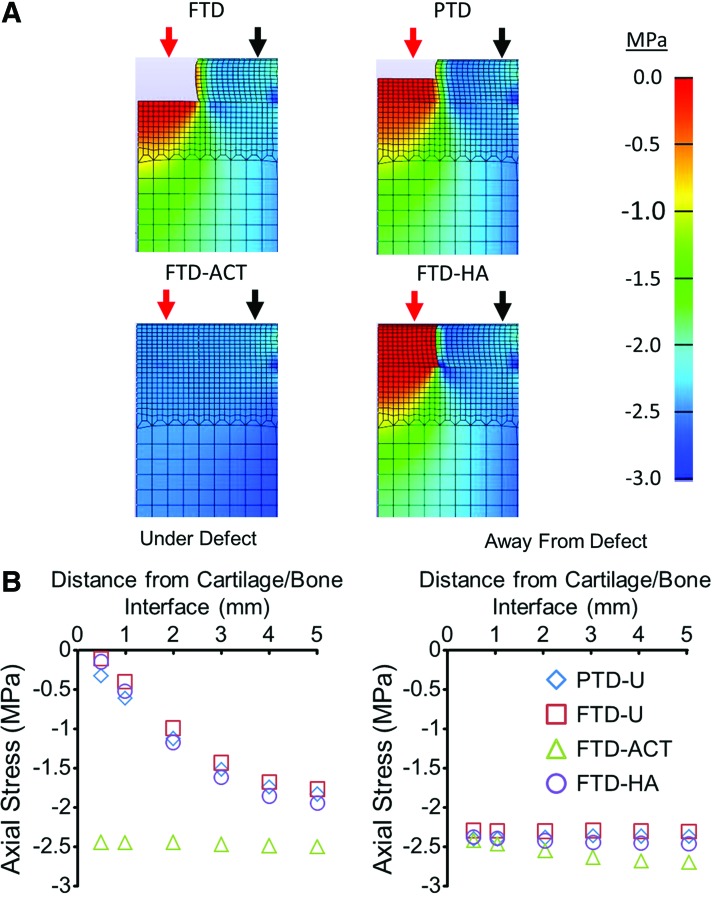
Results: Using μCT, substantial bone remodeling was observed for all FTDs, but not for the PTD group. The best overall histological scores and greatest type II collagen staining was found for the FTD-ACT and PTD groups. The FEM confirmed that only the FTD-ACT group could initially restore appropriate transfer of compressive loads to the underlying bone.

Conclusions: The bony remodeling observed in this model system appears to be a biological phenomena and not a result of altered mechanical loading, with the depth of the focal chondral defect (partial vs. full thickness) dictating the bony remodeling response. The type of cartilage injury should be carefully controlled in studies utilizing this model to evaluate TE approaches for cartilage repair.


Figures
<b>FIG. 1.</b>
FIG. 1.
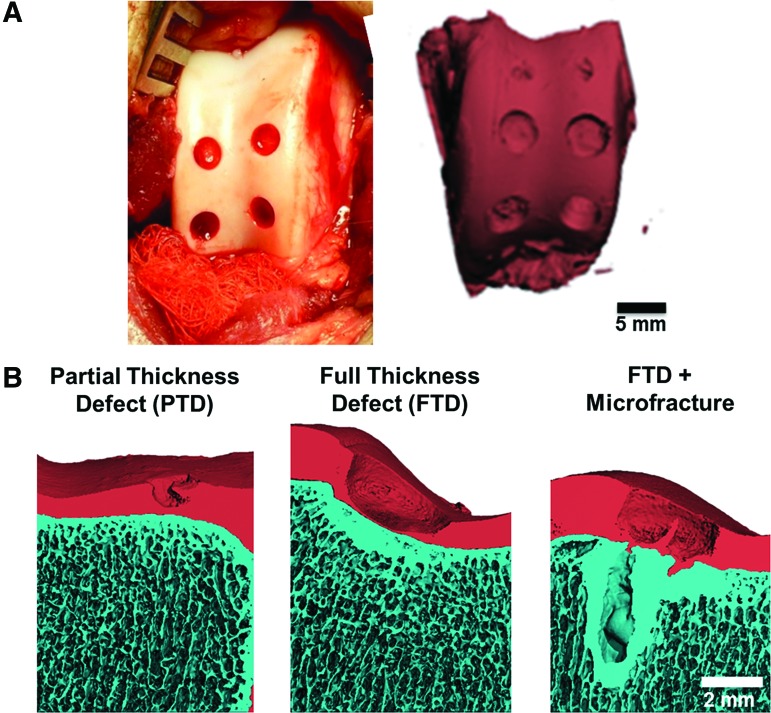
(A) Surgical approach showing location of cartilage defects in the trochlear groove and μCT reconstructions of the entire groove at the time of surgery (scale bar=5 mm). (B) μCT reconstructions of the various injury types at the time of surgery (scale bar=2 mm). μCT, micro-computed tomography. Color images available online at www.liebertpub.com/tea
<b>FIG. 2.</b>
FIG. 2.
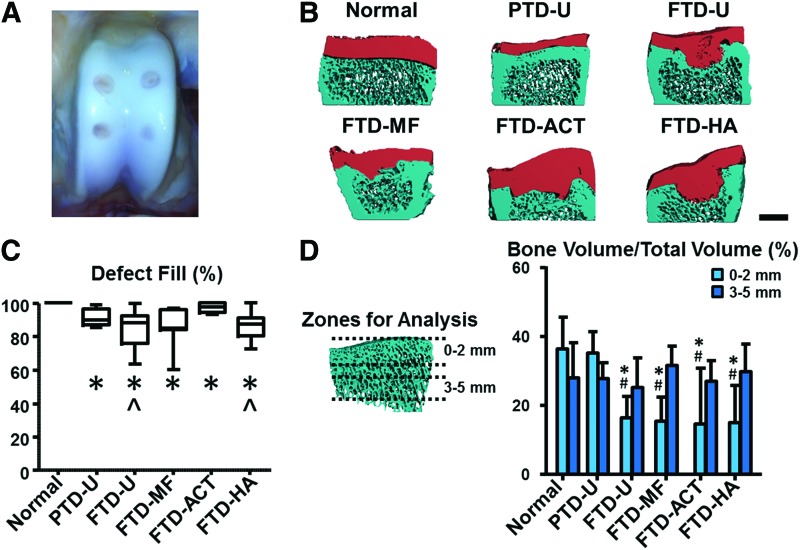
(A) Gross image of a typical trochlear groove after 6 weeks of healing. (B) μCT reconstructions of the cross-section of the defect site for different experimental groups (scale bar=2 mm). (C) Quantification of defect fill via μCT. (D) Quantification of bone volume per total volume in regions 0–2 and 3–5 mm beneath the original bone/cartilage interface at the center of the injury site (*p<0.05 vs. normal, #p<0.05 vs. PTD-U, and ^p<0.05 vs. FTD-ACT). ACT, autologous cartilage transfer; FTD, full-thickness defect; HA, hyaluronic acid; MF, microfracture; PTD, partial-thickness defect; U, untreated. Color images available online at www.liebertpub.com/tea
<b>FIG. 3.</b>
FIG. 3.
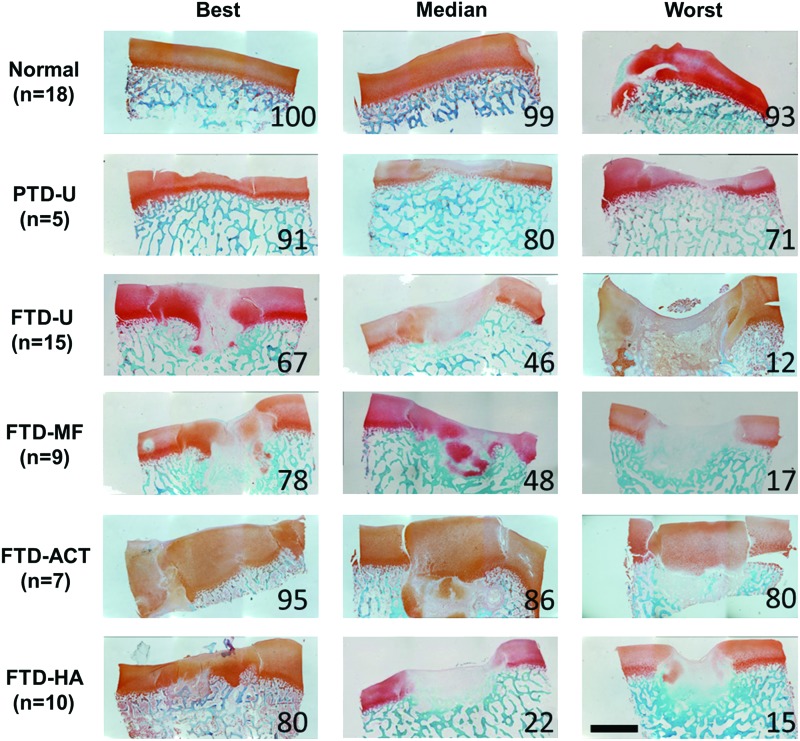
Histological evaluation of partial- or full-thickness cartilage defects and treatment with microfracture, replacement with articular cartilage, or treatment with an HA hydrogel. Staining (Safranin O/fast green) for proteoglycans (red) and proteins (green) showing entire defect and adjacent normal tissue. Numbers represent overall histological score for that specimen from ICRS-II scoring (scale bar=2 mm). Color images available online at www.liebertpub.com/tea
<b>FIG. 4.</b>
FIG. 4.
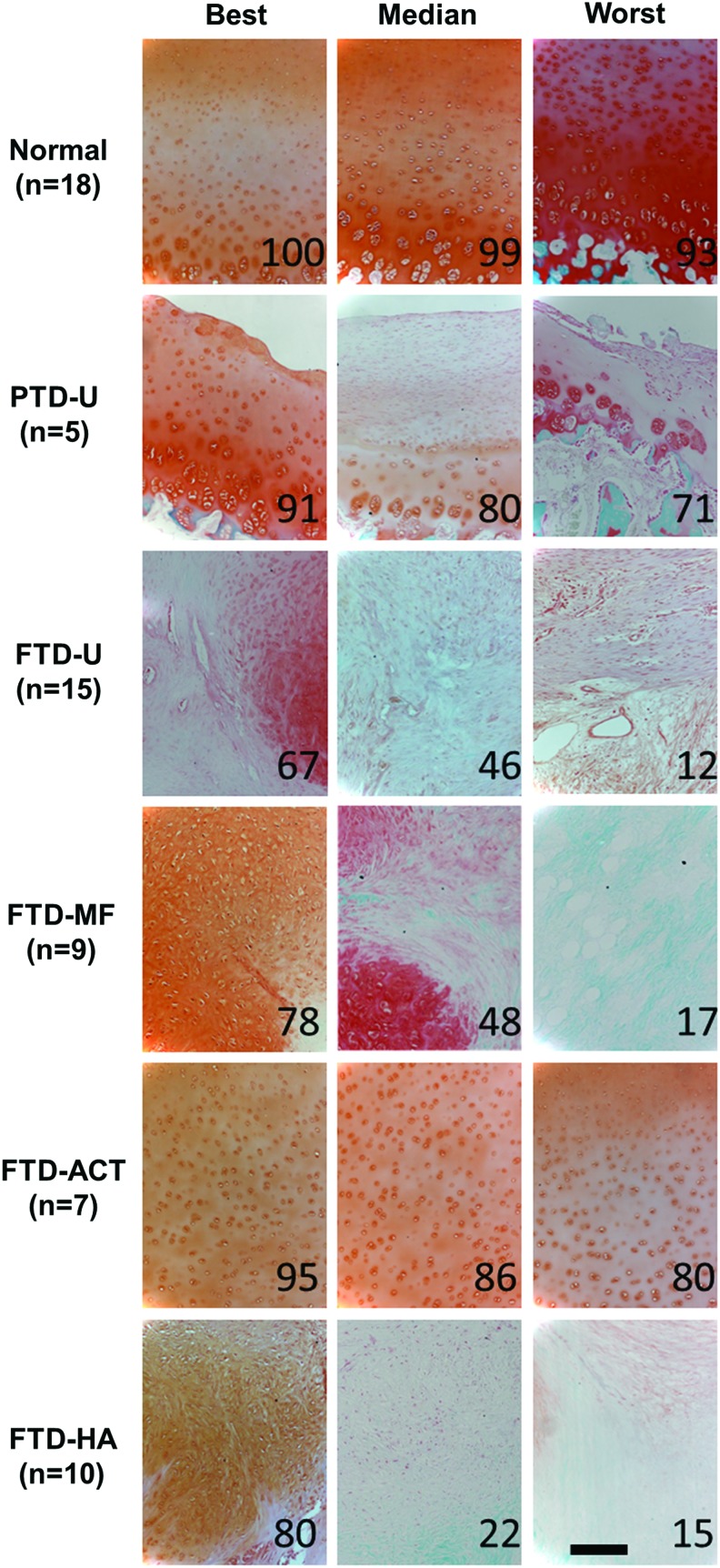
Higher magnification images of neo-tissue in defect for partial- or full-thickness cartilage defects and treatment with microfracture, replacement with articular cartilage, or treatment with an HA hydrogel. Staining (Safranin O/fast green) for proteoglycans (red) and proteins (green). Numbers represent overall histological score for that specimen from ICRS-II scoring (scale bar=200 μm). Color images available online at www.liebertpub.com/tea
<b>FIG. 5.</b>
FIG. 5.
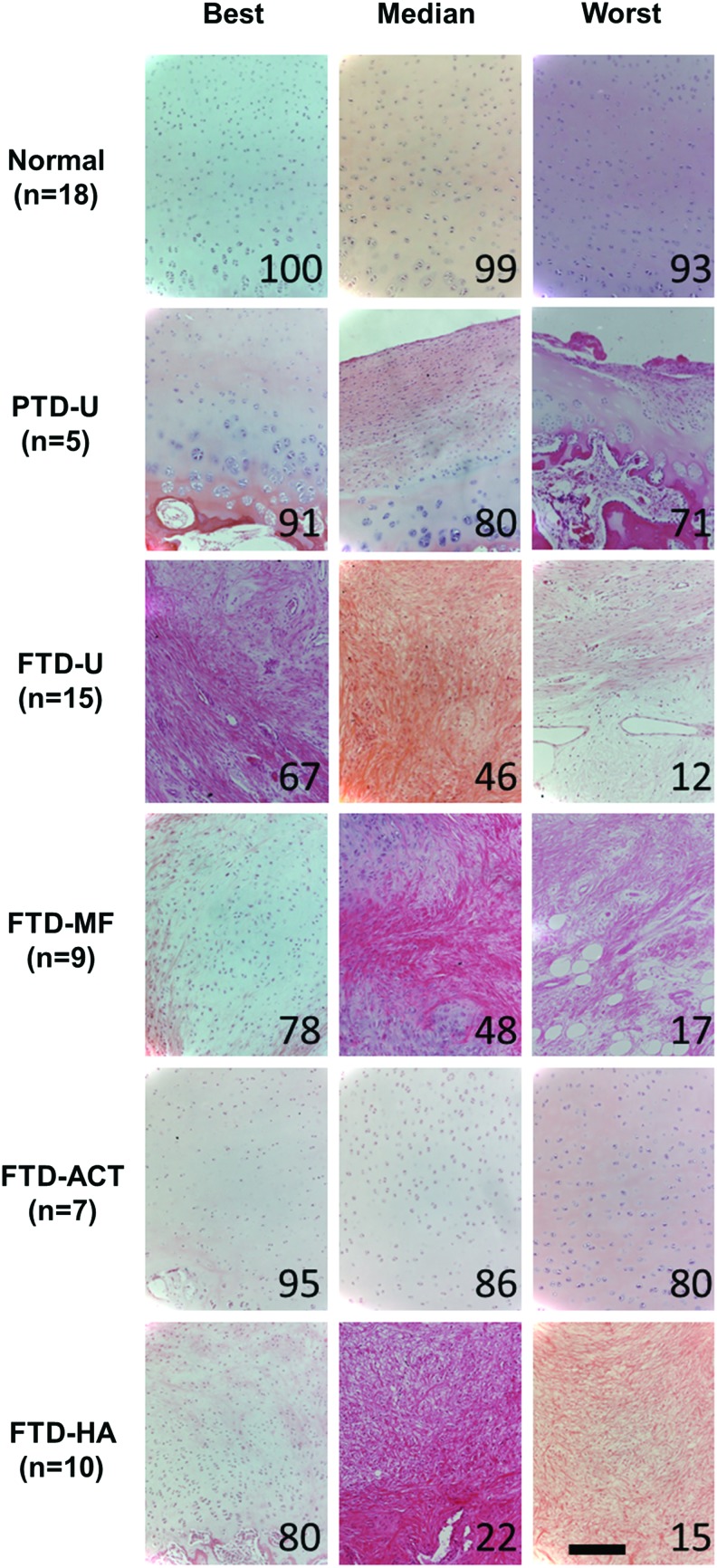
Staining (hematoxylin and eosin) for cells and matrix within neo-tissue in defect for partial- or full-thickness cartilage defects and treatment with microfracture, replacement with articular cartilage, or treatment with an HA hydrogel. Numbers represent overall histological score for that specimen from ICRS-II scoring (scale bar=200 μm). Color images available online at www.liebertpub.com/tea
<b>FIG. 6.</b>
FIG. 6.
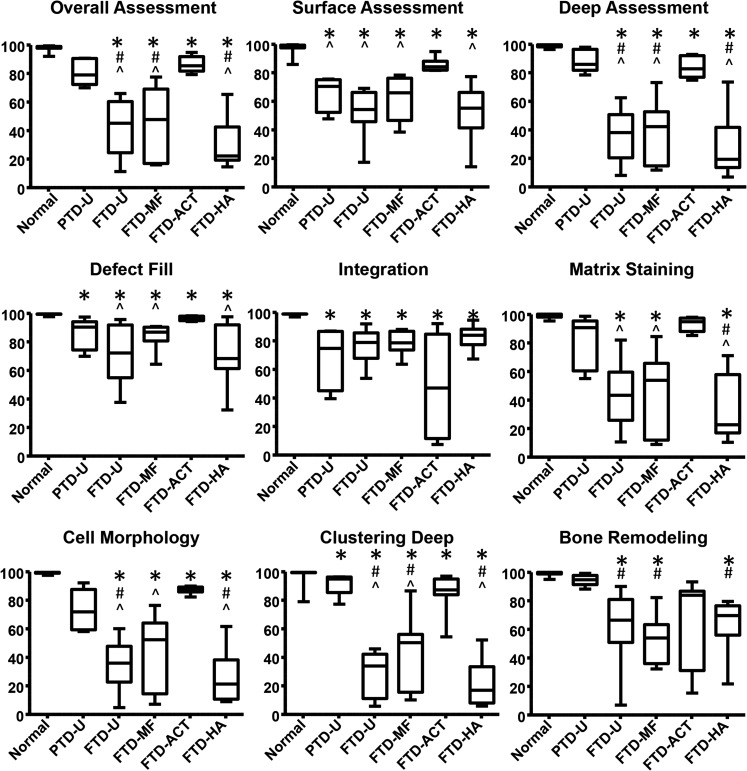
Histological scoring for all treatment groups based on the ICRS-II scoring system (100=best, 0=worst, *p<0.05 vs. normal, #p<0.05 vs. PTD-U, and ^p<0.05 vs. FTD-ACT).
<b>FIG. 7.</b>
FIG. 7.
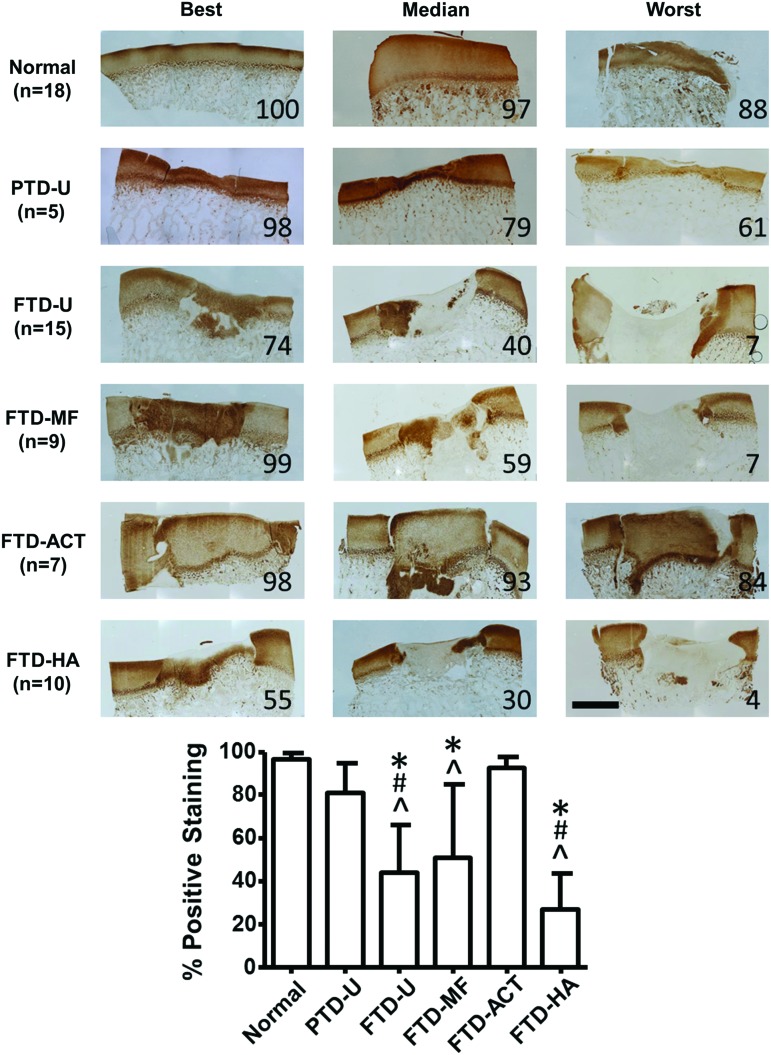
Immunostaining for collagen type II showing entire defect and adjacent normal tissue for partial- or full-thickness cartilage defects and treatment with microfracture, replacement with articular cartilage, or treatment with an HA hydrogel. Numbers within images and the graph at the bottom indicate the percentage of positive staining within the defect (scale bar=2 mm, 100=best, 0=worst, *p<0.05 vs. normal, #p<0.05 vs. PTD-U, and ^p<0.05 vs. FTD-ACT). Color images available online at www.liebertpub.com/tea
<b>FIG. 8.</b>
FIG. 8.
Heat maps showing the axial stress in the defect, cartilage, and bone immediately after compression (A). Stresses under (red arrow) and away from (black arrow) the defect for the various groups as a function of distance from the cartilage/bone interface (B). Color images available online at www.liebertpub.com/tea

References

    1. Widuchowski W., Widuchowski J., and Trzaska T.Articular cartilage defects: Study of 25,124 knee arthroscopies. Knee 14,177, 2007 - PubMed
    1. Curl W.W., Krome J., Gordon E.S., Rushing J., Smith B.P., and Poehling G.G.Cartilage injuries: a review of 31,516 knee arthroscopies. Arthroscopy 13,456, 1997 - PubMed
    1. Heir S., Nerhus T.K., Rotterud J.H., Loken S., Ekeland A., Engebretsen L., and Aroen A.Focal cartilage defects in the knee impair quality of life as much as severe osteoarthritis: a comparison of knee injury and osteoarthritis outcome score in 4 patient categories scheduled for knee surgery. Am J Sports Med 38,231, 2010 - PubMed
    1. Guettler J.H., Demetropoulos C.K., Yang K.H., and Jurist K.A.Osteochondral defects in the human knee: influence of defect size on cartilage rim stress and load redistribution to surrounding cartilage. Am J Sports Med 32,1451, 2004 - PubMed
    1. Wang Y., Ding C., Wluka A.E., Davis S., Ebeling P.R., Jones G., and Cicuttini F.M.Factors affecting progression of knee cartilage defects in normal subjects over 2 years. Rheumatology (Oxford) 45,79, 2006 - PubMed

Publication types

LinkOut - more resources