


VMAT planning study in rectal cancer patients
- PMID: 25319073
- PMCID: PMC4205282
- DOI: 10.1186/s13014-014-0219-1
VMAT planning study in rectal cancer patients
Abstract
Background: To compare the dosimetric differences among fixed field intensity-modulated radiation therapy (IMRT), single-arc volumetric-modulated arc therapy (SA-VMAT) and double-arc volumetric-modulated arc therapy (DA-VMAT) plans in rectal cancer.
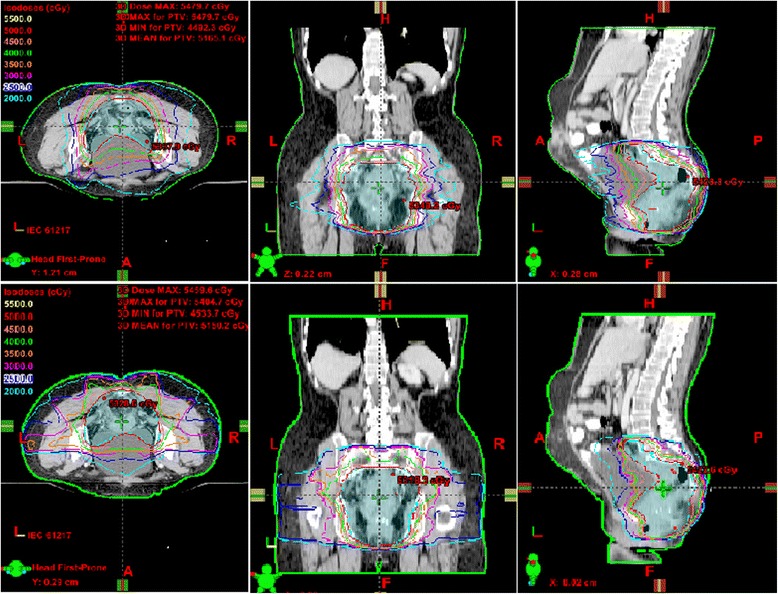
Method: Fifteen patients with rectal cancer previously treated with IMRT in our institution were selected for this study. For each patient, three plans were generated with the planning CT scan: one using a fixed beam IMRT, and two plans using the VMAT technique: SA-VMAT and DA-VMAT. Dose prescription to the PTV was 50 Gy in 2 Gy per fraction. Dose volume histograms (DVH) for the target volume and the organs at risk (small bowel, bladder, femoral heads and healthy tissue) were compared for these different techniques. Monitor units (MU) and delivery treatment time were also reported.
Results: DA-VMAT achieved the highest minimum planning target volume (PTV) dose and the lowest maximal dose, resulting in the most homogeneous PTV dose distribution. DA-VMAT also yielded the best CI, although the difference was not statistically significant. Between SA-VMAT and IMRT, the target dose coverage was largely comparable; however, SA-VMAT was able to achieve a better V95 and V107. VMAT showed to be inferior to IMRT in terms of organ at risk sparing, especially for the small bowel. Compared with IMRT, DA-VMAT increased the V15 of small bowel nearly 55 cc. The MU and treatment delivery time were significantly reduced by the use of VMAT techniques.
Conclusion: VMAT is a new radiation technique that combines the ability to achieve highly conformal dose distributions with highly efficient treatment delivery. Considering the inferior role of normal tissue sparing, especially for small bowel, VMAT need further investigation in rectal cancer treatment.
Figures


References
-
- Guerrero Urbano MT, Henrys AJ, Adams EJ, Norman AR, Bedford JL, Harrington KJ, Nutting CM, Dearnaley DP, Tait DM. Intensity-modulated radiotherapy in patients with locally advanced rectal cancer reduces volume of bowel treated to high dose levels. Int J Radiat Oncol Biol Phys. 2006;65(3):907–916. doi: 10.1016/j.ijrobp.2005.12.056. - DOI - PubMed
-
- Arbea L, Ramos LI, Martínez-Monge R, Moreno M, Aristu J. Intensity-modulated radiation therapy (IMRT) vs. 3D conformal radiotherapy (3DCRT) in locally advanced rectal cancer (LARC): dosimetric comparison and clinical implications. Radiat Oncol. 2010;5:17. doi: 10.1186/1748-717X-5-17. - DOI - PMC - PubMed
-
- Mok H, Crane CH, Palmer MB, Briere TM, Beddar S, Delclos ME, Krishnan S, Das P. Intensity modulated radiation therapy (IMRT): differences in target volumes and improvement in clinically relevant doses to small bowel in rectal carcinoma. Radiat Oncol. 2011;6:63. doi: 10.1186/1748-717X-6-63. - DOI - PMC - PubMed
Publication types
MeSH terms
LinkOut - more resources
Full Text Sources
Other Literature Sources
Research Materials
