


Floral volatile alleles can contribute to pollinator-mediated reproductive isolation in monkeyflowers (Mimulus)
- PMID: 25319242
- PMCID: PMC4268329
- DOI: 10.1111/tpj.12702
Floral volatile alleles can contribute to pollinator-mediated reproductive isolation in monkeyflowers (Mimulus)
Abstract
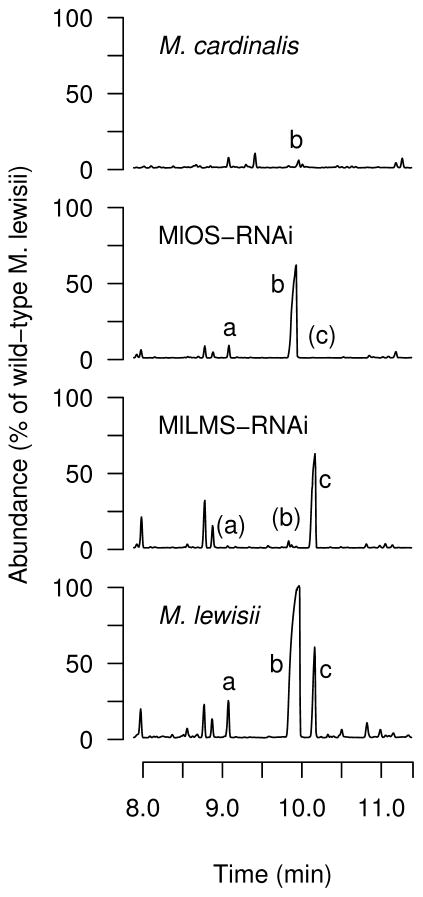
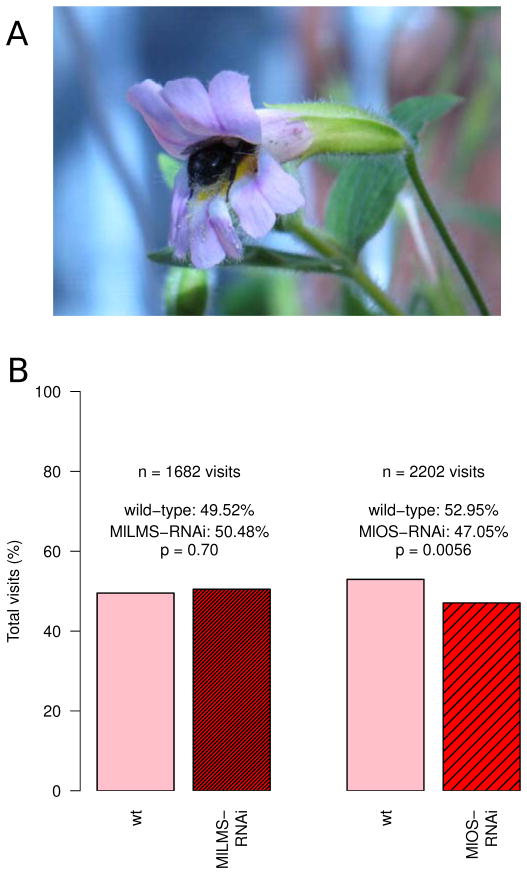
Pollinator-mediated reproductive isolation is a major factor in driving the diversification of flowering plants. Studies of floral traits involved in reproductive isolation have focused nearly exclusively on visual signals, such as flower color. The role of less obvious signals, such as floral scent, has been studied only recently. In particular, the genetics of floral volatiles involved in mediating differential pollinator visitation remains unknown. The bumblebee-pollinated Mimulus lewisii and hummingbird-pollinated Mimulus cardinalis are a model system for studying reproductive isolation via pollinator preference. We have shown that these two species differ in three floral terpenoid volatiles - d-limonene, β-myrcene, and E-β-ocimene - that are attractive to bumblebee pollinators. By genetic mapping and in vitro analysis of enzyme activity we demonstrate that these interspecific differences are consistent with allelic variation at two loci, LIMONENE-MYRCENE SYNTHASE (LMS) and OCIMENE SYNTHASE (OS). Mimulus lewisii LMS (MlLMS) and OS (MlOS) are expressed most strongly in floral tissue in the last stages of floral development. Mimulus cardinalis LMS (McLMS) is weakly expressed and has a nonsense mutation in exon 3. Mimulus cardinalis OS (McOS) is expressed similarly to MlOS, but the encoded McOS enzyme produces no E-β-ocimene. Recapitulating the M. cardinalis phenotype by reducing the expression of MlLMS by RNA interference in transgenic M. lewisii produces no behavioral difference in pollinating bumblebees; however, reducing MlOS expression produces a 6% decrease in visitation. Allelic variation at the OCIMENE SYNTHASE locus is likely to contribute to differential pollinator visitation, and thus promote reproductive isolation between M. lewisii and M. cardinalis. OCIMENE SYNTHASE joins a growing list of 'speciation genes' ('barrier genes') in flowering plants.
Keywords: Mimulus cardinalis; Mimulus lewisii; floral volatiles; pollination; speciation; terpene synthase.
© 2014 The Authors The Plant Journal © 2014 John Wiley & Sons Ltd.
Figures


References
-
- Beardsley PM, Yen A, Olmstead RG. AFLP phylogeny of Mimulus section Erythranthe and the evolution of hummingbird pollination. Evolution. 2003;57(6):1397–1410. - PubMed
-
- Bogdany FJ, Taber S., III The significance of odor for bees orienting across a canyon. Apidologie. 1979;10(1):55–62.
-
- Bohlmann J, Martin D, Oldham NJ, Gershenzon J. Terpenoid secondary metabolism in Arabidopsis thaliana: cDNA cloning, characterization, and functional expression of a myrcene/(E)-β-ocimene synthase. Arch Biochem Biophys. 2000;375(2):261–269. - PubMed
Publication types
MeSH terms
Substances
Grants and funding
LinkOut - more resources
Full Text Sources
Other Literature Sources
