


Role of interleukin-6 in cachexia: therapeutic implications
- PMID: 25319274
- PMCID: PMC4323347
- DOI: 10.1097/SPC.0000000000000091
Role of interleukin-6 in cachexia: therapeutic implications
Abstract
Purpose of review: Interleukin-6 (IL-6) has emerged as a cytokine involved in cachexia progression with some cancers. This review will present the recent breakthroughs in animal models and humans related to targeting IL-6 as a cancer cachexia therapy.
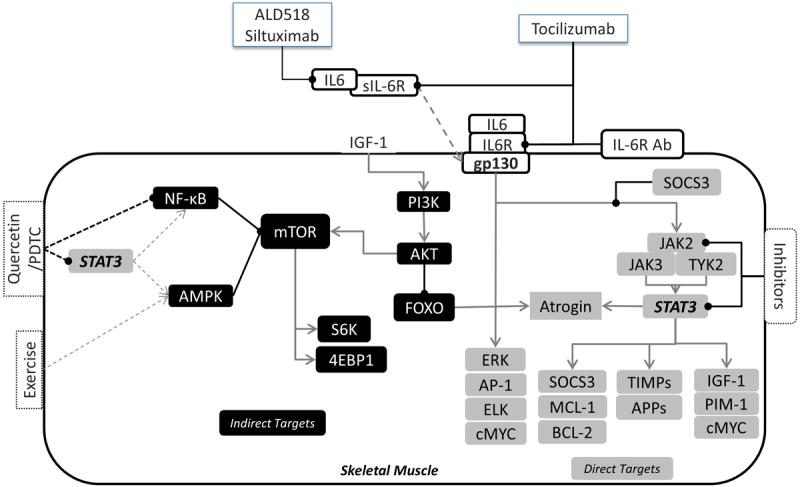
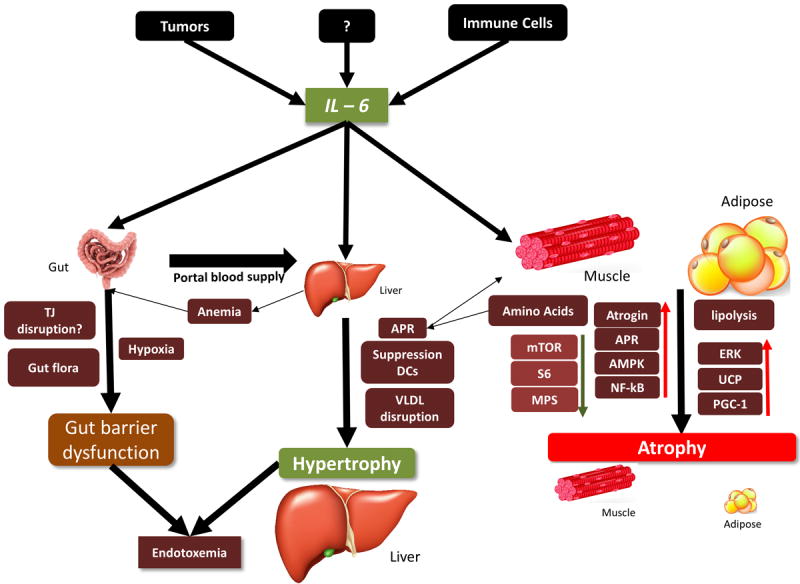
Recent findings: IL-6 can target adipose, skeletal muscle, gut, and liver tissue, which can all affect cachectic patient recovery. IL-6 trans-signaling through the soluble IL-6R has the potential to amplify IL-6 signaling in the cachectic patient. In the skeletal muscle, chronic IL-6 exposure induces proteasome and autophagy protein degradation pathways that lead to wasting. IL-6 is also indirectly associated with AMP-activated kinase (AMPK) and nuclear factor kappa B (NF-κB) activation. Several mouse cancer models have clearly demonstrated that blocking IL-6 and associated signaling can attenuate cachexia progression. Additionally, pharmaceuticals targeting IL-6 and associated signaling can relieve some cachectic symptoms in cancer patients. Research with cachectic mice has demonstrated that exercise and nutraceutical administration can interact with chronic IL-6 signaling during cachexia progression.
Summary: IL-6 remains a promising therapeutic strategy for attenuating cachexia progression with many types of cancer. However, improvement of this treatment will require a better understanding of the indirect and direct effects of IL-6 as well as its tissue-specific actions in the cancer patient.
Conflict of interest statement
There are no conflicts of interest.
Figures
References
-
- Fearon KC, Glass DJ, Guttridge DC. Cancer cachexia: mediators, signaling, and metabolic pathways. Cell Metab. 2012 Aug 8;16(2):153–66. - PubMed
-
- Ando K, Takahashi F, Motojima S, et al. Possible role for tocilizumab, an anti-interleukin-6 receptor antibody, in treating cancer cachexia. J Clin Oncol. 2013 Feb 20;31(6):e69–72. - PubMed
-
- Gallagher IJ, Stephens NA, MacDonald AJ, et al. Suppression of skeletal muscle turnover in cancer cachexia: evidence from the transcriptome in sequential human muscle biopsies. Clinical cancer research : an official journal of the American Association for Cancer Research. 2012 May 15;18(10):2817–27. Research Support, Non-U.S Gov’t. - PubMed
Publication types
MeSH terms
Substances
Grants and funding
LinkOut - more resources
Full Text Sources
Other Literature Sources
Research Materials
Miscellaneous
