Review
. 2014 Nov;262(1):113-33.
doi: 10.1111/imr.12221.

Macrophage proliferation, provenance, and plasticity in macroparasite infection

Affiliations
Free PMC article
Review

Macrophage proliferation, provenance, and plasticity in macroparasite infection

Dominik Rückerl et al. Immunol Rev. 2014 Nov.
Free PMC article

Abstract

Macrophages have long been center stage in the host response to microbial infection, but only in the past 10-15 years has there been a growing appreciation for their role in helminth infection and the associated type 2 response. Through the actions of the IL-4 receptor α (IL-4Rα), type 2 cytokines result in the accumulation of macrophages with a distinctive activation phenotype. Although our knowledge of IL-4Rα-induced genes is growing rapidly, the specific functions of these macrophages have yet to be established in most disease settings. Understanding the interplay between IL-4Rα-activated macrophages and the other cellular players is confounded by the enormous transcriptional heterogeneity within the macrophage population and by their highly plastic nature. Another level of complexity is added by the new knowledge that tissue macrophages can be derived either from a resident prenatal population or from blood monocyte recruitment and that IL-4 can increase macrophage numbers through proliferative expansion. Here, we review current knowledge on the contribution of macrophages to helminth killing and wound repair, with specific attention paid to distinct cellular origins and plasticity potential.

Keywords: IL-4 receptor; helminth infection; inflammation; macrophage; monocyte; wound repair.


Figures

Fig 1
Fig 1
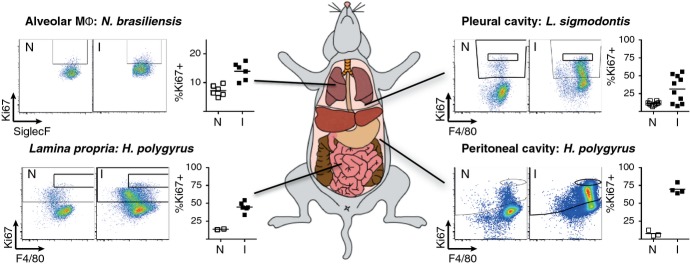
Proliferative expansion of macrophages (MΦ) is induced in various helminth infection models. Representative dotplots of one naive (N) and one infected (I) animal shown. Graphs indicate percent of F4/80+ macrophages that are Ki67+. Data points depict individual animals. Detailed description of materials and methods used in similar experiments can be found in Jenkins et al. . Data from N. brasiliensis infected alveolar macrophages isolated from whole tissue digests (CD11blow SiglecF+ F4/80+ CD11chigh) kindly provided by Dr. Tara E. Sutherland.
Fig 2
Fig 2
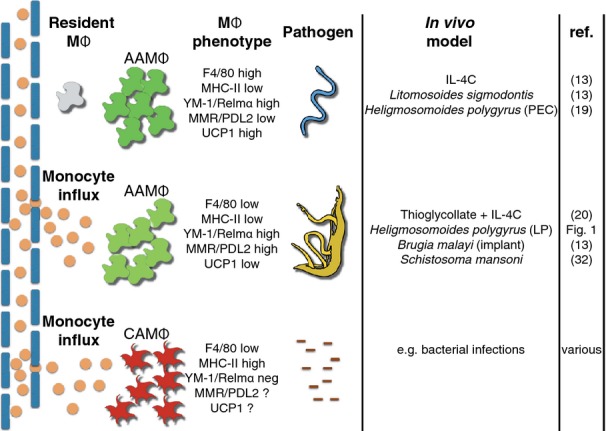
In vivo recruitment/expansion of macrophages (MΦ) is dependent on the infectious agent. Macrophage numbers can expand in the tissues either due to recruitment, proliferation, or a combination of both. This figure illustrates different infection models or experimental manipulations that can lead to these distinct outcomes.
Fig 3
Fig 3
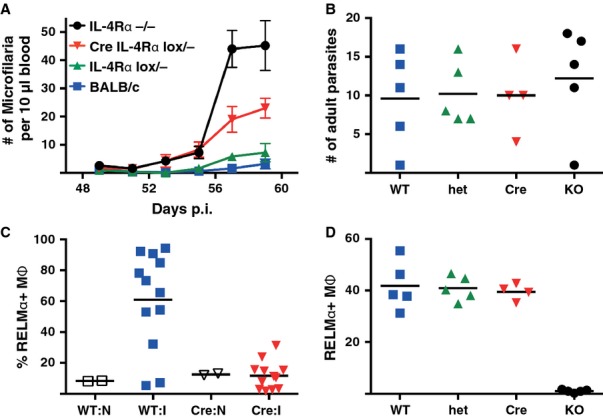
Expression of IL-4Rα by myeloid cells is required for optimal immune responses to filarial infection. BALB/c (blue squares; WT), IL-4Rα-deficient (black circles; KO), IL-4Rα heterozygous (green upward triangles; het), or LysMCre IL-4Rα flox/− (red downward triangles; Cre) were infected by subcutaneous injection of 25 L. sigmodontis L3 stage larvae. (A) At the indicated time points, 10 μl venous blood were collected from each mouse and the number of microfilaria present assessed by microscopic analysis. Data points indicate mean and SEM of 4–5 mice per group. (B) Number of adult parasites present in the pleural cavity of the mice analyzed in (A), 60 days after infection. Data points indicate individual animals and lines indicate mean. (C) Percent Relm-α expressing macrophages 10 days postinfection in naive (N) or infected (I) BALB/c (WT) or LysMCre IL-4Rα flox/− (Cre) mice. (D) Percent Relm-α expressing macrophages in the mice analyzed in A, 60 days postinfection. Detailed description of materials and methods used in similar experiments can be found in van der Werf et al. (A, B) and in Jenkins et al. (C, D).
Fig 4
Fig 4
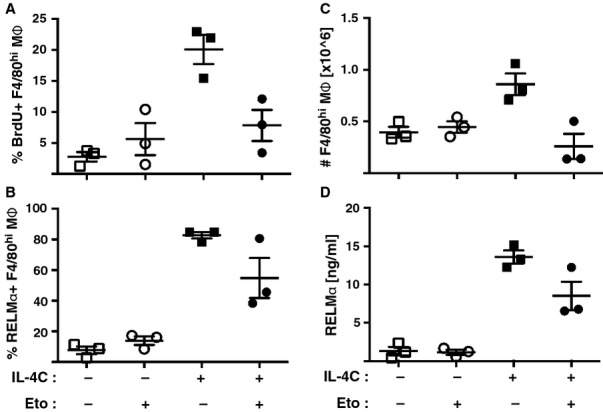
Inhibition of fatty acid oxidation blocks macrophage alternative activation and proliferation in vivo. C57BL/6 mice were injected i.p. with 0.5 mg Etomoxir (Eto, Sigma Aldrich) to inhibit fatty acid oxidation 1 h prior to treatment with IL-4C. Detailed description of similar experiments can be found in Ruckerl et al. . (A) 24 h later, the proliferative expansion of F4/80high cells was determined by 3hr-BrdU pulse and flow cytometry. Data points indicate individual animals, and lines indicate mean. (B) Intracellular RELMα expression in the cells analyzed in (A). (C) Number of F4/80high cells present in the pleural cavity of the mice analyzed in (A). (D) Concentration of RELMα in the lavage fluid isolated from the pleural cavity of the mice analyzed in (A).

References

    1. Hausdorf B. Early evolution of the bilateria. Syst Biol. 2000;49:130–142. - PubMed
    1. Allen JE, Wynn TA. Evolution of Th2 immunity: a rapid repair response to tissue destructive pathogens. PLoS Pathog. 2011;7:e1002003. - PMC - PubMed
    1. Hotez PJ, Brindley PJ, Bethony JM, King CH, Pearce EJ, Jacobson J. Helminth infections: the great neglected tropical diseases. J Clin Invest. 2008;118:1311–1321. - PMC - PubMed
    1. Lustigman S, et al. A research agenda for helminth diseases of humans: the problem of helminthiases. PLoS Negl Trop Dis. 2012;6:e1582. - PMC - PubMed
    1. Crompton DWT, Nesheim MC. Nutritional impact of intestinal helminthiasis during the human life cycle. Annu Rev Nutr. 2002;22:35–59. - PubMed

Publication types