. 2014 Dec;23(23):5904-17.
doi: 10.1111/mec.12966. Epub 2014 Nov 5.

Hive-stored pollen of honey bees: many lines of evidence are consistent with pollen preservation, not nutrient conversion

Affiliations
Free PMC article

Hive-stored pollen of honey bees: many lines of evidence are consistent with pollen preservation, not nutrient conversion

Kirk E Anderson et al. Mol Ecol. 2014 Dec.
Free PMC article

Erratum in

  • Mol Ecol. 2015 Feb;24(3):698. Lanan, Michele C [added]

Abstract

Honey bee hives are filled with stored pollen, honey, plant resins and wax, all antimicrobial to differing degrees. Stored pollen is the nutritionally rich currency used for colony growth and consists of 40-50% simple sugars. Many studies speculate that prior to consumption by bees, stored pollen undergoes long-term nutrient conversion, becoming more nutritious 'bee bread' as microbes predigest the pollen. We quantified both structural and functional aspects associated with this hypothesis using behavioural assays, bacterial plate counts, microscopy and 454 amplicon sequencing of the 16S rRNA gene from both newly collected and hive-stored pollen. We found that bees preferentially consume fresh pollen stored for <3 days. Newly collected pollen contained few bacteria, values which decreased significantly as pollen were stored >96 h. The estimated microbe to pollen grain surface area ratio was 1:1 000 000 indicating a negligible effect of microbial metabolism on hive-stored pollen. Consistent with these findings, hive-stored pollen grains did not appear compromised according to microscopy. Based on year round 454 amplicon sequencing, bacterial communities of newly collected and hive-stored pollen did not differ, indicating the lack of an emergent microbial community co-evolved to digest stored pollen. In accord with previous culturing and 16S cloning, acid resistant and osmotolerant bacteria like Lactobacillus kunkeei were found in greatest abundance in stored pollen, consistent with the harsh character of this microenvironment. We conclude that stored pollen is not evolved for microbially mediated nutrient conversion, but is a preservative environment due primarily to added honey, nectar, bee secretions and properties of pollen itself.

Keywords: Lactobacillus kunkeei; bee bread; fermentation; honey; microbes; nutrition.


Figures

Figure 1
Figure 1
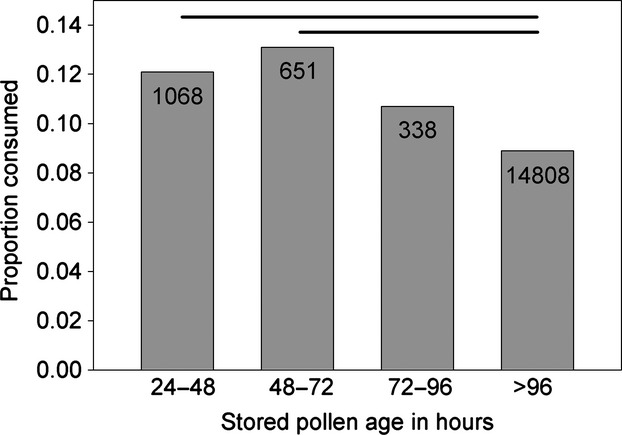
Honey bees prefer to consume pollen stored less than 72 h. Graph depicts combined results from 23 colonies, and three separate week long trials. Within each vertical bar is the total number of pollen containing cells from each storage age available for consumption. Horizontal bars are significant differences between pollen age groups. Bees preferentially consumed recently collected pollen based on a Z-test for proportions (24- to 48-h-old pollen; Z = −3.43; two-tailed P = 0.0006, 48- to 72-h-old pollen; Z = −3.56; two-tailed P = 0.0004).
Figure 2
Figure 2
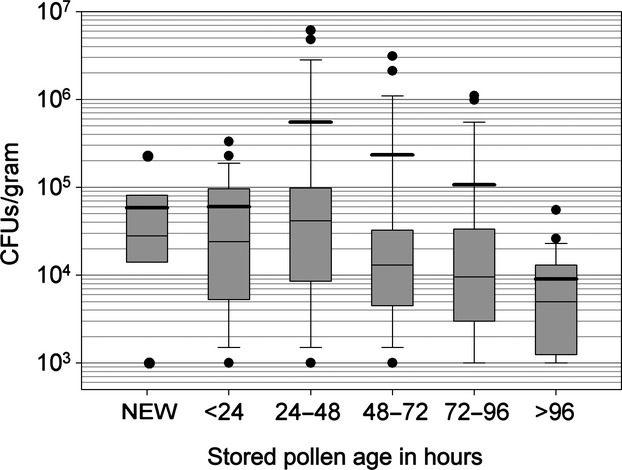
Bacterial abundance decreases with increased pollen storage time. Y-axis is colony-forming units (CFUs per gram) of pollen stored for 1–5 days within active colonies. NEW represents corbicular pollen removed from the legs of returning foragers (n = 8). Values that compose each stored pollen box-plot (n = 24) include average replicate counts from both media types and all plates showing growth above the lowest dilution factor (10−3). All outliers are shown, the median is a horizontal line within the grey box, and the bold black line represents the mean. Regression analysis revealed a significant negative relationship between bacterial counts and pollen storage time following data normalization and removal of statistical outliers (Adj Rsq = 0.15; F = 21.2; P < 0.0001). See Figure S1 (Supporting information) for results partitioned by media type.
Figure 3
Figure 3
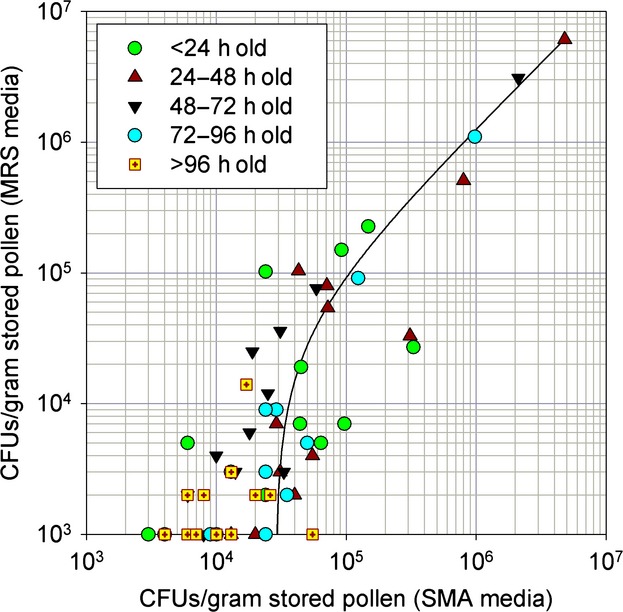
Selective and nonselective media produce similar results above 105 CFUs/gram. Total bacterial counts expressed as colony-forming units (CFUs per gram) of stored pollen aged from 1 to 5 days (see key). Graph is scaled by common log. Bacteria were grown on both nonselective (SMA) and Lactobacillus selective media (MRS). Each data point (symbol) represents the average plate count from three replicate plates and two media.
Figure 4
Figure 4
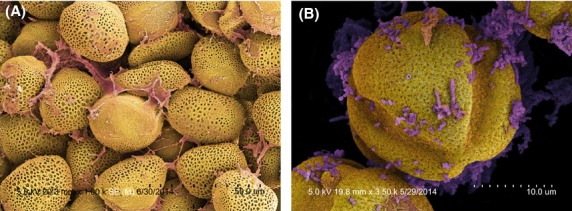
Hive-stored pollen lacks the microbial biomass needed to alter pollen nutrition. Scanning electron micrograph of hive-stored pollen (A), which contains 40–50% simple sugars by weight (pink hue), but only one microbe for every 2500 pollen grains (3.6 × 104 bacteria per gram), many orders of magnitude below that required for pollen predigestion. Shown for contrast and mathematical rigour, images from the hindgut (B) reveal hundreds of bacteria (purple) per pollen grain (4.9 × 109 bacteria per gram, see also; Rada et al. 1997; Kacániová et al. 2004).
Figure 5
Figure 5
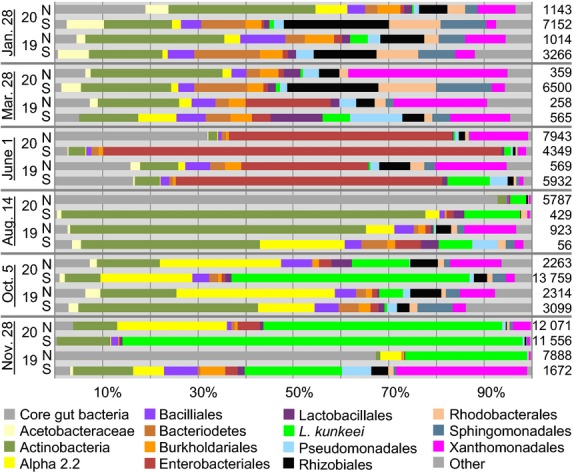
Bacterial communities of newly collected and hive-stored pollen are most similar by season. Relative proportions of bacterial taxa in newly collected (N) and hive-stored (S) pollen from two colonies (19 and 20) sampled at six discrete time points over the course of a year. For each of the pollen associated bacterial libraries, the proportion of sequences belonging to various bacterial taxa is shown as different colours. Grey represents both core gut bacteria (far left) and bacteria occurring at low frequency (far right). Total read number is displayed to the right of each individual library. permanovag analysis based on variance adjusted weighted and generalized pairwise unifrac distances reveals a significant effect of season on bacterial community composition (F5,23 = 2.66; P = 0.001).

References

    1. Ahn J-H, Hong I-P, Bok J-I, et al. Pyrosequencing analysis of the bacterial communities in the guts of honey bees Apis cerana and Apis mellifera in Korea. Journal of Microbiology. 2012;50:735–745. - PubMed
    1. Aizenberg-Gershtein Y, Izhaki I, Halpern M. Do honeybees shape the bacterial community composition in floral nectar? PLoS ONE. 2013;8:e67556. - PMC - PubMed
    1. Aleklett K, Hart M, Shade A. The microbial ecology of flowers: an emerging frontier in phyllosphere research. Botany-Botanique. 2014;92:253–266.
    1. Alvarez-Pérez S, Herrera CM, de Vega C. Zooming-in on floral nectar: a first exploration of nectar-associated bacteria in wild plant communities. FEMS Microbiology Ecology. 2012;80:591–602. - PubMed
    1. Amdam GV, Omholt SW. The regulatory anatomy of honeybee lifespan. Journal of Theoretical Biology. 2002;216:209–228. - PubMed

Publication types

Associated data