Review
. 2014 Oct 15;28(20):2189-204.
doi: 10.1101/gad.250167.114.

Human high-altitude adaptation: forward genetics meets the HIF pathway

Affiliations
Review

Human high-altitude adaptation: forward genetics meets the HIF pathway

Abigail W Bigham et al. Genes Dev. .

Abstract

Humans have adapted to the chronic hypoxia of high altitude in several locations, and recent genome-wide studies have indicated a genetic basis. In some populations, genetic signatures have been identified in the hypoxia-inducible factor (HIF) pathway, which orchestrates the transcriptional response to hypoxia. In Tibetans, they have been found in the HIF2A (EPAS1) gene, which encodes for HIF-2α, and the prolyl hydroxylase domain protein 2 (PHD2, also known as EGLN1) gene, which encodes for one of its key regulators, PHD2. High-altitude adaptation may be due to multiple genes that act in concert with one another. Unraveling their mechanism of action can offer new therapeutic approaches toward treating common human diseases characterized by chronic hypoxia.

Keywords: EGLN1; HIF; PHD2; Tibetan adaptation; high-altitude adaptation; hypoxia.


Figures

Figure 1.
Figure 1.
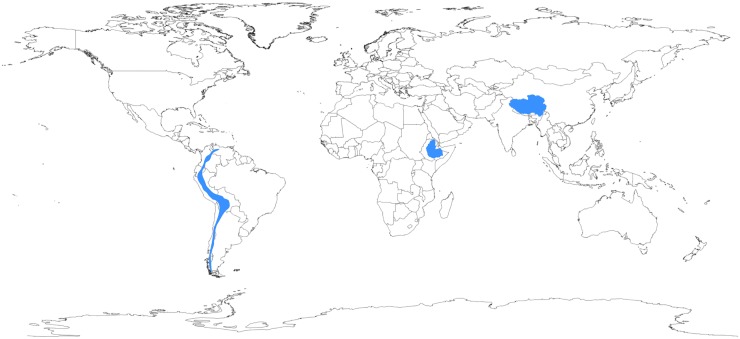
The geography of human adaptation to high altitude. Geographic locations where humans have adapted to life at high altitude are in blue and include (from left to right) the Andean Altiplano, the Semien Plateau, and the Tibetan Plateau. Adapted from Bigham (2008).
Figure 2.
Figure 2.
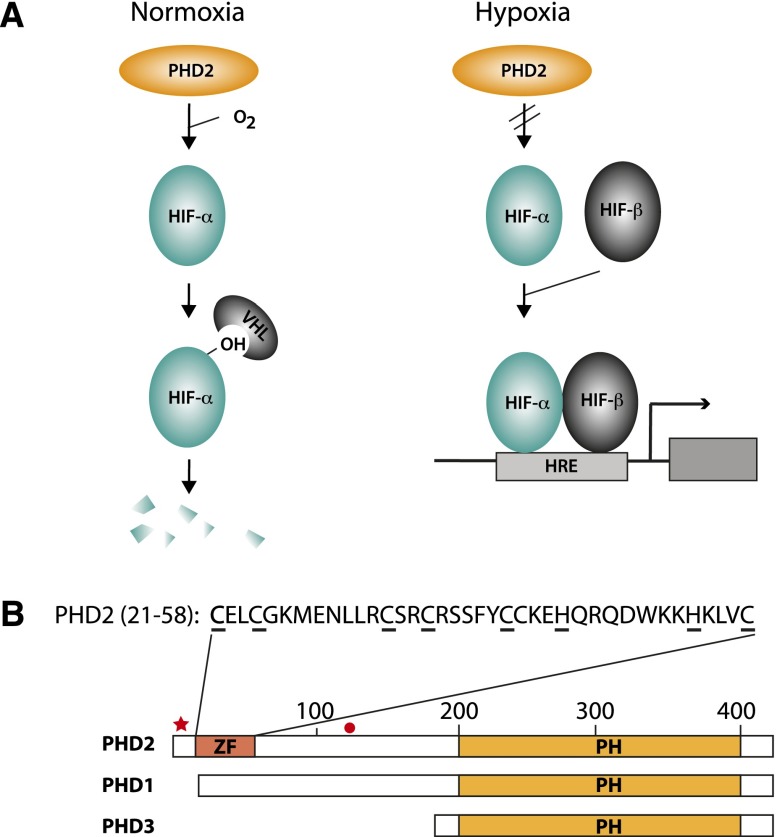
(A) The PHD2:HIF pathway. (Left) Under normoxic conditions, PHD2 constitutively prolyl hydroxylates HIF-α, targeting it for degradation in a VHL-dependent manner. (Right) Under hypoxic conditions, the hydroxylation is arrested, allowing HIF-α stabilization, dimerization with HIF-β, and binding to hypoxia response elements (HREs) that control target genes. (B) The three PHDs. The prolyl hydroxylase (PH) domain resides at the C-terminal end of each paralog. PHD2 is distinctive in harboring a MYND zinc finger (ZF) at its N terminus. The amino acid sequence of this zinc finger (residues 21–58) is shown. Underlines denote predicted zinc chelating residues. The positions of PHD2 Asp4 and Cys127 are indicated by a red star and a black circle, respectively.
Figure 3.
Figure 3.
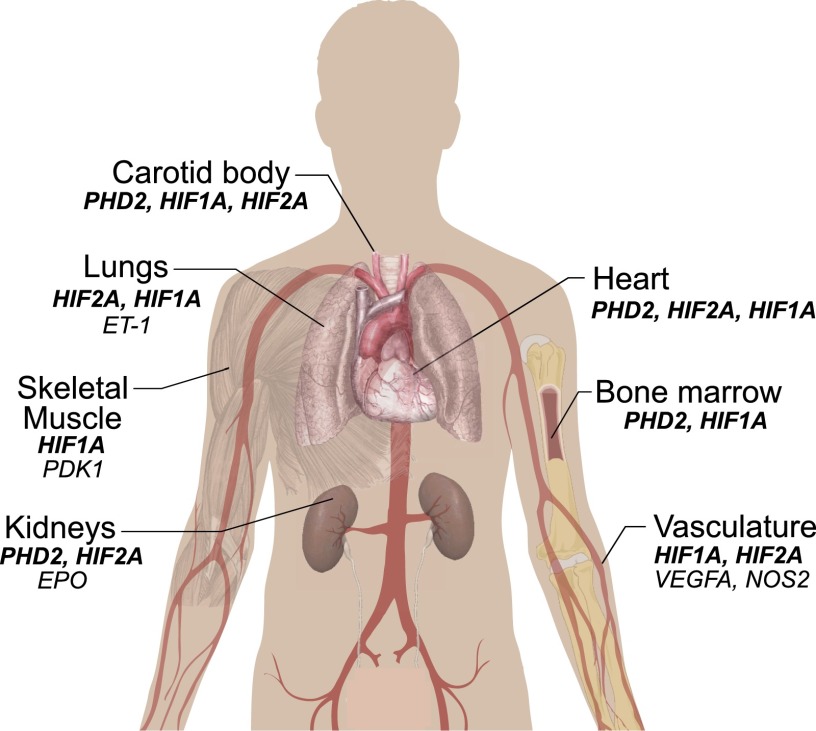
Potential organs involved in high-altitude adaptation, along with select HIF pathway genes (bold italics) and select HIF target genes (nonbold italics) that may be relevant. The genes shown are derived mainly from studies conducted on genetically engineered mice (see Table 2) as well as additional studies on human patients with erythrocytosis.
Figure 4.
Figure 4.
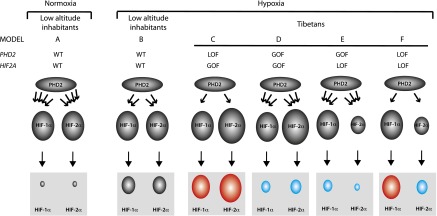
Models for high-altitude adaptation. (Model A) In lowlanders at low altitude, PHD2 constitutively hydroxylates (four arrows between PHD2 and HIF-α) HIF-α, leading to low levels of HIF-α (gray box). (Model B) In lowlanders who ascend to high altitude, PHD2 activity decreases (two arrows), leading to increased HIF-α levels (gray box). Models C–F show various combinations of GOF and LOF PHD2 and HIF2A alleles to potentially explain Tibetan adaptation. The number of arrows emanating from PHD2 indicates hydroxylase activity (one arrow: weak; three arrows: strong), and, immediately below it, the size of HIF-2α indicates whether it is a GOF (larger) or LOF (smaller). The gray boxes at the bottom show the ultimate strength of HIF-α activation resulting from the combined PHD2 and HIF-α activity, with red denoting increased HIF-α activity relative to model B, and blue denoting decreased HIF-α activity relative to model B.

References

    1. Acevedo JM, Centanin L, Dekanty A, Wappner P. 2010. Oxygen sensing in Drosophila: multiple isoforms of the prolyl hydroxylase fatiga have different capacity to regulate HIFα/Sima. PLoS ONE 5: e12390. - PMC - PubMed
    1. Adams WH, Strang LJ. 1975. Hemoglobin levels in persons of Tibetan ancestry living at high altitude. Proc Soc Exp Biol Med 149: 1036–1039 - PubMed
    1. Aggarwal S, Negi S, Jha P, Singh PK, Stobdan T, Pasha MA, Ghosh S, Agrawal A, Prasher B, Mukerji M. 2010. EGLN1 involvement in high-altitude adaptation revealed through genetic analysis of extreme constitution types defined in Ayurveda. Proc Natl Acad Sci 107: 18961–18966 - PMC - PubMed
    1. Al-Sheikh M, Moradkhani K, Lopez M, Wajcman H, Prehu C. 2008. Disturbance in the HIF-1α pathway associated with erythrocytosis: further evidences brought by frameshift and nonsense mutations in the prolyl hydroxylase domain protein 2 (PHD2) gene. Blood Cells Mol Dis 40: 160–165 - PubMed
    1. Anderson ER, Xue X, Shah YM. 2011. Intestinal hypoxia-inducible factor-2α (HIF-2α) is critical for efficient erythropoiesis. J Biol Chem 286: 19533–19540 - PMC - PubMed

Publication types

MeSH terms

Substances

LinkOut - more resources