Review
. 2014 Dec;54(4):369-75.
doi: 10.1007/s12088-014-0498-0. Epub 2014 Sep 30.

Synthetic Biology in Action: Developing a Drug Against MDR-TB

Affiliations
Review

Synthetic Biology in Action: Developing a Drug Against MDR-TB

Anjali Saxena et al. Indian J Microbiol. 2014 Dec.

Abstract

The amalgamation of the research efforts of biologists, chemists and geneticists led by scientists at the Department of Zoology, University of Delhi has resulted in the development of a novel rifamycin derivative; 24-desmethylrifampicin, which is highly effective against multi-drug resistant (MDR) strains of Mycobacterium tuberculosis. The production of rifamycin analogue was facilitated by genetic-synthetic strategies that have opened an interdisciplinary route for the development of more such rifamycin analogues aiming at a better therapeutic potential. The results of this painstaking effort of nearly 25 years of a team of students and scientists led by Professor Rup Lal have been recently published in the Journal of Biological Chemistry (www.jbc.org/content/289/30/21142.long). This strategy can now find applications for developing newer rifamycin analogues that can be harnessed to overcome the problem of MDR, extensively drug resistant (XDR) and totally drug resistant (TDR) M. tuberculosis.

Keywords: 24-desmethylrifamycin; Multidrug resistant Mycobacterium tuberculosis; Rifampicin; Tuberculosis.


Figures
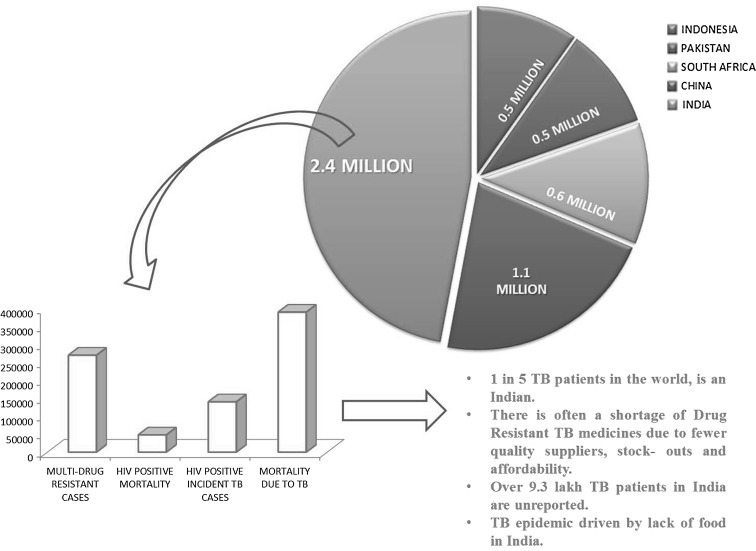
Fig. 1
Fig. 1
An overview of the current scenario of the TB pandemic highlighting the worsening situation in India. The pie chart represents the top five TB burdened countries with 2.4 million cases in India (adapted from WHO Tuberculosis Report-2013)
Fig. 2
Fig. 2
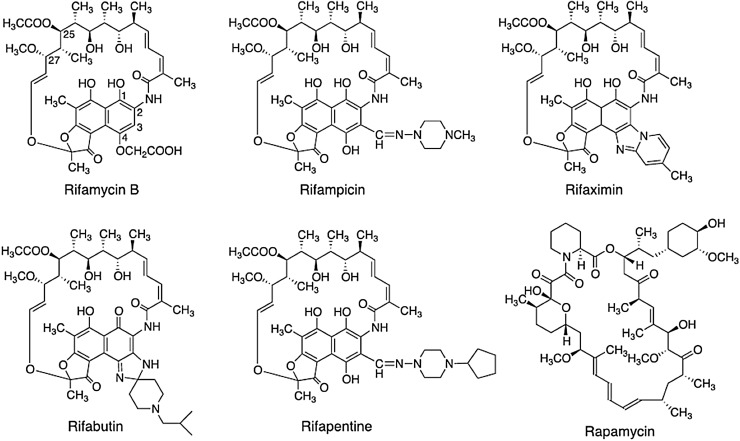
Chemical structures of the semi-synthetic derivatives of Rifamycin B
Fig. 3
Fig. 3
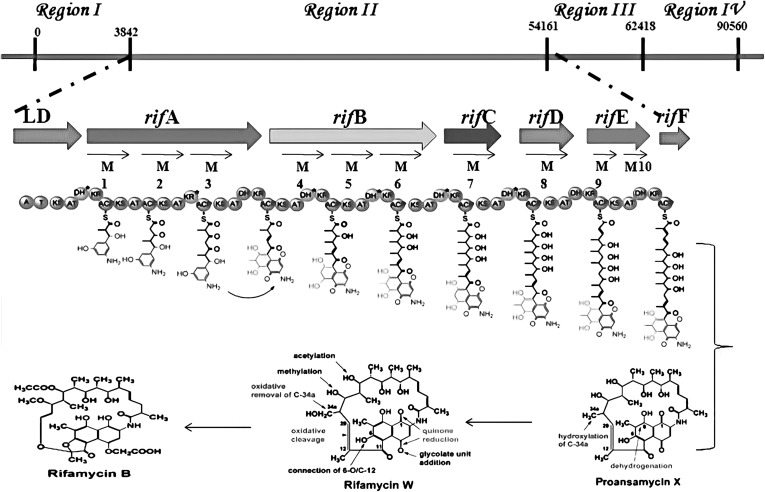
Biosynthetic organization and polyketide chain extension of rifamycin B biosynthesis. The synthesis of the hypothetical intermediate by rifamycin PKS of region II during the biosynthesis of rifamycin B. The chain is assembled of starter unit (AHBA), with two acetate and eight propionate extender units. Rif F, translationally coupled to Rif E, encodes amide synthase and thus displaces the thioesterase linkage of the assembled polyketide chain. Proansamycin X then undergoes post PKS modifications to form rifamycin B
Fig. 4
Fig. 4
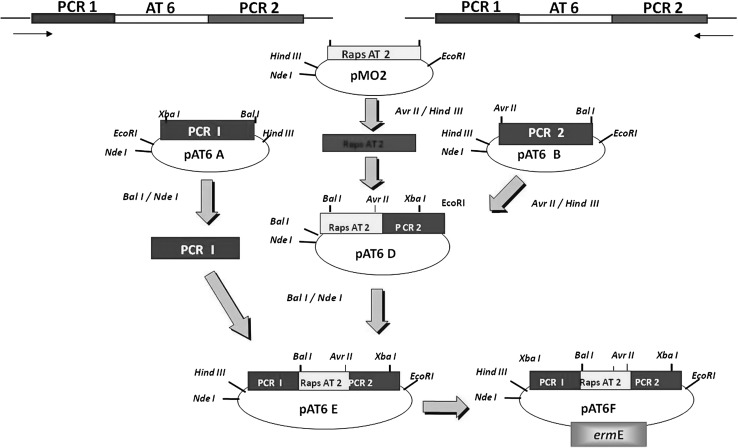
Strategy for the construction of functional cassette pAT6F in the plasmid pIJ4026, which was electroporated into Amycolatopsis mediterranei to swap rifAT6 with rapAT2. The flanking regions immediately upstream (41862–43533 bp-PCRI) and downstream (44488–45989 bp-PCRII) of rifPKS of AT6 domain were amplified using primer pair I, II and primer pair III, IV, respectively to obtain PCR I and PCRII amplified products. PCRI and PCRII were cloned in pUC18 and named as pAT6A and pAT6B, respectively. The plasmid pMO2 was digested to release rapAT2, which was ligated with linearized pAT6B to form plasmid pAT6D. PCRI from pAT6A was digested and ligated into linearized pAT6D to form the plasmid pAT6E. The entire construct PCRI + rapAT2 + PCRII was digested and eluted from pAT8E and finally cloned in the plasmid pIJ4026, which confers erythromycin resistance to the host organism, A. mediterranei S699. This final construct pAT6F was transformed in the wild type strain (A. mediterranei S699)
Fig. 5
Fig. 5
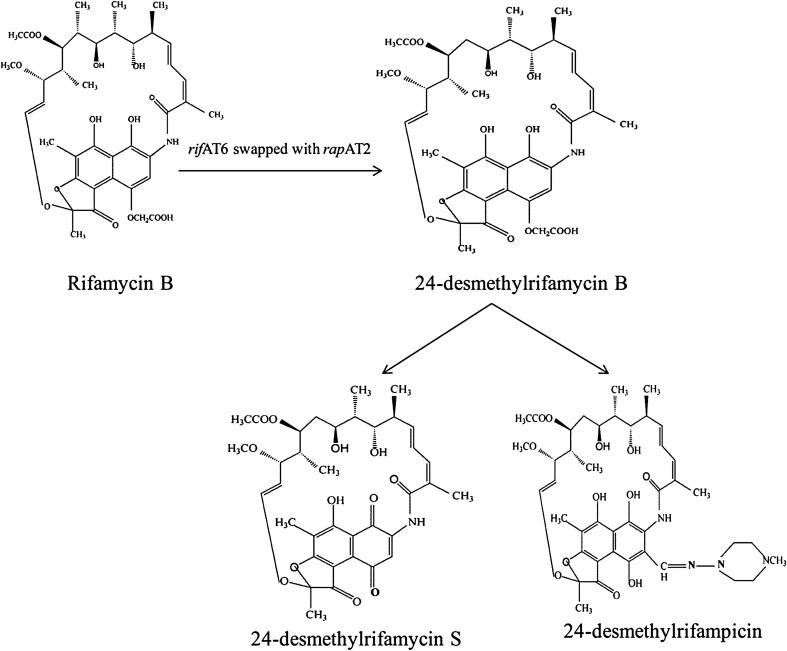
Chemical structures of Rifamycin B and its analogues 24-desemthylrifamycin B, 24-desmethylrifamycin S and 24-desmethylrifampicin (lacking methyl group)

References

    1. Kalia VC, Rani A, Lal S, Cheema S, Raut CP. Combing databases reveals potential antibiotic producers. Expert Opin on Drug Discov. 2007;2:211–224. doi: 10.1517/17460441.2.2.211. - DOI - PubMed
    1. Purohit HJ, Cheema S, Lal S, Raut CP, Kalia VC. In search of drug targets for Mycobacterium tuberculosis. Infect Disord Drug Targets. 2007;7:245–250. doi: 10.2174/187152607782110068. - DOI - PubMed
    1. Global tuberculosis report 2013-www.who.in/tb/publications/global_report/en/
    1. Maggi N, Pasqalucci CR, Ballotta R, Sensi P. Rifampicin: a new orally active rifamycin. Chemotherapea. 1966;11:285–292. doi: 10.1159/000220462. - DOI - PubMed
    1. Wehrli W, Knusel F, Schmid K, Staehelin, M (1968) Interaction of rifamycin with bacterial RNA polymerase. Proc Natl Acad Sci USA 61: 667–673. (http://www.ncbi.nlm.nih.gov/pmc/articles/PMC225211/?page=1) - PMC - PubMed

LinkOut - more resources