


Developing an incident management system to support Ebola response -- Liberia, July-August 2014
- PMID: 25321071
- PMCID: PMC4584751
Developing an incident management system to support Ebola response -- Liberia, July-August 2014
Abstract
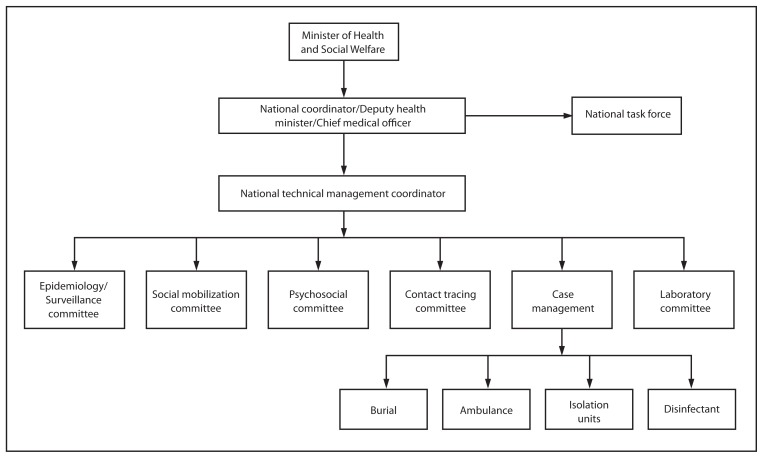
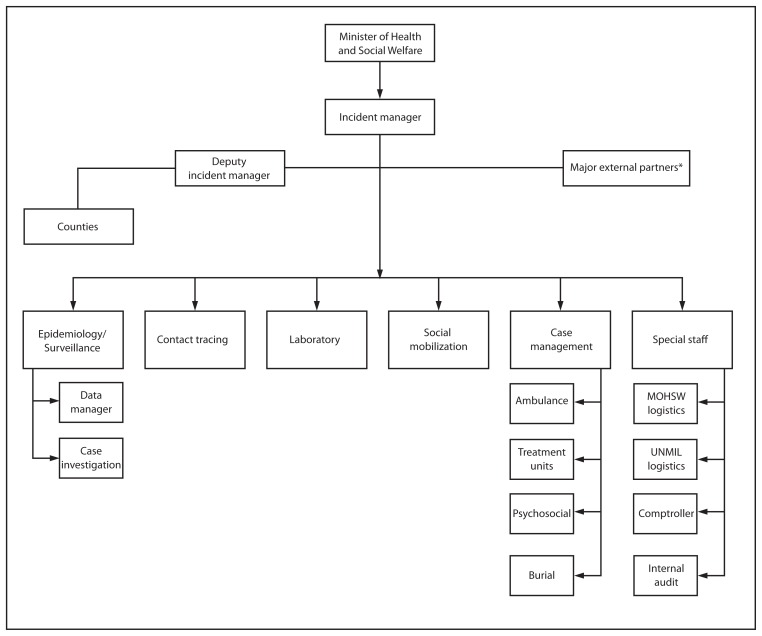
The ongoing Ebola virus disease (Ebola) outbreak in West Africa is the largest and most sustained Ebola epidemic recorded, with 6,574 cases. Among the five affected countries of West Africa (Liberia, Sierra Leone, Guinea, Nigeria, and Senegal), Liberia has had the highest number cases (3,458). This epidemic has severely strained the public health and health care infrastructure of Liberia, has resulted in restrictions in civil liberties, and has disrupted international travel. As part of the initial response, the Liberian Ministry of Health and Social Welfare (MOHSW) developed a national task force and technical expert committee to oversee the management of the Ebola-related activities. During the third week of July 2014, CDC deployed a team of epidemiologists, data management specialists, emergency management specialists, and health communicators to assist MOHSW in its response to the growing Ebola epidemic. One aspect of CDC's response was to work with MOHSW in instituting incident management system (IMS) principles to enhance the organization of the response. This report describes MOHSW's Ebola response structure as of mid-July, the plans made during the initial assessment of the response structure, the implementation of interventions aimed at improving the system, and plans for further development of the response structure for the Ebola epidemic in Liberia.
Figures
References
-
- Incident Management System Ebola Epidemiology Team, CDC; Ministries of Health of Guinea, Sierra Leone, Liberia, Nigeria, and Senegal; Viral Special Pathogens Branch, National Center for Emerging and Zoonotic Infectious Diseases, CDC. Ebola virus disease outbreak—West Africa, September 2014. MMWR. 2014;63:865–6. - PMC - PubMed
-
- CDC. Ebola in Liberia. Atlanta, GA: US Department of Health and Human Services, CDC; 2014. Available at http://wwwnc.cdc.gov/travel/notices/warning/ebola-liberia.
-
- Emergency Management Institute. ICS review document. Washington, DC: US Department of Homeland Security, Federal Emergency Management Agency, Emergency Management Institute; 2008. Available at http://www.training.fema.gov/emiweb/is/icsresource/assets/reviewmaterial....
-
- Ministry of Health and Social Welfare (Liberia) Department of Health Services. Monrovia, Liberia: Ministry of Health and Social Welfare, Department of Health Services; 2014. Available at http://www.mohsw.gov.lr/content_display.php?submenu_id=60&sub=submenu.
MeSH terms
LinkOut - more resources
Full Text Sources
Medical
Research Materials
