Quantitative technique for robust and noise-tolerant speed measurements based on speckle decorrelation in optical coherence tomography
- PMID: 25322018
- PMCID: PMC4247190
- DOI: 10.1364/OE.22.024411
Quantitative technique for robust and noise-tolerant speed measurements based on speckle decorrelation in optical coherence tomography
Abstract
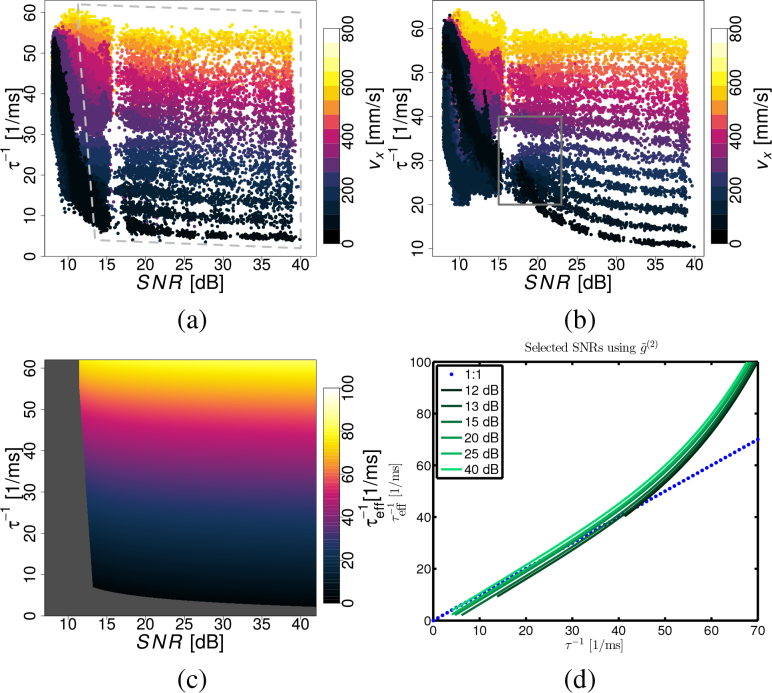
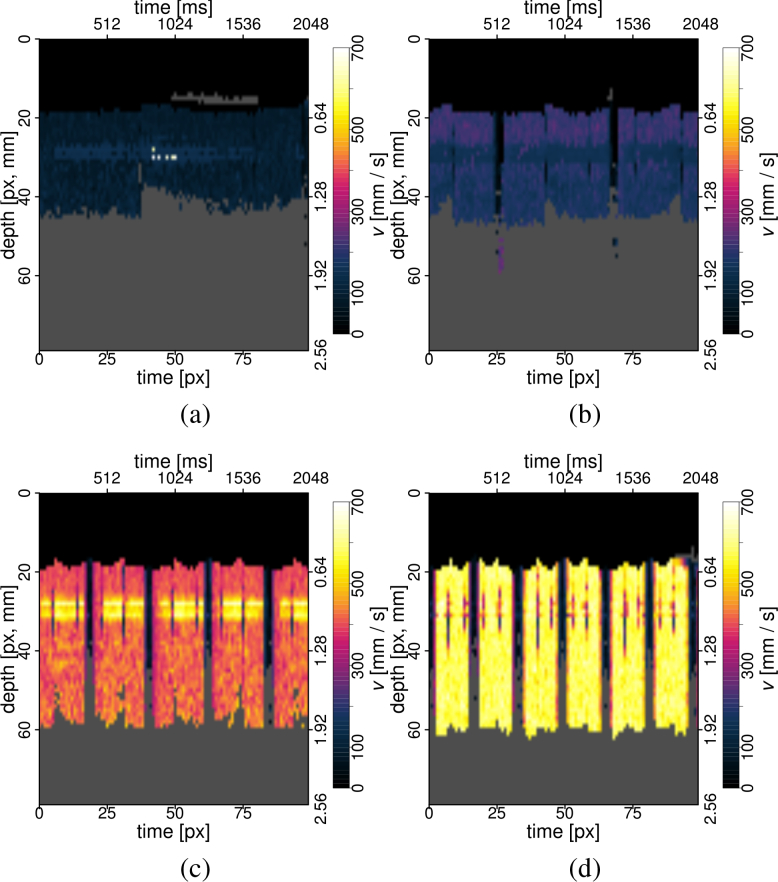
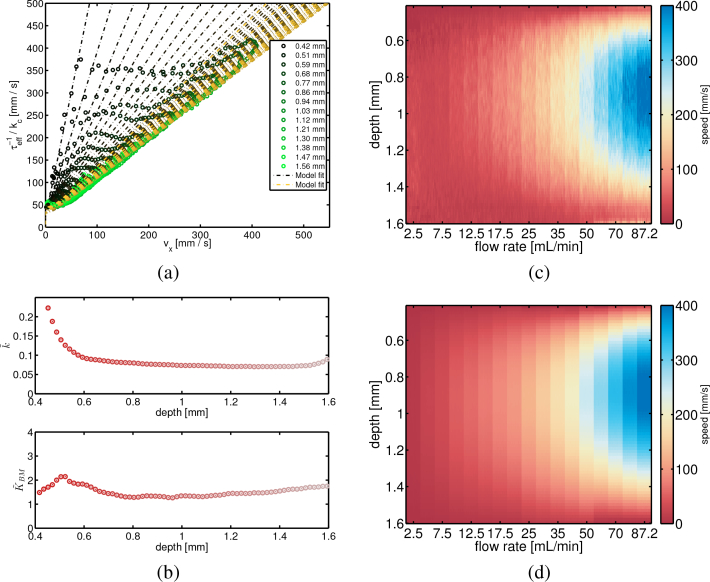
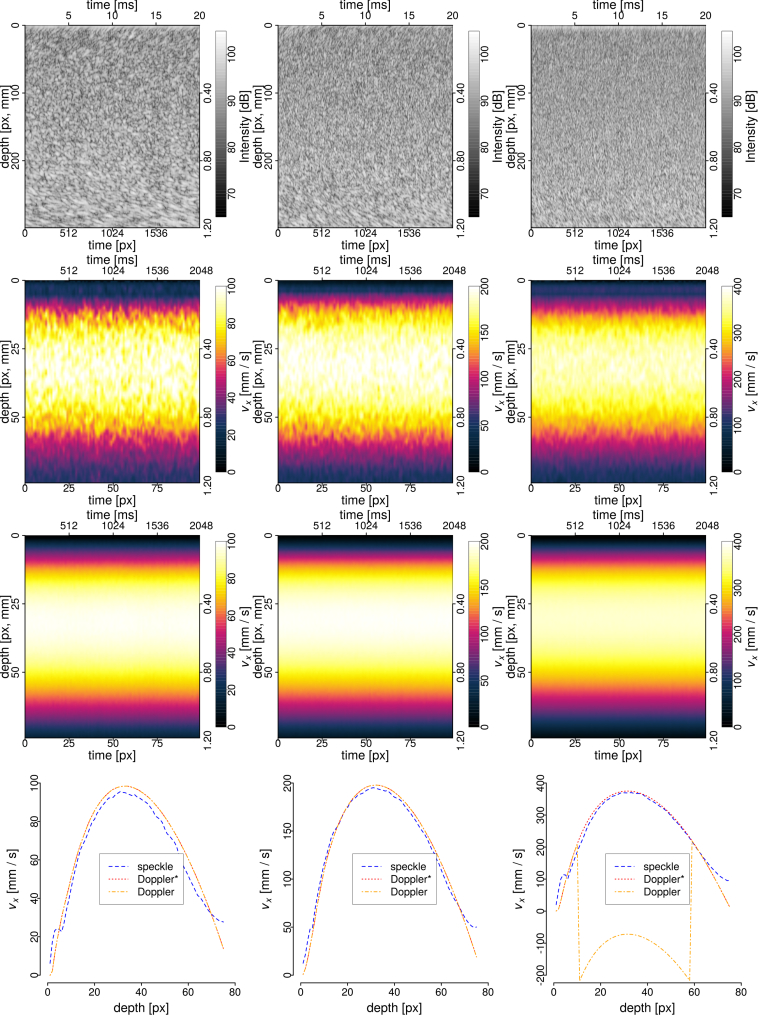
Intensity-based techniques in optical coherence tomography (OCT), such as those based on speckle decorrelation, have attracted great interest for biomedical and industrial applications requiring speed or flow information. In this work we present a rigorous analysis of the effects of noise on speckle decorrelation, demonstrate that these effects frustrate accurate speed quantitation, and propose new techniques that achieve quantitative and repeatable measurements. First, we derive the effect of background noise on the speckle autocorrelation function, finding two detrimental effects of noise. We propose a new autocorrelation function that is immune to the main effect of background noise and permits quantitative measurements at high and moderate signal-to-noise ratios. At the same time, this autocorrelation function is able to provide motion contrast information that accurately identifies areas with movement, similar to speckle variance techniques. In order to extend the SNR range, we quantify and model the second effect of background noise on the autocorrelation function through a calibration. By obtaining an explicit expression for the decorrelation time as a function of speed and diffusion, we show how to use our autocorrelation function and noise calibration to measure a flowing liquid. We obtain accurate results, which are validated by Doppler OCT, and demonstrate a very high dynamic range (> 600 mm/s) compared to that of Doppler OCT (±25 mm/s). We also derive the behavior for low flows, and show that there is an inherent non-linearity in speed measurements in the presence of diffusion due to statistical fluctuations of speckle. Our technique allows quantitative and robust measurements of speeds using OCT, and this work delimits precisely the conditions in which it is accurate.
Figures
References
-
- Bouma B. E., Tearney G. J., eds., Handbook of optical coherence tomography (Marcel Dekker Inc, 2002).
-
- Stifter D., Leiss-Holzinger E., Major Z., Baumann B., Pircher M., Götzinger E., Hitzenberger C. K., Heise B., “Dynamic optical studies in materials testing with spectral-domain polarization-sensitive optical coherence tomography,” Opt. Express 18, 25712–25725 (2010). 10.1364/OE.18.025712 - DOI - PubMed
Publication types
MeSH terms
Grants and funding
LinkOut - more resources
Full Text Sources
Other Literature Sources