Effect of psoriasis severity on hypertension control: a population-based study in the United Kingdom
- PMID: 25322196
- PMCID: PMC4728300
- DOI: 10.1001/jamadermatol.2014.2094
Effect of psoriasis severity on hypertension control: a population-based study in the United Kingdom
Abstract
Importance: Hypertension is prevalent among patients with psoriasis. The effect of psoriasis and its severity on hypertension control is unknown.
Objective: To determine the association between uncontrolled blood pressure and psoriasis, both overall and according to objectively measured psoriasis severity, among patients with diagnosed hypertension.
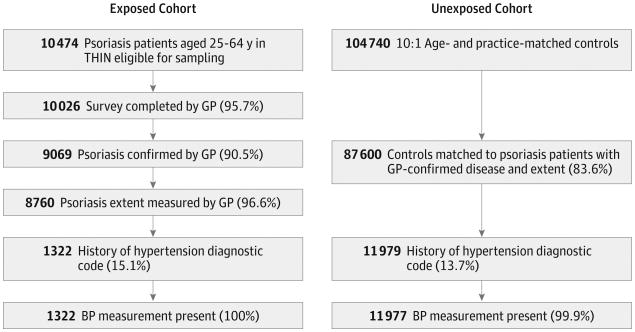
Design, setting, and participants: Population-based cross-sectional study nested in a prospective cohort drawn from The Health Improvement Network (THIN), an electronic medical records database broadly representative of the general population in the United Kingdom. The study population included a random sample of patients with psoriasis (n = 1322) between the ages of 25 and 64 years in THIN who were included in the Incident Health Outcomes and Psoriasis Events prospective cohort and their age- and practice-matched controls without psoriasis (n = 11,977). All included patients had a diagnosis of hypertension; their psoriasis diagnosis was confirmed and disease severity was classified by their general practitioners.
Main outcomes and measures: Uncontrolled hypertension was defined as a systolic blood pressure of 140 mm Hg or higher or a diastolic blood pressure of 90 mm Hg or higher based on the blood pressure recorded closest in time to the assessment of psoriasis severity.
Results: There was a significant positive dose-response relationship between uncontrolled hypertension and psoriasis severity as objectively determined by the affected body surface area in both unadjusted and adjusted analyses that controlled for age, sex, body mass index, smoking and alcohol use status, presence of comorbid conditions, and current use of antihypertensive medications and nonsteroidal anti-inflammatory drugs (adjusted odds ratio [aOR], 0.97; 95% CI, 0.82-1.14 for mild psoriasis; aOR, 1.20; 95% CI, 0.99-1.45 for moderate psoriasis; and aOR, 1.48; 95% CI, 1.08-2.04 for severe psoriasis; P = .01 for trend). The likelihood of uncontrolled hypertension among psoriasis overall was also increased, although not statistically significantly so (aOR, 1.10; 95% CI, 0.98-1.24).
Conclusions and relevance: Among patients with hypertension, psoriasis was associated with a greater likelihood of uncontrolled hypertension in a dose-dependent manner, with the greatest likelihood observed among those with moderate to severe psoriasis defined by 3% or more of the body surface area affected. Our data suggest a need for more effective blood pressure management, particularly among patients with more severe psoriasis.
Conflict of interest statement
Figures
References
-
- Rachakonda TD, Schupp CW, Armstrong AW. Psoriasis prevalence among adults in the United States. J Am Acad Dermatol. 2014;70(3):512–516. - PubMed
-
- Neimann AL, Shin DB, Wang X, Margolis DJ, Troxel AB, Gelfand JM. Prevalence of cardiovascular risk factors in patients with psoriasis. J Am Acad Dermatol. 2006;55(5):829–835. - PubMed
-
- Armstrong AW, Harskamp CT, Armstrong EJ. The association between psoriasis and hypertension: a systematic review and meta-analysis of observational studies. J Hypertens. 2013;31(3):433–443. - PubMed
Publication types
MeSH terms
Grants and funding
LinkOut - more resources
Full Text Sources
Other Literature Sources
Medical