Predicted long-term cardiovascular risk among young adults in the national longitudinal study of adolescent health
- PMID: 25322295
- PMCID: PMC4232148
- DOI: 10.2105/AJPH.2014.302148
Predicted long-term cardiovascular risk among young adults in the national longitudinal study of adolescent health
Abstract
Objectives: We estimated the distribution of predicted long-term cardiovascular disease (CVD) risk among young adults in the United States.
Methods: Our data were derived from National Longitudinal Study of Adolescent Health participants (n = 14 333; average age: 28.9 years). We used a Framingham-derived risk prediction function to calculate 30-year risks of "hard" and "general" CVD by gender and race/ethnicity.
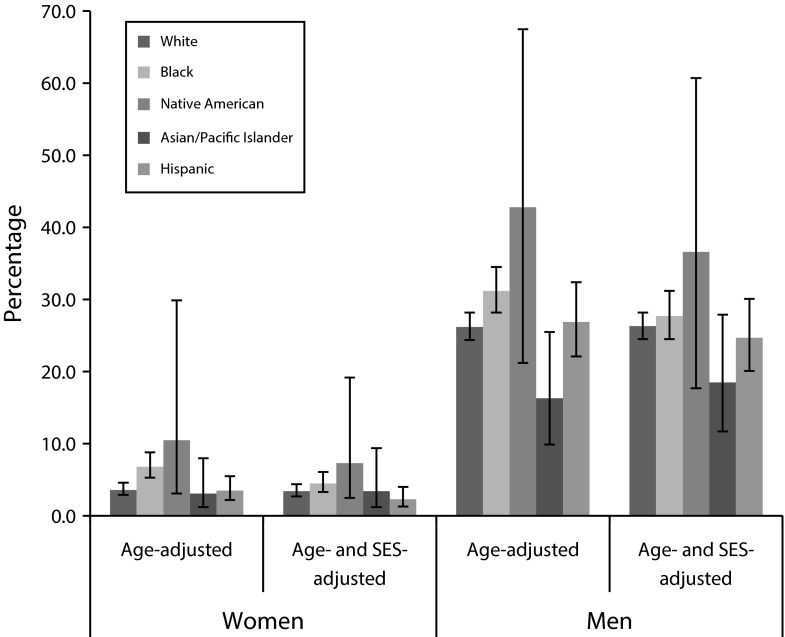
Results: Average 30-year risks for hard and general CVD were 10.4% (95% confidence interval [CI] = 10.1%, 10.7%) and 17.3% (95% CI = 17.0%, 17.7%) among men and 4.4% (95% CI = 4.3%, 4.6%) and 9.2% (95% CI = 8.9%, 9.5%) among women. Average age-adjusted risks of hard and general CVD were higher among Blacks and American Indians than among Whites and lower among Asian/Pacific Islander women than White women. American Indian men continued to have a higher risk of general CVD after adjustment for socioeconomic status. Four percent of women (95% CI = 3.6%, 5.0%) and 26.2% of men (95% CI = 24.7%, 27.8%) had a 20% or higher risk of general CVD. Racial differences were detected but were not significant after adjustment for socioeconomic status.
Conclusions: Average CVD risk among young adults is high. Population-based prevention strategies and improved detection and treatment of high-risk individuals are needed to reduce the future burden of CVD.
Figures
References
-
- Heidenreich PA, Trogdon JG, Khavjou OA et al. Forecasting the future of cardiovascular disease in the United States: a policy statement from the American Heart Association. Circulation. 2011;123(8):933–944. - PubMed
-
- Weintraub WS, Daniels SR, Burke LE et al. Value of primordial and primary prevention for cardiovascular disease: a policy statement from the American Heart Association. Circulation. 2011;124(8):967–990. - PubMed
-
- Kavey RE, Daniels SR, Lauer RM, Atkins DL, Hayman LL, Taubert K. American Heart Association guidelines for primary prevention of atherosclerotic cardiovascular disease beginning in childhood. J Pediatr. 2003;142(4):368–372. - PubMed
-
- Results From the 2010 National Survey on Drug Use and Health: Summary of National Findings. Rockville, MD: Substance Abuse and Mental Health Services Administration; 2011.
-
- Centers for Disease Control and Prevention. Behavioral Risk Factor Surveillance System. Available at: http://www.cdc.gov/brfss. Accessed August 20, 2014.
Publication types
MeSH terms
Grants and funding
LinkOut - more resources
Full Text Sources
Other Literature Sources