Review
. 2014 Dec 15;20(24):6233-41.
doi: 10.1158/1078-0432.CCR-14-0900. Epub 2014 Oct 16.

New strategies in acute myelogenous leukemia: leukemogenesis and personalized medicine

Affiliations
Review

New strategies in acute myelogenous leukemia: leukemogenesis and personalized medicine

Ivana Gojo et al. Clin Cancer Res. .

Abstract

Recent advances in molecular technology have unraveled the complexity of leukemogenesis and provided the opportunity to design more personalized and pathophysiology-targeted therapeutic strategies. Despite the use of intensive chemotherapy, relapse remains the most common cause for therapeutic failure in acute myelogenous leukemia (AML). The interactions between leukemia stem cells (LSC) and marrow microenvironment appear to be critical in promoting therapeutic resistance through progressive acquisition of genetic and epigenetic changes within leukemia cells and immune evasion, resulting in leukemia cell survival. With advances in genomic-sequencing efforts, epigenetic and phenotypic characterization, personalized therapeutic strategies aimed at critical leukemia survival mechanisms may be feasible in the near future. Here, we review select novel approaches to therapy of AML such as targeting LSC, altering leukemia/marrow microenvironment interactions, inhibiting DNA repair or cell-cycle checkpoints, and augmenting immune-based antileukemia activity.


Conflict of interest statement

Disclosure of Potential Conflicts of Interest

No potential conflicts of interest were disclosed.

Figures
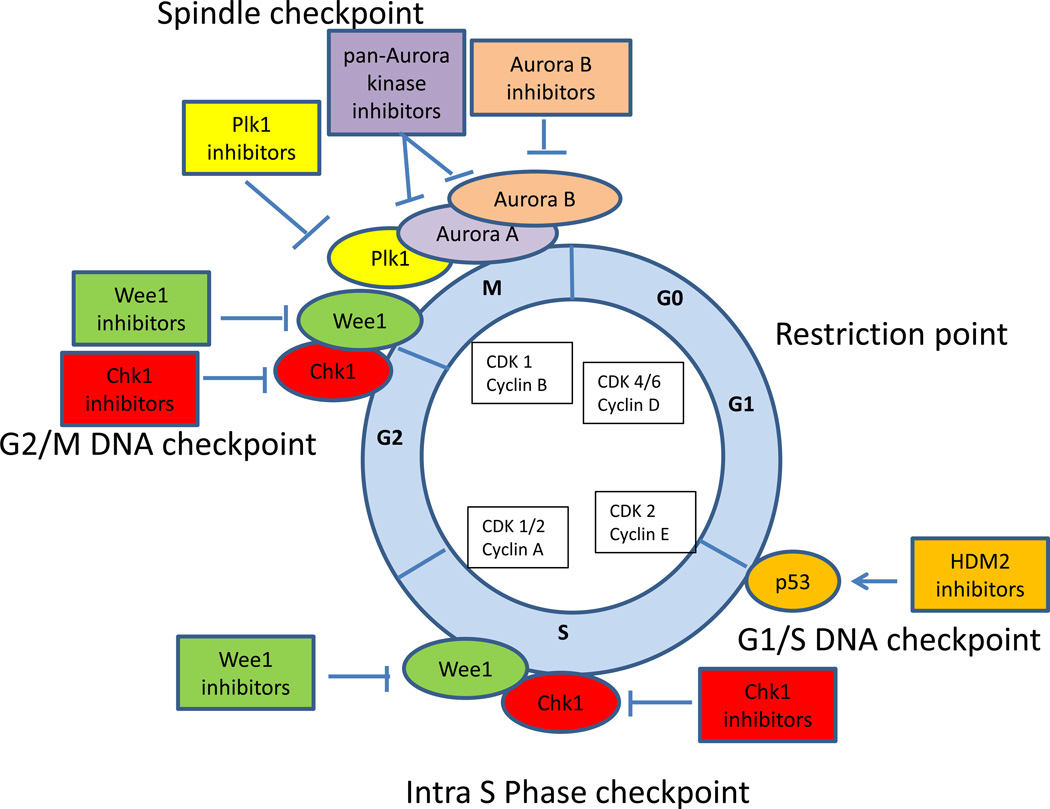
Figure 1
Figure 1
Cell cycle checkpoint inhibitors in AML. Cell cycle is controlled by successive activation of cyclin-cyclin dependent kinases (CDKs). Cell cycle checkpoints serve to stop progression of the cell cycle in response to DNA damage, to allow time for DNA repair and to preserve genomic integrity. The p53-dependent G1/S checkpoint blocks initiation of DNA replication. p53 is frequently altered (mutations or losses) in patients with complex karyotype AML. Inhibitors of HDM2 (RG7112, RO5503781 and MK-8242) are in clinical studies in AML alone or in combination with cytarabine and have a potential to be effective in leukemia cells that retain wild-type p53. Tumors that are defective in p53 function rely on an intact S phase and G2 checkpoint. Depending on the type of genotoxic stress, either ataxia-telangectasia mutated (ATM) protein kinase or ataxia-telangiectasia-related (ATR) protein kinase are activated leading to activation of Chk1 and Wee1 kinases that inactivate Cdk1 resulting in intra S phase and G2/M arrest, allowing time for DNA repair. Inhibition of Chk1 (MK8776) and Wee1 (MK1775) sensitizes leukemia cells to cytarabine cytotoxicity in preclinical studies and the combination of Chk1 inhibitor and cytarabine is in a phase II testing in AML. Synergistic activity has been described for Chk1 and Wee1 inhibition in leukemia cells. PLK1 and Aurora kinases are critical for centrosome maturation and proper formation of the mitotic spindle, and also play a role in chromosome segregation and cytokinesis. Plk1 inhibitor (volasertib) and Aurora B kinase inhibitor (AZD1152) have shown promising clinical activity in AML patients when given with low dose cytarabine. In addition, several pan CDK inhibitors (flavopiridol, dinaciclib) have been explored as a therapeutic strategy in AML. Flavopiridol in combination with cytarabine and mitoxantrone (FLAM) is in a phase III testing for newly diagnosed AML.

References

    1. Cancer Genome Atlas Research Network. Genomic and epigenomic landscapes of adult de novo acute myeloid leukemia. N Engl J Med. 2013;368:2059–2074. - PMC - PubMed
    1. Ding L, Ley TJ, Larson DE, Miller CA, Koboldt DC, Welch JS, et al. Clonal evolution in relapsed acute myeloid leukaemia revealed by whole-genome sequencing. Nature. 2012;481:506–510. - PMC - PubMed
    1. Walter MJ, Shen D, Ding L, Shao J, Koboldt DC, Chen K, et al. Clonal architecture of secondary acute myeloid leukemia. N Engl J Med. 2012;366:1090–1098. - PMC - PubMed
    1. Grunwald MR, Lin M-T, Pratz KW, Gocke CD, Levis MJ. Tandem duplication PCR (TD-PCR) is a novel method of detecting minimal residual disease in FLT3/ITD AML and is highly predictive of relapse risk following allogeneic transplant [abstract]; In: Proceedings of the 54th ASH Annual Meeting and Exposition; Atlanta, GA. Washington (DC): ASH; Dec 8–11, 2012. 2012. Abstract nr 2479.
    1. Hourigan CS, Karp JE. Minimal residual disease in acute myeloid leukaemia. Nat Rev Clin Oncol. 2013;10:460–471. - PMC - PubMed

Publication types
