


A cross-sectional study of hearing thresholds among 4627 Norwegian train and track maintenance workers
- PMID: 25324318
- PMCID: PMC4202010
- DOI: 10.1136/bmjopen-2014-005529
A cross-sectional study of hearing thresholds among 4627 Norwegian train and track maintenance workers
Abstract
Objective: Railway workers performing maintenance work of trains and tracks could be at risk of developing noise-induced hearing loss, since they are exposed to noise levels of 75-90 dB(A) with peak exposures of 130-140 dB(C). The objective was to make a risk assessment by comparing the hearing thresholds among train and track maintenance workers with a reference group not exposed to noise and reference values from the ISO 1999.
Design: Cross-sectional.
Setting: A major Norwegian railway company.
Participants: 1897 and 2730 male train and track maintenance workers, respectively, all exposed to noise, and 2872 male railway traffic controllers and office workers not exposed to noise.
Outcome measures: The primary outcome was the hearing threshold (pure tone audiometry, frequencies from 0.5 to 8 kHz), and the secondary outcome was the prevalence of audiometric notches (Coles notch) of the most recent audiogram.
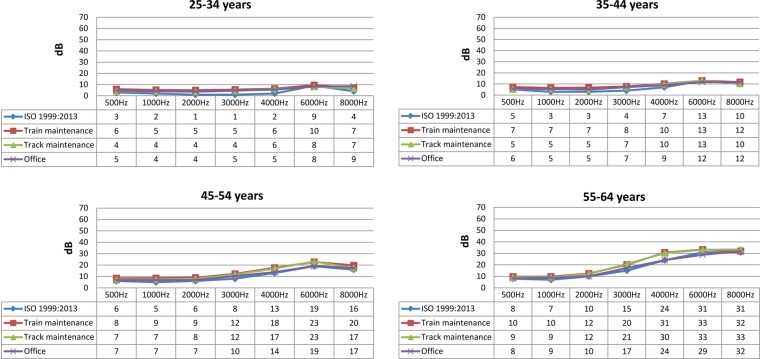
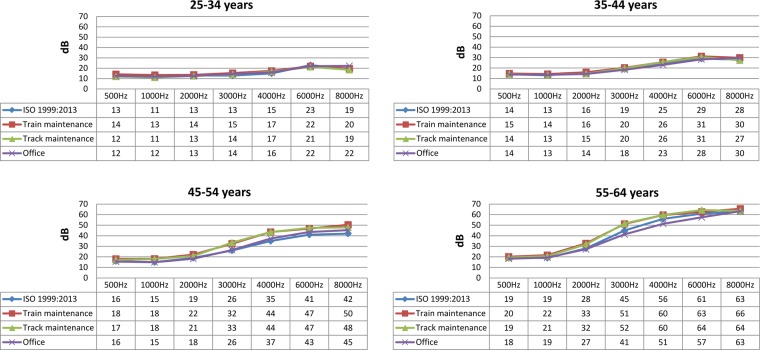
Results: Train and track maintenance workers aged 45 years or older had a small mean hearing loss in the 3-6 kHz area of 3-5 dB. The hearing loss was less among workers younger than 45 years. Audiometric notches were slightly more prevalent among the noise exposed (59-64%) group compared with controls (49%) for all age groups. They may therefore be a sensitive measure in disclosing an early hearing loss at a group level.
Conclusions: Train and track maintenance workers aged 45 years or older, on average, have a slightly greater hearing loss and more audiometric notches compared with reference groups not exposed to noise. Younger (<45 years) workers have hearing thresholds comparable to the controls.
Keywords: EPIDEMIOLOGY; OCCUPATIONAL & INDUSTRIAL MEDICINE; PREVENTIVE MEDICINE.
Published by the BMJ Publishing Group Limited. For permission to use (where not already granted under a licence) please go to http://group.bmj.com/group/rights-licensing/permissions.
Figures
References
-
- Samant Y, Parker D, Wergeland E, et al. The Norwegian Labour Inspectorate's Registry for Work-Related Diseases: data from 2006. Int J Occup Environ Health 2008;14:272–9 - PubMed
-
- Cruickshanks KJ, Wiley TL, Tweed TS, et al. Prevalence of hearing loss in older adults in Beaver Dam, Wisconsin. The Epidemiology of Hearing Loss Study. Am J Epidemiol 1998;148:879–86 - PubMed
-
- Le Prell CG, Henderson D. Perspectives on noise-induced hearing loss. In: Le Prell CG, Henderson D, Fay RR, et al., eds. Noise induced hearing loss. New York: Springer, 2012:1–10
-
- Kvestad E, Czajkowski N, Krog NH, et al. Heritability of hearing loss. Epidemiology 2012;23:328–31 - PubMed
-
- Tambs K, Hoffman HJ, Borchgrevink HM, et al. Hearing loss induced by noise, ear infections, and head injuries: results from the Nord-Trondelag Hearing Loss Study. Int J Audiol 2003;42:89–105 - PubMed
MeSH terms
LinkOut - more resources
Full Text Sources
Other Literature Sources
Medical
Miscellaneous
