ANCA as a predictor of relapse: useful in patients with renal involvement but not in patients with nonrenal disease
- PMID: 25324502
- PMCID: PMC4341475
- DOI: 10.1681/ASN.2013111233
ANCA as a predictor of relapse: useful in patients with renal involvement but not in patients with nonrenal disease
Abstract
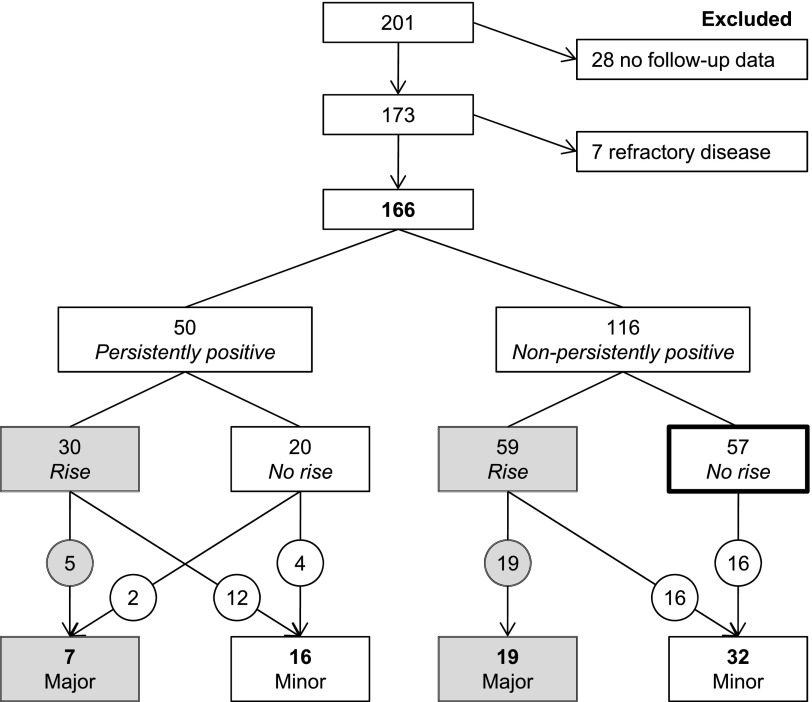
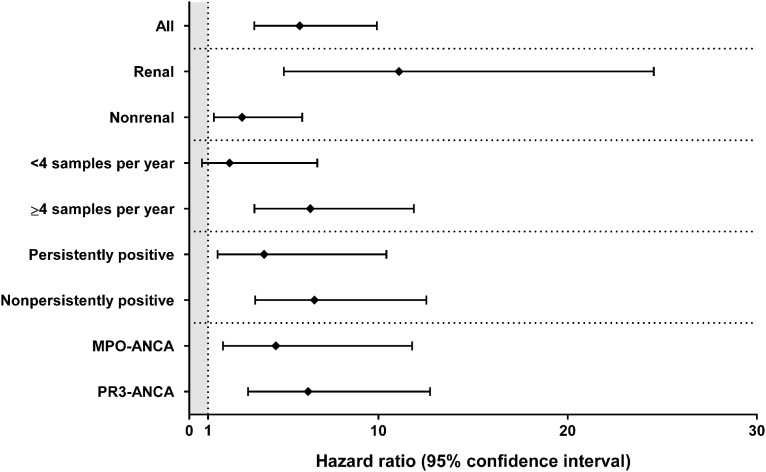
The value of measuring ANCA during follow-up to predict a relapse is controversial. On the basis of recently obtained pathophysiologic insights, we postulated that measuring ANCA is useful in patients with renal involvement but is less valuable in patients with nonrenal disease. One hundred sixty-six consecutive patients with ANCA-associated vasculitis, positive for either proteinase 3 (PR3)-ANCA or myeloperoxidase (MPO)-ANCA, were included in our study, followed at regular intervals, and tested for PR3-ANCA and MPO-ANCA. In this cohort, 104 patients had renal involvement (72 with PR3-ANCA, 32 with MPO-ANCA) and 62 patients had nonrenal disease (36 with PR3-ANCA, 26 with MPO-ANCA). During an average (±SD) follow-up of 49±33 months and 18±14 ANCA measurements, 89 ANCA rises and 74 relapses were recorded. ANCA rises correlated with relapses in patients who presented with renal involvement (hazard ratio [HR], 11.09; 95% confidence interval [95% CI], 5.01 to 24.55), but in comparison, associated only weakly with relapses in patients who presented with nonrenal disease (HR, 2.79; 95% CI, 1.30 to 5.98). In conclusion, longitudinal ANCA measurements may be useful in patients with renal involvement but is less valuable in patients with nonrenal disease.
Keywords: ANCA; GN; vasculitis.
Copyright © 2015 by the American Society of Nephrology.
Figures
Comment in
- 505–507 doi: 10.1681/ASN.2014080817
References
-
- Wilde B, van Paassen P, Witzke O, Tervaert JWC: New pathophysiological insights and treatment of ANCA-associated vasculitis. Kidney Int 79: 599–612, 2011 - PubMed
-
- Tervaert JWC, van der Woude FJ, Fauci AS, Ambrus JL, Velosa J, Keane WF, Meijer S, van der Giessen M, The TH, van der Hem GK, Kallenberg GM: Association between active Wegener’s granulomatosis and anticytoplasmic antibodies. Arch Intern Med 149: 2461–2465, 1989 - PubMed
-
- Tervaert JWC, Damoiseaux J: Antineutrophil cytoplasmic autoantibodies: How are they detected and what is their use for diagnosis, classification and follow-up? Clin Rev Allergy Immunol 43: 211–219, 2012 - PubMed
-
- Birck R, Schmitt WH, Kaelsch IA, van der Woude FJ: Serial ANCA determinations for monitoring disease activity in patients with ANCA-associated vasculitis: Systematic review. Am J Kidney Dis 47: 15–23, 2006 - PubMed
MeSH terms
Substances
LinkOut - more resources
Full Text Sources
Other Literature Sources
Medical
Research Materials
Miscellaneous