


Spatial-temporal analysis of Cache Valley virus (Bunyaviridae: Orthobunyavirus) infection in anopheline and culicine mosquitoes (Diptera: Culicidae) in the northeastern United States, 1997-2012
- PMID: 25325321
- PMCID: PMC4208611
- DOI: 10.1089/vbz.2014.1669
Spatial-temporal analysis of Cache Valley virus (Bunyaviridae: Orthobunyavirus) infection in anopheline and culicine mosquitoes (Diptera: Culicidae) in the northeastern United States, 1997-2012
Abstract
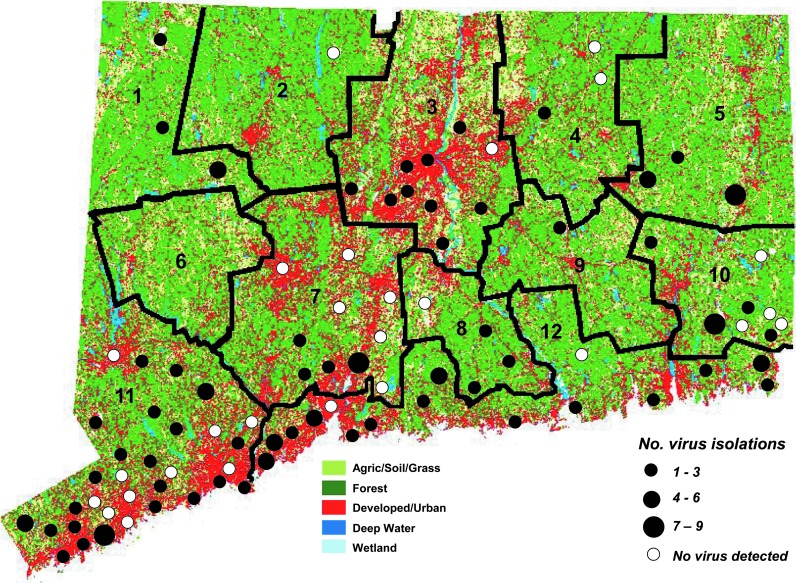
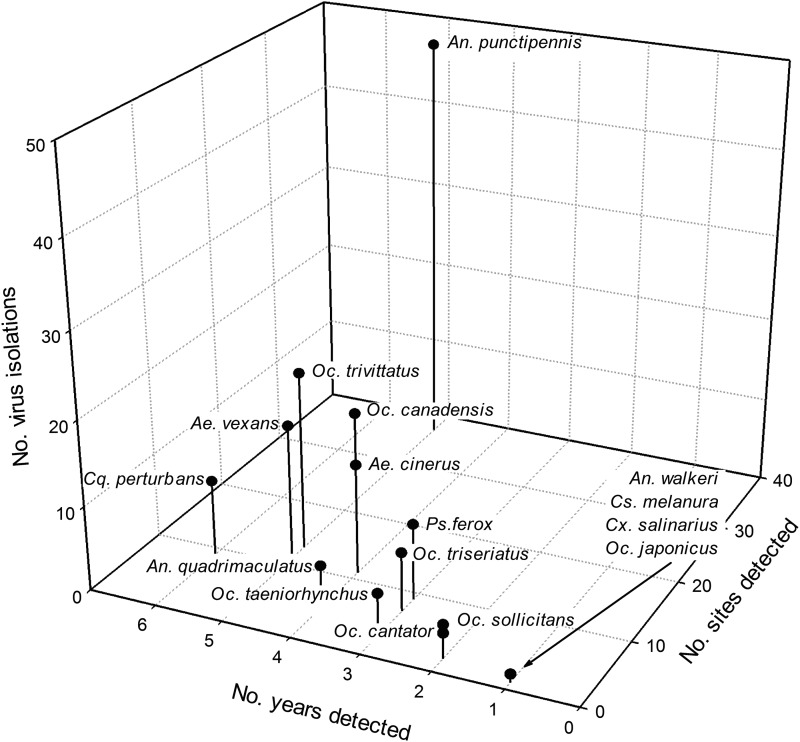
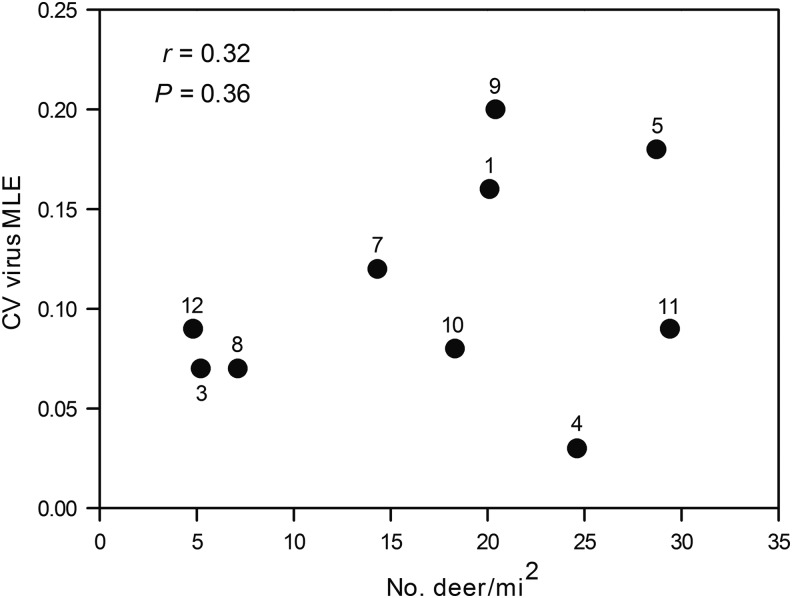
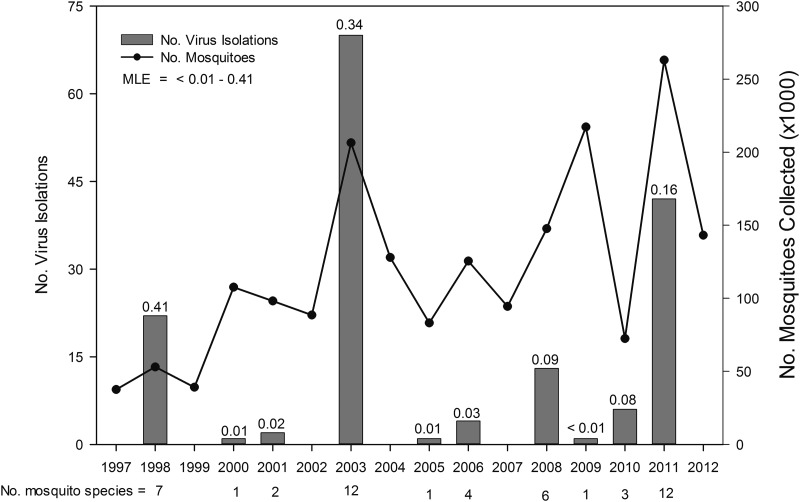
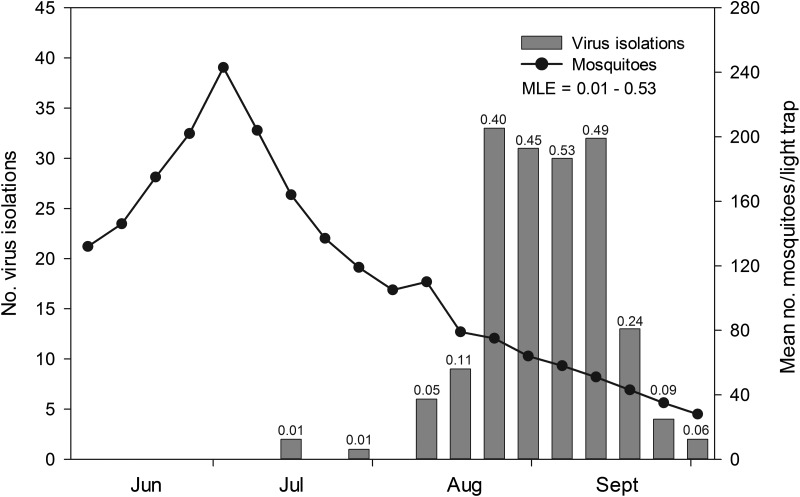
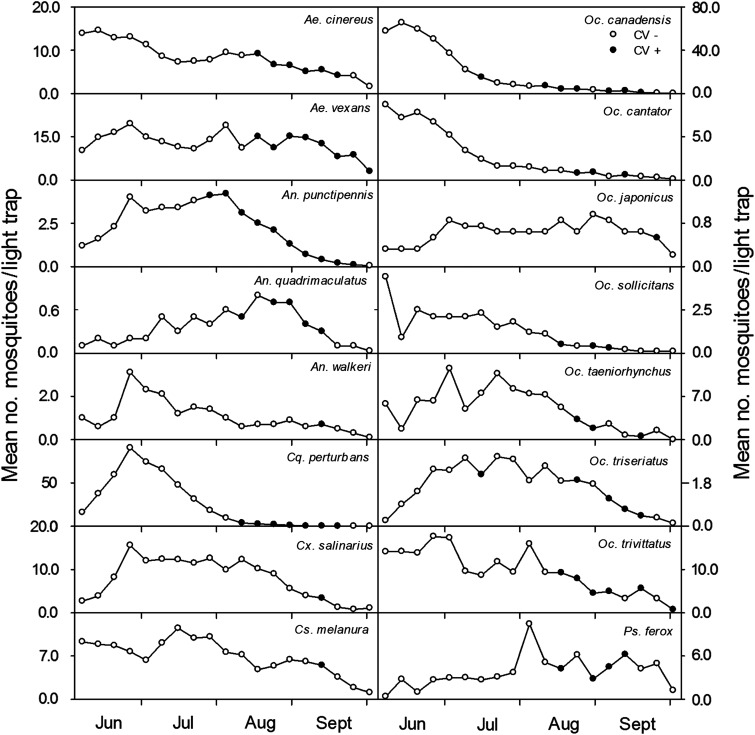
Cache Valley virus (CVV) is a mosquito-borne bunyavirus (family Bunyaviridae, genus Orthobunyavirus) that is enzootic throughout much of North and Central America. White-tailed deer (Odocoileus virginianus) have been incriminated as important reservoir and amplification hosts. CVV has been found in a diverse array of mosquito species, but the principal vectors are unknown. A 16-year study was undertaken to identify the primary mosquito vectors in Connecticut, quantify seasonal prevalence rates of infection, and define the spatial geographic distribution of CVV in the state as a function of land use and white-tailed deer populations, which have increased substantially over this period. CVV was isolated from 16 mosquito species in seven genera, almost all of which were multivoltine and mammalophilic. Anopheles (An.) punctipennis was incriminated as the most consistent and likely vector in this region on the basis of yearly isolation frequencies and the spatial geographic distribution of infected mosquitoes. Other species exhibiting frequent temporal and moderate spatial geographic patterns of virus isolation within the state included Ochlerotatus (Oc.) trivittatus, Oc. canadensis, Aedes (Ae.) vexans, and Ae. cinereus. New isolation records for CVV were established for An. walkeri, Culiseta melanura, and Oc. cantator. Other species from which CVV was isolated included An. quadrimaculatus, Coquillettidia perturbans, Culex salinarius, Oc. japonicus, Oc. sollicitans, Oc. taeniorhynchus, Oc. triseriatus, and Psorophora ferox. Mosquitoes infected with CVV were equally distributed throughout urban, suburban, and rural locales, and infection rates were not directly associated with the localized abundance of white-tailed deer, possibly due to their saturation throughout the region. Virus activity in mosquitoes was episodic with no consistent pattern from year-to-year, and fluctuations in yearly seasonal infection rates did not appear to be directly impacted by overall mosquito abundance. Virus infection in mosquitoes occurred late in the season that mostly extended from mid-August through September, when adult mosquito populations were visibly declining and were comparatively low. Findings argue for a limited role for vertical transmission for the perpetuation of CVV as occurs with other related bunyaviruses.
Keywords: Anopheles punctipennis; Bunyaviridae; Cache Valley virus; Mosquito; Orthobunyavirus.
Figures
References
-
- Anderson JR. A land use and land cover classification system for use with remote sensor data. Washington, DC: US Government Printing Office, Geological Survey Professional Paper 964, 1976
-
- Andreadis TG, Thomas MC, Shepard JJ. Identification Guide to the Mosquitoes of Connecticut. Bulletin of The Connecticut Agricultural Experiment Station, No. 966, 2005:1–173
-
- Andreadis TG, Anderson JF, Armstrong PM, Main AJ. Isolations of Jamestown Canyon virus (Bunyaviridae: Orthobunyavirus) from field-collected mosquitoes (Diptera: Culicidae) in Connecticut, USA: A ten-year analysis, 1997–2006. Vector-Borne Zoonotic Dis 2008; 8:175–188 - PubMed
-
- Armstrong PM, Andreadis TG. A new genetic variant of La Crosse virus isolated from New England. Am J Trop Med Hyg 2006; 75:491–496 - PubMed
Publication types
MeSH terms
Grants and funding
LinkOut - more resources
Full Text Sources
Other Literature Sources
Medical
