


Relationships between sleep stages and changes in cognitive function in older men: the MrOS Sleep Study
- PMID: 25325465
- PMCID: PMC4335525
- DOI: 10.5665/sleep.4500
Relationships between sleep stages and changes in cognitive function in older men: the MrOS Sleep Study
Abstract
Study objective: To investigate the associations between sleep stage distributions and subsequent decline in cognitive function in older men over time.
Design: A population-based prospective substudy of the Osteoporotic Fractures in Men Study.
Settings: Six sites in the United States.
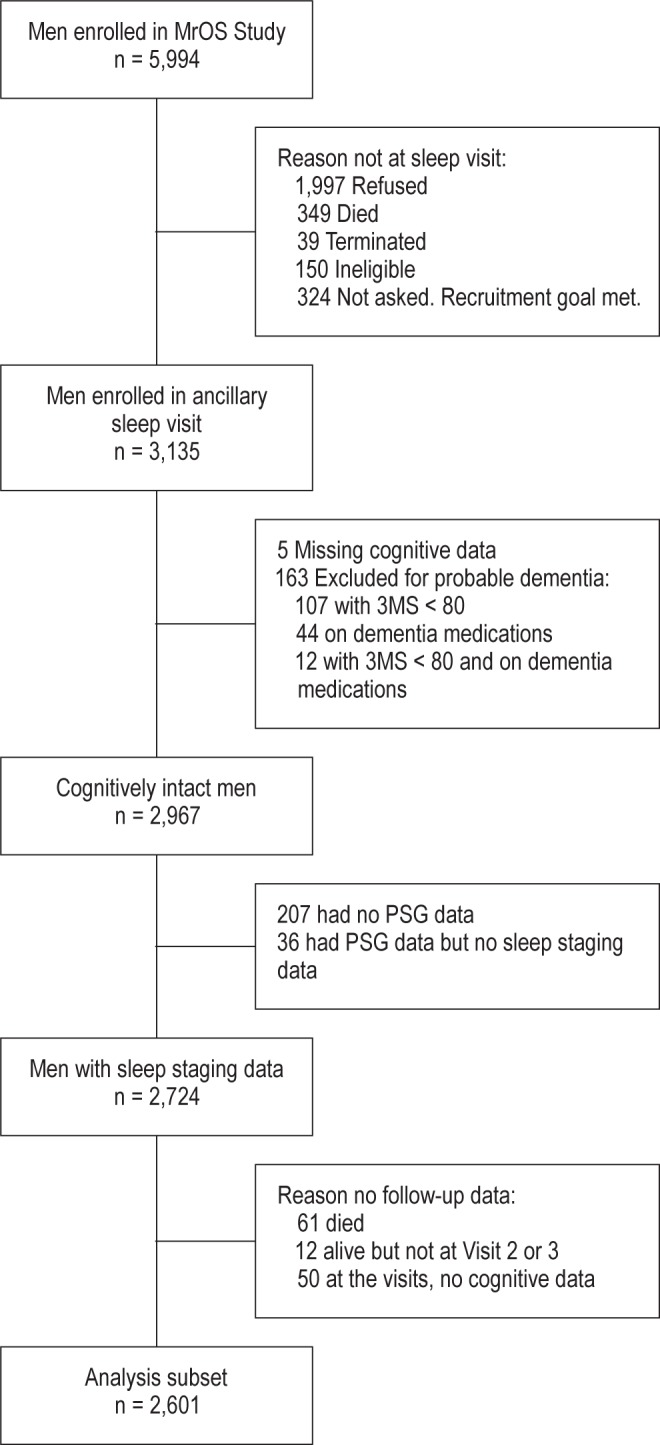
Participants: Community-dwelling men aged 67 y or older (n = 2,601), who were free of probable dementia at sleep visit. Follow-up averaged 3.4 y.
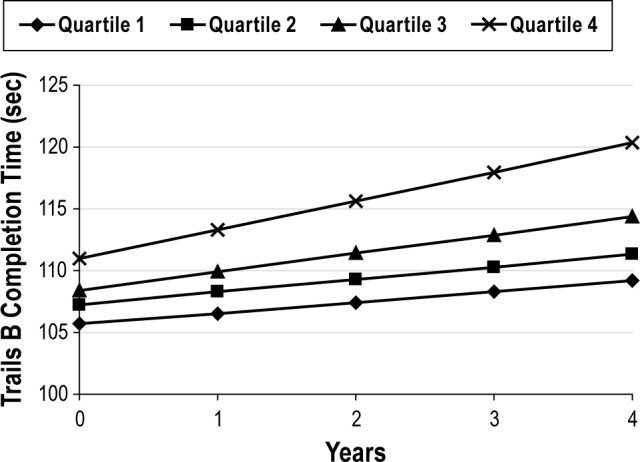
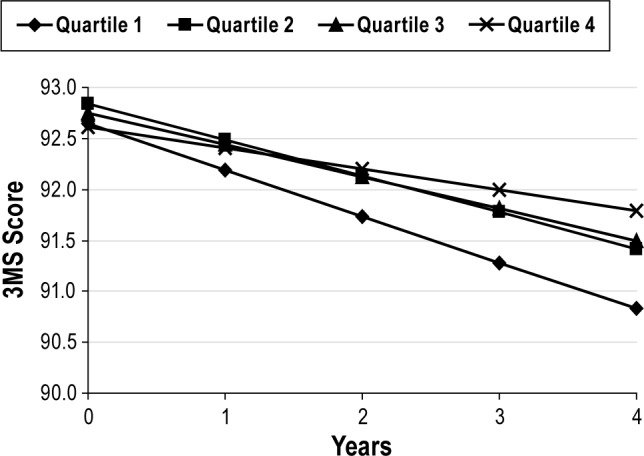
Measurement and results: Sleep stages were identified by in-home polysomnography at the initial sleep visit (2003-2005). Cognitive outcomes were assessed with the Trail Making Test Part B and Modified Mini-Mental State Examination (3MS) at sleep visit and two follow-up visits. After adjusting for multiple confounders compared with men in the lowest quartile of percent of sleep time spent in Stage N1, those in the highest quartile had a twofold increase in cognitive decline for both cognitive tests (adjusted annualized percent change/y: Trail Making Test Part B Q1 = 1.06, Q4 = 2.45, P = 0.01; 3MS Q1 = -0.27, Q4 = -0.48, P = 0.03). In addition, compared with men in the highest quartile, men in the lowest quartile of percent of sleep time in Stage R revealed more cognitive decline on the 3MS (adjusted annualized percent change/y: Q1 = -0.49, Q4 = -0.22, P = 0.003). These findings were consistent even after further adjustment of total sleep time and sleep disordered breathing. No significant relationships between other sleep stages (N2, N3) and cognitive change were found.
Conclusion: Increased time in Stage N1 and less time in Stage R are associated with worsening cognitive performance in older men over time.
Keywords: aging; cognitive function; cohort study; sleep stages.
© 2015 Associated Professional Sleep Societies, LLC.
Figures
Comment in
-
Is cognitive aging associated with levels of REM sleep or slow wave sleep?Sleep. 2015 Mar 1;38(3):335-6. doi: 10.5665/sleep.4482. Sleep. 2015. PMID: 25669196 Free PMC article. No abstract available.
References
-
- Ancoli-Israel S, Kripke DF, Klauber MR, Mason WJ, Fell R, Kaplan O. Periodic limb movements in sleep in community-dwelling elderly. Sleep. 1991;14:496–500. - PubMed
-
- Ferri R, Manconi M, Lanuzza B, et al. Age-related changes in periodic leg movements during sleep in patients with restless legs syndrome. Sleep Med. 2008;9:790–8. - PubMed
-
- Claman DM, Redline S, Blackwell T, et al. Prevalence and correlates of periodic limb movements in older women. J Clin Sleep Med. 2006;2:438–45. - PubMed
-
- Schubert CR, Cruickshanks KJ, Dalton DS, Klein BE, Klein R, Nondahl DM. Prevalence of sleep problems and quality of life in an older population. Sleep. 2002;25:889–93. - PubMed
-
- Foley DJ, Monjan AA, Brown SL, Simonsick EM, Wallace RB, Blazer DG. Sleep complaints among elderly persons: an epidemiologic study of three communities. Sleep. 1995;18:425–32. - PubMed
Publication types
MeSH terms
Grants and funding
- U01 AG042145/AG/NIA NIH HHS/United States
- U01 AG042140/AG/NIA NIH HHS/United States
- UL1 TR000128/TR/NCATS NIH HHS/United States
- U01 AG042143/AG/NIA NIH HHS/United States
- R01 HL070838/HL/NHLBI NIH HHS/United States
- R01 HL070842/HL/NHLBI NIH HHS/United States
- U01 AG027810/AG/NIA NIH HHS/United States
- R01 HL070839/HL/NHLBI NIH HHS/United States
- U01 AG018197/AG/NIA NIH HHS/United States
- U01 AR066160/AR/NIAMS NIH HHS/United States
- U01 AG042124/AG/NIA NIH HHS/United States
- R01 HL070847/HL/NHLBI NIH HHS/United States
- R01 HL071194/HL/NHLBI NIH HHS/United States
- U01 AG042139/AG/NIA NIH HHS/United States
- R01 HL070841/HL/NHLBI NIH HHS/United States
- R01 HL070837/HL/NHLBI NIH HHS/United States
- R01 HL070848/HL/NHLBI NIH HHS/United States
- U01 AG042168/AG/NIA NIH HHS/United States
LinkOut - more resources
Full Text Sources
Other Literature Sources
