


Mobility Disability in Older Adults: At the Intersection of People and Places
- PMID: 25326342
- PMCID: PMC4873765
- DOI: 10.1093/geront/gnu094
Mobility Disability in Older Adults: At the Intersection of People and Places
Abstract
Purpose: Mobility disability is associated with poor lower body function among older adults. This study examines whether specific types of neighborhood characteristics moderate that association.
Design and methods: This study is based on a cross-sectional sample of 884 people aged ≥ 65 years identified through service organizations in Alameda County, CA; Cook County, IL; Allegheny County, PA; and Wake and Durham counties, NC. In-person interviews focus on neighborhood characteristics, physical and cognitive function, depression, and walking. Functional capacity is tested using objective measures of lower body strength, balance, and walking speed. Mobility disability, the main study outcome, is measured as self-reported level of difficulty in walking 2-3 neighborhood blocks. Estimates of main and interactive effects are derived from logistic regression models.
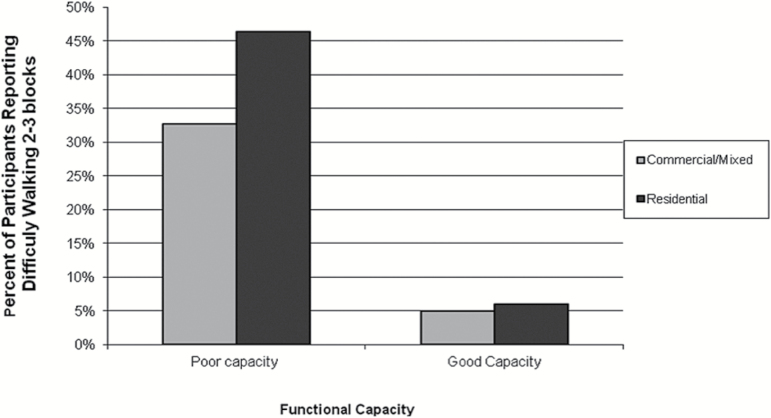
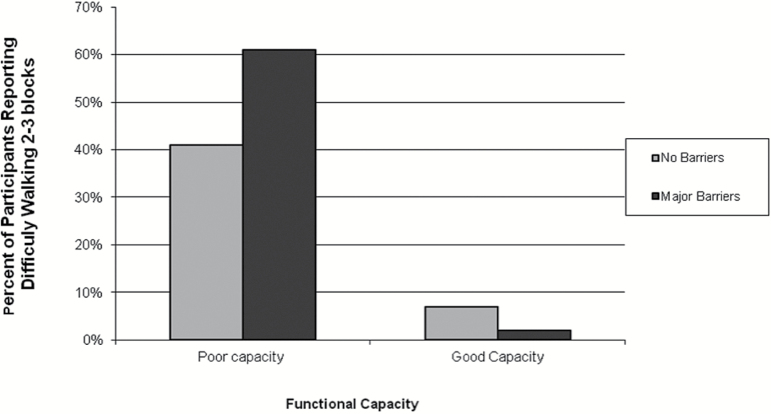
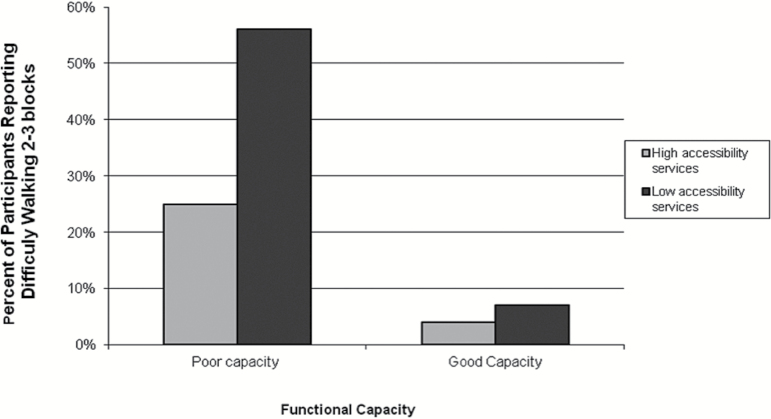
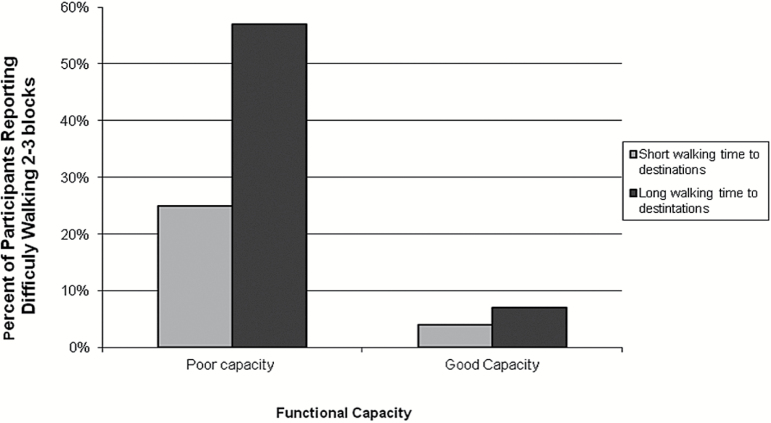
Results: Among older adults with poor lower body function, those who report less proximity to goods and services and barriers to walking report more mobility disability than other older adults. In contrast, among older adults with good lower body function, there is a low prevalence of mobility disability and little association between perceptions of the neighborhood and mobility disability.
Implications: In addition to more refined longitudinal studies, this research provides a foundation for innovative place-based rehabilitation and hospital discharge programs for older adults newly diagnosed and treated for chronic health conditions.
© The Author 2014. Published by Oxford University Press on behalf of The Gerontological Society of America. All rights reserved. For permissions, please e-mail: journals.permissions@oup.com.
Figures
References
-
- Andresen E. M. Malmgren J. A. Carter W. B., & Patrick D. L. (1994). Screening for depression in well older adults: evaluation of a short form of the CES-D (Center for Epidemiologic Studies Depression Scale). American Journal of Preventive Medicine, 10, 77–84. doi:10.1037/t10141-000 - PubMed
-
- Balfour J. L., & Kaplan G. A. (2002). Neighborhood environment and loss of physical function in older adults: evidence from the Alameda County Study. American Journal of Epidemiology, 155, 507–515. doi:10.1093/aje/155.6.507 - PubMed
-
- Barnes D. Yaffe K. Satariano W., & Tager I (2003). A longitudinal study of cardiorespiratory fitness and cognitive function in healthy older adults. Geriatrics, 51, 459–465. doi:10.1046/j.1532-5415.2003.51153.x - PubMed
-
- Billick S. B. Siedenburg E. Burgert W. 3rd, & Bruni-Solhkhah S. M. (2001). Validation of the Mental Alternation Test with the Mini-Mental State Examination in geriatric psychiatric inpatients and normal controls. Comprehensive Psychiatry, 42, 202–205. doi:10.1053/comp.2001.23146 - PubMed
Publication types
MeSH terms
Grants and funding
LinkOut - more resources
Full Text Sources
Other Literature Sources
Medical
