


Detection and validation of stay-green QTL in post-rainy sorghum involving widely adapted cultivar, M35-1 and a popular stay-green genotype B35
- PMID: 25326366
- PMCID: PMC4219115
- DOI: 10.1186/1471-2164-15-909
Detection and validation of stay-green QTL in post-rainy sorghum involving widely adapted cultivar, M35-1 and a popular stay-green genotype B35
Abstract
Background: Sorghum [Sorghum bicolor (L.) Moench] is an important dry-land cereal of the world providing food, fodder, feed and fuel. Stay-green (delayed-leaf senescence) is a key attribute in sorghum determining its adaptation to terminal drought stress. The objective of this study was to validate sorghum stay-green quantitative trait loci (QTL) identified in the past, and to identify new QTL in the genetic background of a post-rainy adapted genotype M35-1.
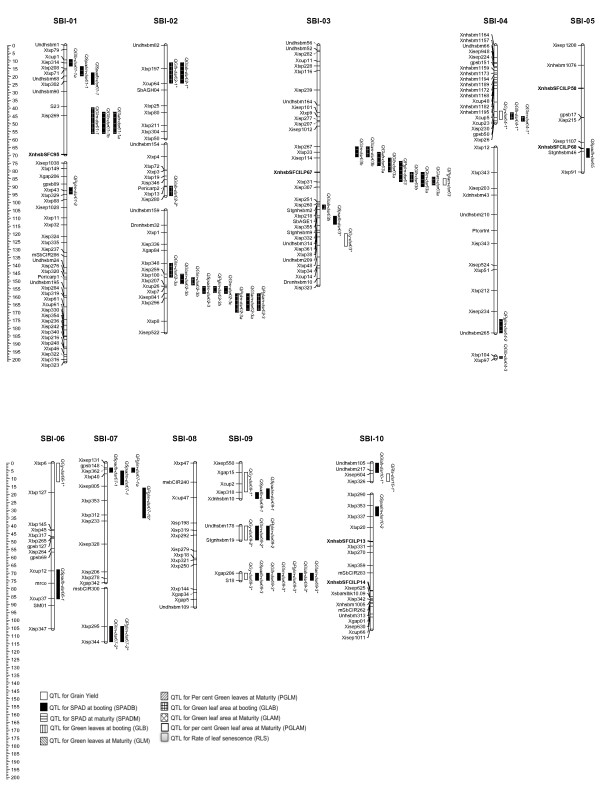
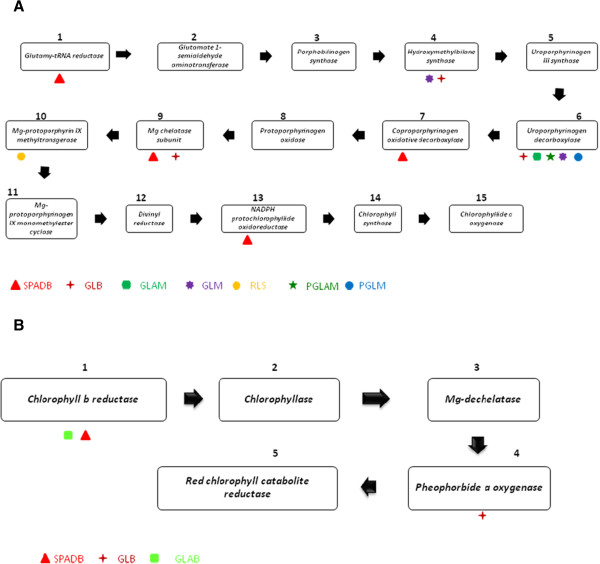
Results: A genetic linkage map based on 245 F9 Recombinant Inbred Lines (RILs) derived from a cross between M35-1 (more senescent) and B35 (less senescent) with 237 markers consisting of 174 genomic, 60 genic and 3 morphological markers was used. The phenotypic data collected for three consecutive post-rainy crop seasons on the RIL population (M35-1 × B35) was used for QTL analysis. Sixty-one QTL were identified for various measures of stay-green trait and each trait was controlled by one to ten QTL. The phenotypic variation explained by each QTL ranged from 3.8 to 18.7%. Co-localization of QTL for more than five traits was observed on two linkage groups i.e. on SBI-09-3 flanked by S18 and Xgap206 markers and, on SBI-03 flanked by XnhsbSFCILP67 and Xtxp31. QTL identified in this study were stable across environments and corresponded to sorghum stay-green and grain yield QTL reported previously. Of the 60 genic SSRs mapped, 14 were closely linked with QTL for ten traits. A genic marker, XnhsbSFCILP67 (Sb03g028240) encoding Indole-3-acetic acid-amido synthetase GH3.5, was co-located with QTL for GLB, GLM, PGLM and GLAM on SBI-03. Genes underlying key enzymes of chlorophyll metabolism were also found in the stay-green QTL regions.
Conclusions: We validated important stay-green QTL reported in the past in sorghum and detected new QTL influencing the stay-green related traits consistently. Stg2, Stg3 and StgB were prominent in their expression. Collectively, the QTL/markers identified are likely candidates for subsequent verification for their involvement in stay-green phenotype using NILs and to develop drought tolerant sorghum varieties through marker-assisted breeding for terminal drought tolerance in sorghum.
Figures
References
-
- Doggett H. Sorghum. 2. London, New York: Longman; published by Wiley; 1988.
-
- Paterson AH, Bowers JE, Feltus AF. Genomics of sorghum, a semi-arid cereal and emerging model for tropical grass genomics. In: Moore PH, Ming R, editors. Genomics of Tropical Crops. New York: Springer; 2008.
-
- FAO 2009.http://www.fao.org/statistics/en/
-
- Rao PP, Basavaraj G, Wasim A, Bhagavatula S. SAT eJ. 2010. An analysis of availability and utilization of sorghum grain in India.
Publication types
MeSH terms
Substances
LinkOut - more resources
Full Text Sources
Other Literature Sources
Miscellaneous
