. 2014 Dec 15;35(32):2305-18.
doi: 10.1002/jcc.23753. Epub 2014 Oct 18.

Lightweight object oriented structure analysis: tools for building tools to analyze molecular dynamics simulations

Affiliations

Lightweight object oriented structure analysis: tools for building tools to analyze molecular dynamics simulations

Tod D Romo et al. J Comput Chem. .

Abstract

LOOS (Lightweight Object Oriented Structure-analysis) is a C++ library designed to facilitate making novel tools for analyzing molecular dynamics simulations by abstracting out the repetitive tasks, allowing developers to focus on the scientifically relevant part of the problem. LOOS supports input using the native file formats of most common biomolecular simulation packages, including CHARMM, NAMD, Amber, Tinker, and Gromacs. A dynamic atom selection language based on the C expression syntax is included and is easily accessible to the tool-writer. In addition, LOOS is bundled with over 140 prebuilt tools, including suites of tools for analyzing simulation convergence, three-dimensional histograms, and elastic network models. Through modern C++ design, LOOS is both simple to develop with (requiring knowledge of only four core classes and a few utility functions) and is easily extensible. A python interface to the core classes is also provided, further facilitating tool development.

Keywords: analysis; convergence; membranes; molecular dynamics; software.


Figures

Figure 1
Figure 1
LOOS classes used to model molecular structure and associated file formats. Only a small subset of member functions and operators are shown for illustrative purposes.
Figure 2
Figure 2
Sharing Atom objects between different AtomicGroup’s
Figure 3
Figure 3
Examples of membrane analysis methods included with LOOS. (A) Lipid order parameters with error estimation. (B) Distance-based lipid molecular order parameters (C) Lipid orientation map
Figure 4
Figure 4
Using elastic network models. LOOS provides tools and libraries for normal mode analysis of elastic network models. (A) Construction of an ENM. The cartoon structure of a protein is shown in blue, with black spheres representing α-carbons. The yellow sticks connecting α-carbons illustrate the springs in a stand distance-cutoff ENM (as defined in ref. 42). (B) A representative Hessian matrix of an ENM. Normal model analysis of this matrix yields collective motions (This figure reproduced from ref. 40) (C) Reconstruction of a low-frequency motion. The yellow vectors indicate the direction of a given eigenvector (or normal mode). The relative length of these sticks are proportional to each α-carbon’s contribution to the mode.
Figure 5
Figure 5
Common methods of assessing quality of sampling using a 4 µs long all-atom rhodopsin simulation. (A) RMSD to the average structure. (B) All-to-All RMSD. Pairwise comparison of all structures from the dataset. (C) Cumulative histogram of ionone ring torsion.
Figure 6
Figure 6
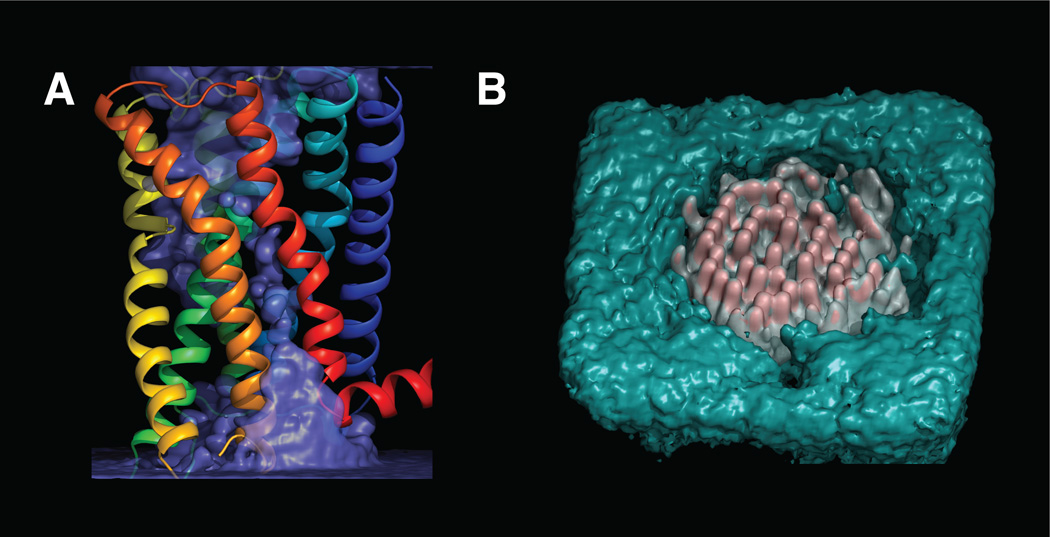
Examples of density calculated using LOOS and rendered with PyMol. (A) Water density inside of β2AR contoured at bulk density (B) Membrane lipid density beneath a lipopeptide micelle (not shown). POPE lipids colored white (bulk lipid contour) and red (double bulk), and POPG lipids colored cyan (bulk).

References

    1. Brooks B, Bruccoleri R, Olafson B, States D, Swaminathan S, Karplus M. Journal of Computational Chemistry. 1983;4:187.
    1. Case DA, Cheatham TE, Darden T, Gohlke H, Luo R, Merz KM, Onufriev A, Simmerling C, Wang B, Woods RJ. Journal of Computational Chemistry. 2005;26:1668. - PMC - PubMed
    1. Roe DR, Cheatham TE. Journal Of Chemical Theory And Computation. 2013;9:3084. - PubMed
    1. Glykos NM. Journal of Computational Chemistry. 2006;27:1765. - PubMed
    1. Koukos PI, Glykos NM. Journal of Computational Chemistry. 2013;34:2310. - PubMed

LinkOut - more resources