


Post-mastectomy radiotherapy can improve survival in breast cancer patients aged 35 years or younger with four or more positive nodes but not in one to three positive nodes
- PMID: 25328402
- PMCID: PMC4199562
- DOI: 10.2147/TCRM.S69997
Post-mastectomy radiotherapy can improve survival in breast cancer patients aged 35 years or younger with four or more positive nodes but not in one to three positive nodes
Abstract
Introduction: This retrospective study investigated the clinical value of post-mastectomy radiotherapy (PMRT) in female Chinese breast cancer patients aged 35 years or younger with positive axillary lymph nodes after mastectomy.
Methods: We performed an analysis of clinical pathological data from 221 female Chinese breast cancer patients aged 35 years or younger treated between 1998 and 2007. Patients were diagnosed with positive axillary lymph nodes and underwent mastectomy. PMRT was delivered to 92 patients.
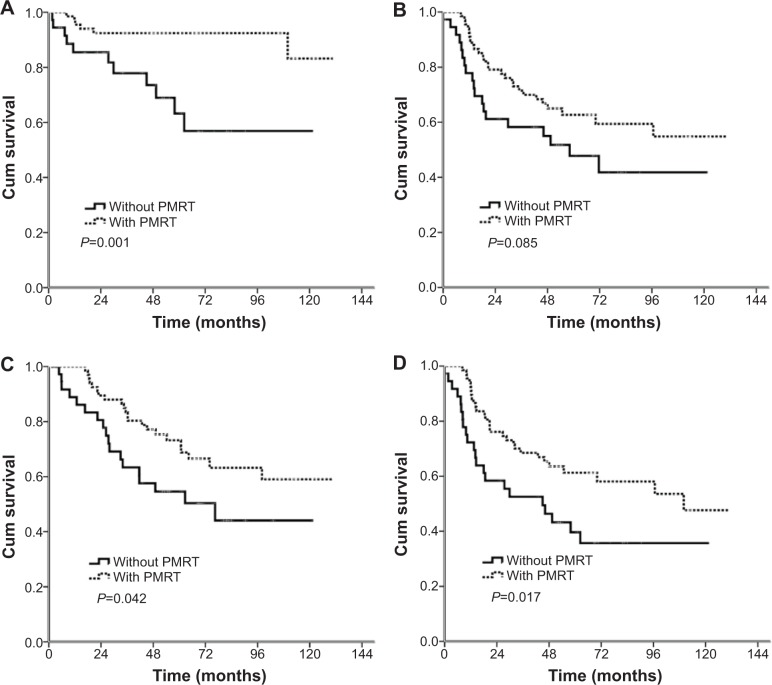
Results: The median follow-up was 61 months. The 5-year locoregional recurrence-free survival (LRFS), distant metastasis-free survival (DMFS), disease-free survival (DFS), and overall survival (OS) were 84.1%, 65.2%, 61.4%, and 77.2%, respectively. Univariate survival analysis (P=0.003) and multivariate analysis (P<0.001) both suggested that PMRT is an independent prognostic factor of LRFS. PMRT positively affected LRFS (P=0.003), but had no significant impact on DMFS (P=0.429), DFS (P=0.146), and OS (P=0.750). PMRT improved LRFS (P=0.001), DFS (P=0.017), and OS (P=0.042) in patients with four or more positive nodes, but no survival benefit was observed in patients with one to three positive nodes (P>0.05).
Conclusion: PMRT can improve survival in breast cancer patients aged 35 years or younger with four or more positive nodes but not in those with one to three positive nodes.
Keywords: breast cancer; locoregional recurrence; mastectomy; radiation therapy; young age.
Figures
References
-
- Agarwal G, Pradeep PV, Aggarwal V, Yip CH, Cheung PS. Spectrum of breast cancer in Asian women. World J Surg. 2007;31(5):1031–1040. - PubMed
-
- Hankey BF, Ries LA, Edwards BK. The surveillance, epidemiology, and end results program: a national resource. Cancer Epidemiol Biomarkers Prev. 1999;8(12):1117–1121. - PubMed
-
- Holli K, Isola J. Effect of age on the survival of breast cancer patients. Eur J Cancer. 1997;33(3):425–428. - PubMed
-
- Winchester DP, Osteen RT, Menck HR. The National Cancer Data Base report on breast carcinoma characteristics and outcome in relation to age. Cancer. 1996;78(8):1838–1843. - PubMed
LinkOut - more resources
Full Text Sources
Other Literature Sources
