. 2014 Sep 17;6(9):71.
doi: 10.1186/s13073-014-0071-9. eCollection 2014.

NGS-Logistics: federated analysis of NGS sequence variants across multiple locations

Affiliations

NGS-Logistics: federated analysis of NGS sequence variants across multiple locations

Amin Ardeshirdavani et al. Genome Med. .

Abstract

As many personal genomes are being sequenced, collaborative analysis of those genomes has become essential. However, analysis of personal genomic data raises important privacy and confidentiality issues. We propose a methodology for federated analysis of sequence variants from personal genomes. Specific base-pair positions and/or regions are queried for samples to which the user has access but also for the whole population. The statistics results do not breach data confidentiality but allow further exploration of the data; researchers can negotiate access to relevant samples through pseudonymous identifiers. This approach minimizes the impact on data confidentiality while enabling powerful data analysis by gaining access to important rare samples. Our methodology is implemented in an open source tool called NGS-Logistics, freely available at https://ngsl.esat.kuleuven.be.


Figures
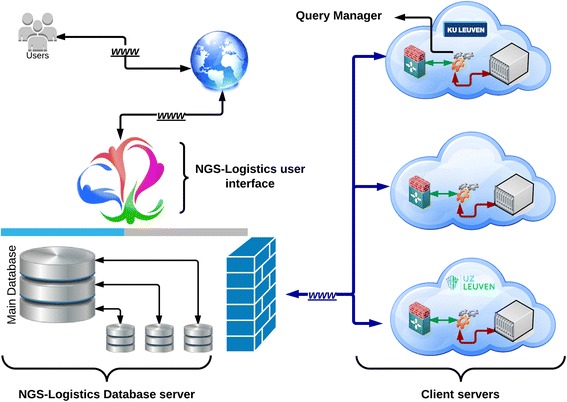
Figure 1
Figure 1
NGS-Logistics components. Users pass their queries from the NGS-Logistics web interface to the clients. Requests are stored and scheduled in the main database. Each center has one database, being the only way of communication between centers and the main system. Centers and their databases are connected through a secured connection, to which only valid and trusted IPs are allowed to connect. The query manager is responsible for tracking and running the request, as well as collecting and returning the results to the main system.
Figure 2
Figure 2
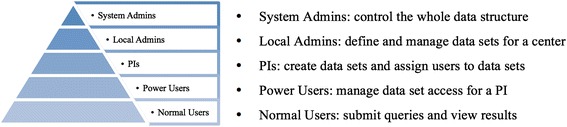
NGS-Logistics user types and their access levels.
Figure 3
Figure 3
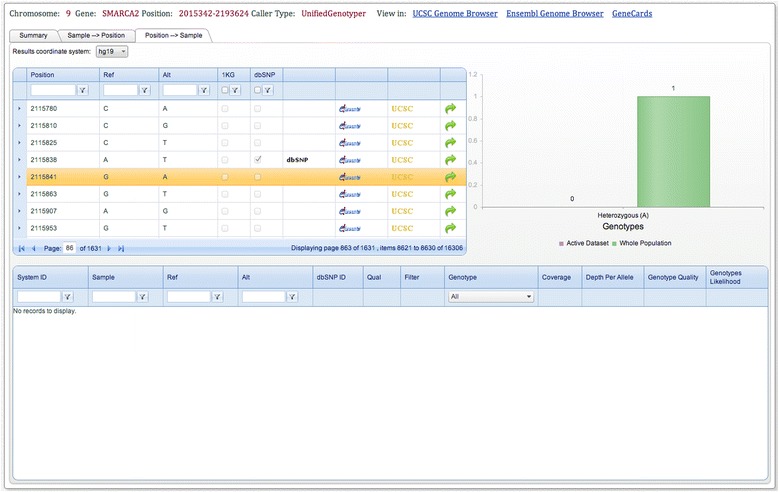
NGS-Logistics area query results page (Position to Sample section) for SMARCA2 . Results demonstrate that at the selected position (chr9:2115841, build 19) a G to A mutation can be observed with heterozygous genotypes. The graph shows the differences between the active data set and the whole population. Users can see the list of samples to which they have access and related information in the detail table (if any is available). For further inquiries about the selected position, links to the public databases are provided. Also users are able to submit a single point query if they are interested to see more details about the selected position.
Figure 4
Figure 4
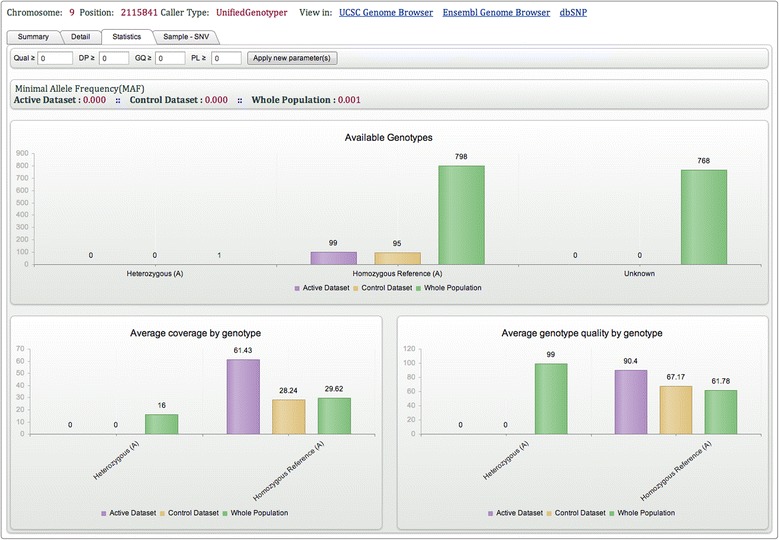
Single point query result page (Statistics section) for chr9:2115841. The query of chr9:2115841 shows that only one sample is polymorphic at this position. All samples that can be genotyped at this position from the active data set, the control data set and the whole population are homozygous reference. The MAF of this variant in each data set is thus very low.
Figure 5
Figure 5
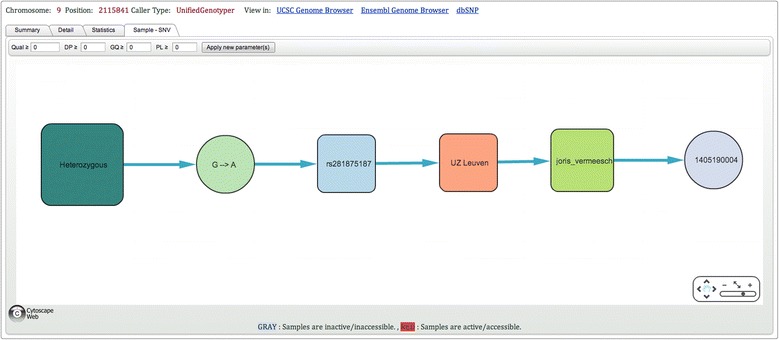
Single point query results page (Sample to SNV section) for chr9:2115841. Those samples that have a mutation are clustered based on their genotypes, dbSNP ID, Center, and Sample Owner name. Samples are labeled by their System Sample ID, which is different from the actual sample name, and are color-coded according to the user’s active data set (red = active/accessible, grey = inactive/inaccessible).
Figure 6
Figure 6
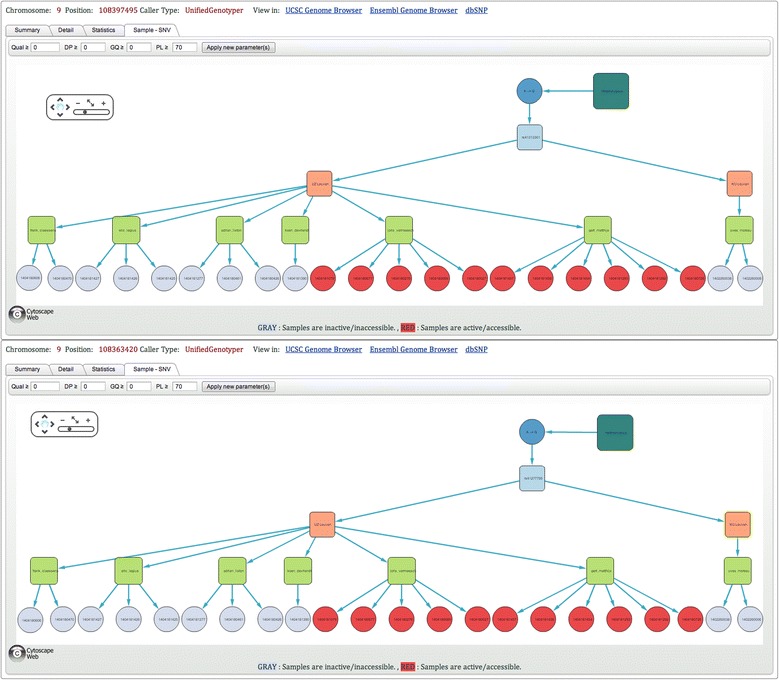
Single point query results page (Sample to SNV section) for chr9:108363420 and chr9:108397495, build 19. For both positions variants genotyped with PL <70 are filtered before counting polymorphic samples (PL: phred-scaled genotype likelihood). Since all 22 individuals carried both variants in a heterozygous state, we are able to conclude that the variants are on the same allele.

References

    1. Voelkerding KV, Dames SA, Durtschi JD. Next-generation sequencing: from basic research to diagnostics. Clin Chem. 2009;55:641–658. doi: 10.1373/clinchem.2008.112789. - DOI - PubMed
    1. Genomes Project C. Abecasis GR, Auton A, Brooks LD, DePristo MA, Durbin RM, Handsaker RE, Kang HM, Marth GT, McVean GA. An integrated map of genetic variation from 1,092 human genomes. Nature. 2012;491:56–65. doi: 10.1038/nature11632. - DOI - PMC - PubMed
    1. Prime Minister’s Office: DNA tests to revolutionise fight against cancer and help 100,000 NHS patients [http://www.gov.uk/government/news/dna-tests-to-revolutionise-fight-again...]
    1. Boomsma DI, Wijmenga C, Slagboom EP, Swertz MA, Karssen LC, Abdellaoui A, Ye K, Guryev V, Vermaat M, van Dijk F, Francioli LC, Hottenga JJ, Laros JF, Li Q, Li Y, Cao H, Chen R, Du Y, Li N, Cao S, van Setten J, Menelaou A, Pulit SL, Hehir-Kwa JY, Beekman M, Elbers CC, Byelas H, de Craen AJ, Deelen P, Dijkstra M, et al. The Genome of the Netherlands: design, and project goals. Eur J Hum Genet. 2014;22:221–227. doi: 10.1038/ejhg.2013.118. - DOI - PMC - PubMed
    1. DNA Sequencing Costs: Data from the NHGRI Genome Sequencing Program (GSP) [http://www.genome.gov/sequencingcosts]

LinkOut - more resources