


Cardiovascular Events Following Smoke-Free Legislations: An Updated Systematic Review and Meta-Analysis
- PMID: 25328861
- PMCID: PMC4198310
- DOI: 10.1007/s40572-014-0020-1
Cardiovascular Events Following Smoke-Free Legislations: An Updated Systematic Review and Meta-Analysis
Abstract
Background: Legislations banning smoking in indoor public places and workplaces are being implemented worldwide to protect the population from secondhand smoke exposure. Several studies have reported reductions in hospitalizations for acute coronary events following the enactment of smoke-free laws.
Objective: We set out to conduct a systematic review and meta-analysis of epidemiologic studies examining how legislations that ban smoking in indoor public places impact the risk of acute coronary events.
Methods: We searched MEDLINE, EMBASE, and relevant bibliographies including previous systematic reviews for studies that evaluated changes in acute coronary events, following implementation of smoke-free legislations. Studies were identified through December 2013. We pooled relative risk (RR) estimates for acute coronary events comparing post- vs. pre-legislation using inverse-variance weighted random-effects models.
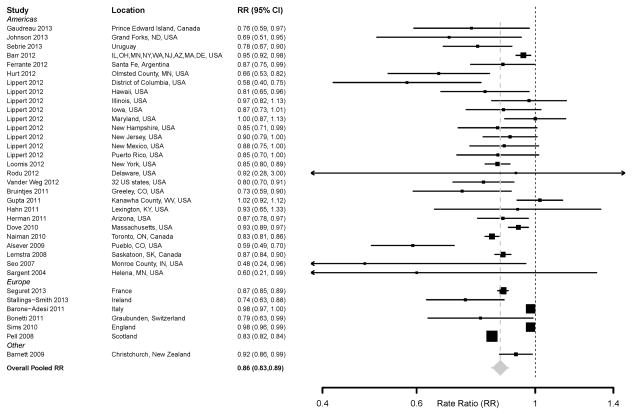
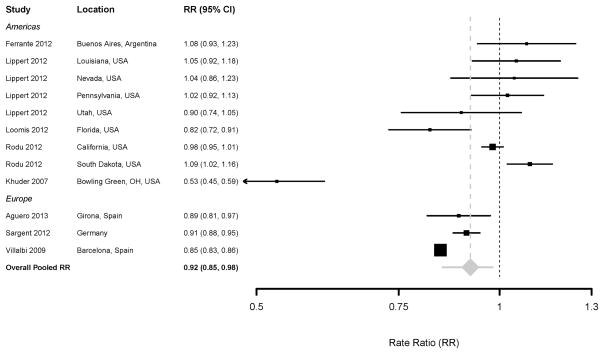
Results: Thirty-one studies providing estimates for 47 locations were included. The legislations were implemented between 1991 and 2010. Following the enactment of smoke-free legislations, there was a 12 % reduction in hospitalizations for acute coronary events (pooled RR: 0.88, 95 % CI: 0.85-0.90). Reductions were 14 % in locations that implemented comprehensive legislations compared to an 8 % reduction in locations that only had partial restrictions. In locations with reductions in smoking prevalence post-legislation above the mean (2.1 % reduction) there was a 14 % reduction in events compared to 10 % in locations below the mean. The RRs for acute coronary events associated with enacting smoke-free legislation were 0.87 vs. 0.89 in locations with smoking prevalence pre-legislation above and below the mean (23.1 %), and 0.87 vs. 0.89 in studies from the Americas vs. other regions.
Conclusion: The implementation of smoke-free legislations was related to reductions in acute coronary event hospitalizations in most populations evaluated. Benefits are greater in locations with comprehensive legislations and with greater reduction in smoking prevalence post-legislation. These cardiovascular benefits reinforce the urgent need to enact and enforce smoke-free legislations that protect all citizens around the world from exposure to tobacco smoke in public places.
Keywords: Cardiovascular diseases; Legislations; Smoke-free policy; Tobacco smoke pollution.
Conflict of interest statement
Miranda R. Jones, Joaquin Barnoya, Saverio Stranges, Lia Losonczy, and Ana Navas-Acien declare that they have no conflicts of interest.
Figures
References
-
- Barnoya J, Glantz SA. Cardiovascular effects of secondhand smoke: nearly as large as smoking. Circulation. 2005;111(20):2684–98. - PubMed
-
- World Health Organization (WHO) WHO framework convention on tobacco control. Geneva, Switzerland: 2005.
-
-
An action plan for ETS in Europe and adjacent areas, 1989–1992. 1988.
-
-
- Barnoya J, Glantz SA. The tobacco industry and secondhand smoke: lessons from Central and South America. Ethn Dis. 2003;13(2 Suppl 2):S88–90. - PubMed
-
- Chapman S, Borland R, Hill D, Owen N, Woodward S. Why the tobacco industry fears the passive smoking issue. Int J Health Serv. 1990;20(3):417–27. - PubMed
Grants and funding
LinkOut - more resources
Full Text Sources
Other Literature Sources