


Writing in and reading ICU diaries: qualitative study of families' experience in the ICU
- PMID: 25329581
- PMCID: PMC4199718
- DOI: 10.1371/journal.pone.0110146
Writing in and reading ICU diaries: qualitative study of families' experience in the ICU
Abstract
Purpose: Keeping an ICU patient diary has been reported to benefit the patient's recovery. Here, we investigated the families' experience with reading and writing in patient ICU diaries kept by both the family and the staff.
Methods: We conducted a qualitative study involving 32 semi-structured in-depth interviews of relatives of 26 patients (34% of all family members who visited patients) who met our ICU-diary criterion, i.e., ventilation for longer than 48 hours. Grounded theory was used to conceptualise the interview data via a three-step coding process (open coding, axial coding, and selective coding).
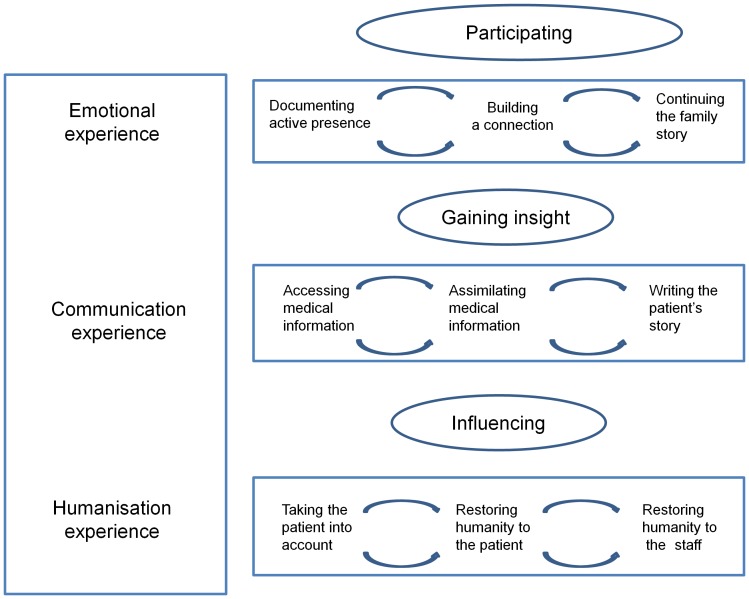
Results: Communicative, emotional, and humanising experiences emerged from our data. First, family members used the diaries to access, understand, and assimilate the medical information written in the diaries by staff members, and then to share this information with other family members. Second, the diaries enabled family members to maintain a connection with the patient by documenting their presence and expressing their love and affection. Additionally, families confided in the diaries to maintain hope. Finally, family members felt the diaries humanized the medical staff and patient.
Conclusions: Our findings indicate positive effects of diaries on family members. The diaries served as a powerful tool to deliver holistic patient- and family-centered care despite the potentially dehumanising ICU environment. The diaries made the family members aware of their valuable role in caring for the patient and enhanced their access to and comprehension of medical information. Diaries may play a major role in improving the well-being of ICU-patient families.
Conflict of interest statement
Figures
References
-
- Azoulay E, Pochard F, Kentish-Barnes N, Chevret S, Aboab J, et al. (2005) Risk of post-traumatic stress symptoms in family members of intensive care unit patients. Am J Respir Crit Care Med 171: 987–994. - PubMed
-
- Berwick DM, Kotagal M (2004) Restricted visiting hours in ICUs: time to change. JAMA 292: 736–737. - PubMed
-
- Giannini A, Miccinesi G, Leoncino S (2008) Visiting policies in Italian intensive care units: a nationwide survey. Intensive Care Medicine 34: 1256–1262. - PubMed
-
- Azoulay E, Chevret S, Leleu G, Pochard F, Barboteu M, et al. (2000) Half the families of intensive care unit patients experience inadequate communication with physicians. Crit Care Med 28: 3044–3049. - PubMed
-
- Azoulay E, Pochard F, Chevret S, Adrie C, Annane D, et al. (2004) Half the family members of intensive care unit patients do not want to share in the decision-making process: a study in 78 French intensive care units. Crit Care Med 32: 1832–1838. - PubMed
MeSH terms
LinkOut - more resources
Full Text Sources
Other Literature Sources
Medical
Miscellaneous
