


Comparison of long-term survival and toxicity of cisplatin delivered weekly versus every three weeks concurrently with intensity-modulated radiotherapy in nasopharyngeal carcinoma
- PMID: 25329593
- PMCID: PMC4199726
- DOI: 10.1371/journal.pone.0110765
Comparison of long-term survival and toxicity of cisplatin delivered weekly versus every three weeks concurrently with intensity-modulated radiotherapy in nasopharyngeal carcinoma
Abstract
Background: We aimed to compare the long-term survival outcomes and acute toxicity of cisplatin administered weekly versus every three weeks concurrently with intensity-modulated radiotherapy (IMRT) in patients with nasopharyngeal carcinoma (NPC).
Methods: This was a retrospective review of 154 patients with histologically proven, non-disseminated NPC who were treated using IMRT between January 2003 and December 2007. Seventy-three patients (47.4%) received 5-7 weeks of 30-40 mg/m2 cisplatin weekly; 81 patients (52.6%) received two or three cycles of 80 mg/m2 cisplatin every three weeks. IMRT was delivered at 68 Gy/30 fractions to the nasopharyngeal gross target volume and 60-66 Gy to the involved neck area.
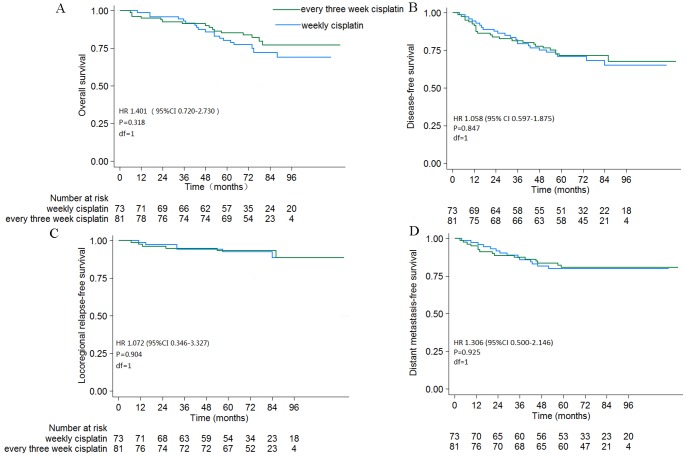
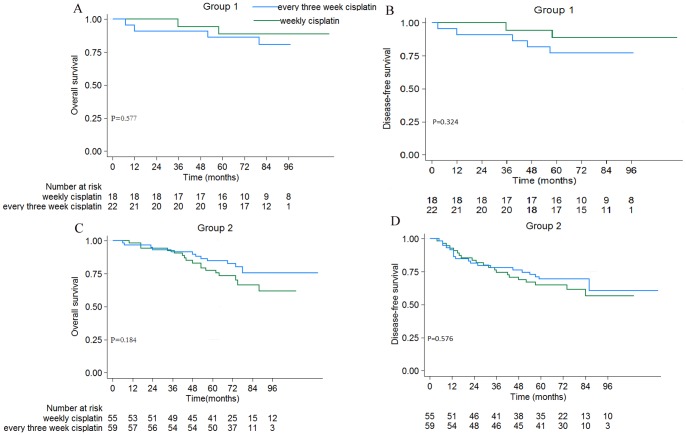
Results: The clinical characteristics and treatment factors of the two groups were well-balanced. The median follow-up was 74 months (range, 6-123 months), and the 5-year overall survival, disease-free survival, locoregional relapse-free survival, and distant metastasis-free survival rates were 85.2% vs. 78.9% (P = 0.318), 71.6% vs. 71.0% (P = 0.847), 93.5% vs. 92.6% (P = 0.904), and 80.9% vs. 80.1% (P = 0.925) for the group treated every three weeks and weekly, respectively. Subgroup analyses indicated no significant differences in the survival rates of the two groups among patients with early- or advanced-stage disease. The incidence of acute toxicities was similar between groups.
Conclusion: IMRT with concurrent cisplatin administered weekly or every three weeks leads to similar long-term survival outcomes and acute toxicity in NPC regardless of whether patients have early- or advanced-stage disease.
Conflict of interest statement
Figures
References
-
- Jemal A, Bray F, Center MM, Ferlay J, Ward E, et al. (2011) Global cancer statistics. CA Cancer J Clin 61: 69–90. - PubMed
-
- Edge SB, Byrd DR, Compton CC, Fritz AG, Greene FL, et al. (2009) American Joint Committee on Cancer Manual for Staging of Cancer [M]. 7th ed. Philadelphia: JB Lippincott. 649 p.
-
- Chen L, Mao YP, Xie FY, Liu LZ, Sun Y, et al. (2012) The seventh edition of the UICC/AJCC staging system for nasopharyngeal carcinoma is prognostically useful for patients treated with intensity-modulated radiotherapy from an endemic area in China. Radiat Oncol Biol Phys 104: 331–337. - PubMed
-
- Al-Sarraf M, LeBlanc M, Giri PG, Fu KK, Cooper J, et al. (1998) Chemoradiotherapy versus radiotherapy in patients with advanced nasopharyngeal cancer: phase III randomized Intergroup Study 0099. J Clin Oncol 16: 1310–1317. - PubMed
-
- Lee AW, Lau WH, Tung SY, Chua DT, Chappell R, et al. (2005) Preliminary results of a randomized study on therapeutic gain by concurrent chemotherapy for regionally-advanced nasopharyngeal carcinoma: NPC-9901 trial by the Hong Kong Nasopharyngeal Cancer Study Group. J Clin Oncol 23: 6966–6975. - PubMed
Publication types
MeSH terms
Substances
LinkOut - more resources
Full Text Sources
Other Literature Sources
