


Altered levels of serum sphingomyelin and ceramide containing distinct acyl chains in young obese adults
- PMID: 25329603
- PMCID: PMC4217001
- DOI: 10.1038/nutd.2014.38
Altered levels of serum sphingomyelin and ceramide containing distinct acyl chains in young obese adults
Abstract
Objective: Recent studies indicate that sphingolipids, sphingomyelin (SM) and ceramide (Cer) are associated with the development of metabolic syndrome. However, detailed profiles of serum sphingolipids in the pathogenesis of this syndrome are lacking. Here we have investigated the relationship between the molecular species of sphingolipids in serum and the clinical features of metabolic syndrome, such as obesity, insulin resistance, fatty liver disease and atherogenic dyslipidemia.
Subjects: We collected serum from obese (body mass index, BMI⩾35, n=12) and control (BMI=20-22, n=11) volunteers (18-27 years old), measured the levels of molecular species of SM and Cer in the serum by liquid chromatography-mass spectrometry and analyzed the parameters for insulin resistance, liver function and lipid metabolism by biochemical blood test.
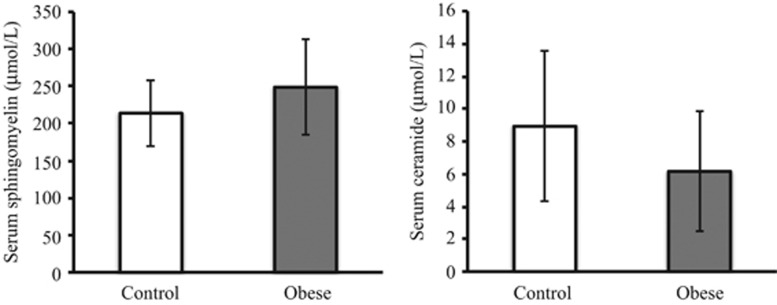
Results: The SM C18:0 and C24:0 levels were higher, and the C20:0 and C22:0 levels tended to be higher in the obese group than in the control group. SM C18:0, C20:0, C22:0 and C24:0 significantly correlated with the parameters for obesity, insulin resistance, liver function and lipid metabolism, respectively. In addition, some Cer species tended to correlate with these parameters. However, SM species containing unsaturated acyl chains and most of the Cer species were not associated with these parameters.
Conclusions: The present results demonstrate that the high levels of serum SM species with distinct saturated acyl chains (C18:0, C20:0, C22:0 and C24:0) closely correlate with the parameters of obesity, insulin resistance, liver function and lipid metabolism, suggesting that these SM species are associated with the development of metabolic syndrome and serve as novel biomarkers of metabolic syndrome and its associated diseases.
Figures
References
-
- Lee JM. Why young adults hold the key to assessing the obesity epidemic in children. Arch Pediatr Adolesc Med. 2008;162:682–687. - PubMed
-
- Das UN. Obesity: genes, brain, gut, and environment. Nutrition. 2010;26:459–473. - PubMed
-
- Yuyama K, Mitsutake S, Igarashi Y. Pathological roles of ceramide and its metabolites in metabolic syndrome and Alzheimer's disease. Biochim Biophys Acta. 2014;1841:793–798. - PubMed
-
- Merrill AH. De novo sphingolipid biosynthesis: a necessary, but dangerous, pathway. J Biol Chem. 2002;277:25843–25846. - PubMed
LinkOut - more resources
Full Text Sources
Other Literature Sources
