


The mediating role of parenting in the associations between household chaos and children's representations of family dysfunction
- PMID: 25329862
- PMCID: PMC4239165
- DOI: 10.1080/14616734.2014.966124
The mediating role of parenting in the associations between household chaos and children's representations of family dysfunction
Abstract
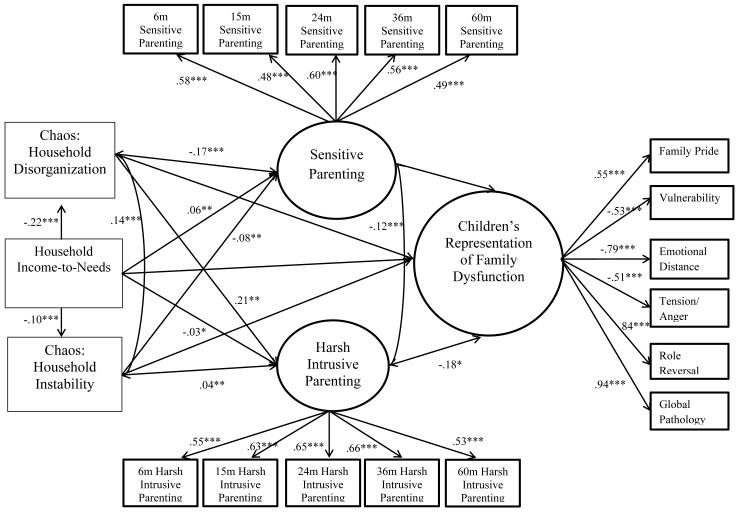
Children's drawings are thought to reflect their mental representations of self and their interpersonal relations within families. Household chaos is believed to disrupt key proximal processes related to optimal development. The present study examines the mediating role of parenting behaviors in the relations between two measures of household chaos, instability and disorganization, and how they may be evidenced in children's representations of family dysfunction as derived from their drawings. The sample (N = 962) is from a longitudinal study of rural poverty exploring the ways in which child, family, and contextual factors shape development over time. Findings reveal that, after controlling for numerous factors including child and primary caregiver covariates, there were significant indirect effects from cumulative family disorganization, but not cumulative family instability, on children's representation of family dysfunction through parenting behaviors. Results suggest that the proximal effects of daily disorganization outweigh the effects of periodic instability overtime.
Keywords: children’s representations; family dysfunction; household chaos; parenting; poverty.
References
-
- Ackerman BP, Brown ED. Physical and psychosocial turmoil in the home and cognitive development. 2010
-
- Ackerman BP, Kogos J, Youngstrom E, Schoff K, Izard C. Family instability and the problem behaviors of children from economically disadvantaged families. Developmental Psychology. 1999;35:258. - PubMed
-
- Ainsworth MDS, Blehar MC, Waters E, Wall S. Patterns of attachment: A psychological study of the strange situation. Lawrence Erlbaum; 1978.
-
- Amato PR. The consequences of divorce for adults and children. Journal of Marriage and the Family. 2000;62:1269–1287.
-
- Arbuckle JL. Full information estimation in the presence of incomplete data. In: Marcoulides GA, Schumacker RE, editors. Advanced structural equation modeling. Erlbaum; Mahwah, NJ: 1996. pp. 243–277.
MeSH terms
Grants and funding
LinkOut - more resources
Full Text Sources
Other Literature Sources
Medical
