


The Andersen aerobic fitness test: reliability and validity in 10-year-old children
- PMID: 25330388
- PMCID: PMC4201545
- DOI: 10.1371/journal.pone.0110492
The Andersen aerobic fitness test: reliability and validity in 10-year-old children
Abstract
Background: High aerobic fitness is consistently associated with a favorable metabolic risk profile in children. Direct measurement of peak oxygen consumption (VO2peak) is often not feasible, thus indirect tests such as the Andersen test are required in many settings. The present study seeks to determine the reliability and validity of the Andersen test in 10-year-old children.
Methods: A total of 118 10-year-old children (67 boys and 51 girls) were recruited from one school and performed four VO2peak tests over three weeks: three Andersen tests (indirect) and one continuous progressive treadmill test (direct). Of these, 104 children provided valid data on all Andersen tests and 103 children also provided valid data on the direct treadmill test. Reliability and validity were assessed using Bland Altman plots and linear regression analysis.
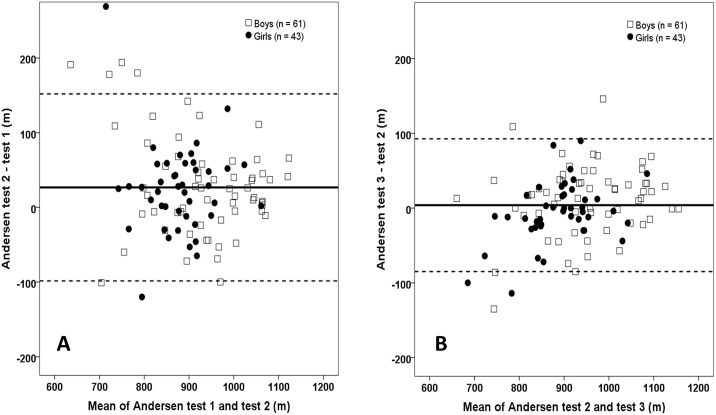
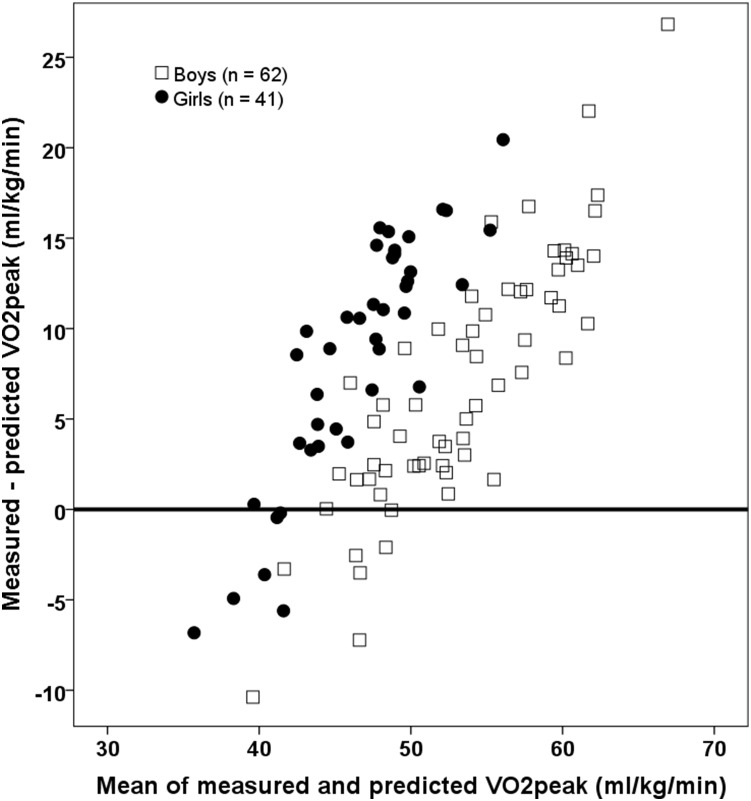
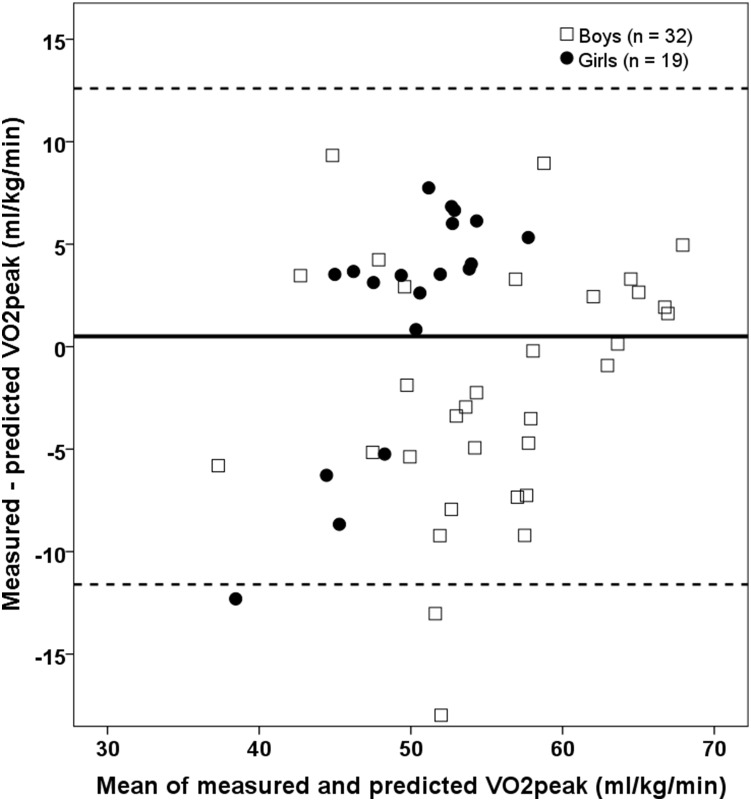
Results: Bias (mean change) and random error (limits of agreement) were 26.7±125.2 m for test 2 vs. test 1 (p<.001 for mean difference) and 3.9±88.8 m for test 3 vs. test 2 (p = .514 for mean difference). The equation to estimate VO2peak suggested by Andersen et al. (2008) showed a poor fit in the present sample; thus, we suggest a new equation: VO2peak = 23.262+0.050*Andersen distance -3.858*gender -0.376*body weight (R2 = 0.61, standard error of the estimate = 5.69, p<.001, boys = 0, girls = 1).
Conclusions: The Andersen test provided reliable and valid data on a group level. However, a substantial degree of individual variability was found for estimates of VO2peak. Researchers should be aware of the amount of noise in indirect tests that estimate aerobic fitness.
Conflict of interest statement
Figures
References
-
- Andersen LB, Sardinha LB, Froberg K, Riddoch CJ, Page AS, et al. (2008) Fitness, fatness and clustering of cardiovascular risk factors in children from Denmark, Estonia and Portugal: the European Youth Heart Study. Int J Pediatr Obes 3 Suppl 158–66. - PubMed
-
- Anderssen SA, Cooper AR, Riddoch C, Sardinha LB, Harro M, et al. (2007) Low cardiorespiratory fitness is a strong predictor for clustering of cardiovascular disease risk factors in children independent of country, age and sex. Eur J Cardiovasc Prev Rehabil 14: 526–531. - PubMed
-
- Fogelholm M (2010) Physical activity, fitness and fatness: relations to mortality, morbidity and disease risk factors. A systematic review. Obes rev 11: 202–221. - PubMed
-
- Myers J, Prakash M, Froelicher V, Do D, Partington S, et al. (2002) Exercise capacity and mortality among men referred for exercise testing. N Engl J Med 436: 793–801. - PubMed
-
- Jorgensen T, Andersen LB, Froberg K, Maeder U, Smith LV, et al. (2009) Position statement: Testing physical condition in a population - how good are the methods? Eur J Sport Sci 9: 257–267.
MeSH terms
LinkOut - more resources
Full Text Sources
Other Literature Sources
Medical
