


The history of genetics in inflammatory bowel disease
- PMID: 25331623
- PMCID: PMC4188925
The history of genetics in inflammatory bowel disease
Abstract
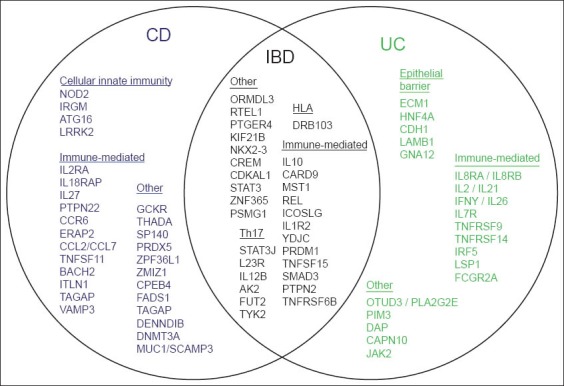
The influence of genetics in the etiology of inflammatory bowel disease (IBD) was initially demonstrated by epidemiological data, including differences in prevalence among different ethnic groups, familial aggregation of IBD, concordance in twins, and association with genetic syndromes. These early observations paved the way to molecular genetics in IBD, and culminated in the identification of nucleotide-binding oligomerization domain containing 2 (NOD2) gene as an IBD risk gene in 2001. As in other complex diseases, the advent of Genome Wide Association studies has dramatically improved the resolution of the IBD genome and our understanding of the pathogenesis of IBD. However, the complexity of the genetic puzzle in IBD seems more pronounced today than ever previously. In total, 163 risk genes/loci have been identified, and the corresponding number of possible causal variants is challenging. The great majority of these loci are associated with both Crohn's disease and ulcerative colitis, suggesting that nearly all of the biological mechanisms involved in one disease play some role in the other. Interestingly, a large proportion of the IBD risk loci are also shared with other immune-mediated diseases, primary immunodeficiencies and mycobacterial diseases.
Keywords: Inflammatory bowel disease; genetic epidemiology; genetics.
Conflict of interest statement
Conflict of Interest: None
Figures
References
-
- Economou M, Pappas G. New global map of Crohn's disease: Genetic, environmental, and socioeconomic correlations. Inflamm Bowel Dis. 2008;14:709–720. - PubMed
-
- Binder V. Genetic epidemiology in inflammatory bowel disease. Dig Dis. 1998;16:351–355. - PubMed
-
- Kyle J. Crohn's disease in the northeastern and northern Isles of Scotland: an epidemiological review. Gastroenterology. 1992;103:392–399. - PubMed
-
- Gunesh S, Thomas GA, Williams GT, Roberts A, Hawthorne AB. The incidence of Crohn's disease in Cardiff over the last 75 years: an update for 1996-2005. Aliment Pharmacol Ther. 2008;27:211–219. - PubMed
Publication types
LinkOut - more resources
Full Text Sources