. 2015 Jan;59(1):178-85.
doi: 10.1128/AAC.03684-14. Epub 2014 Oct 20.

Nonclinical and pharmacokinetic assessments to evaluate the potential of tedizolid and linezolid to affect mitochondrial function

Affiliations

Nonclinical and pharmacokinetic assessments to evaluate the potential of tedizolid and linezolid to affect mitochondrial function

Shawn Flanagan et al. Antimicrob Agents Chemother. 2015 Jan.

Abstract

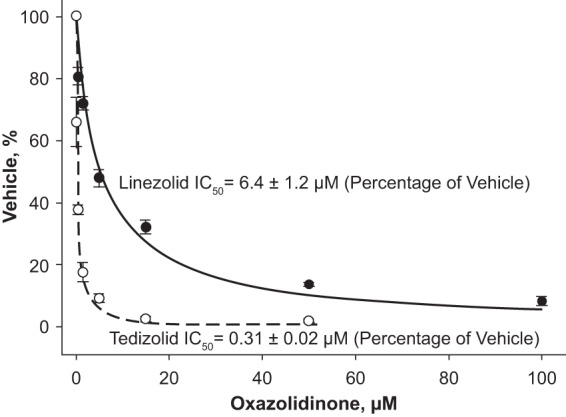
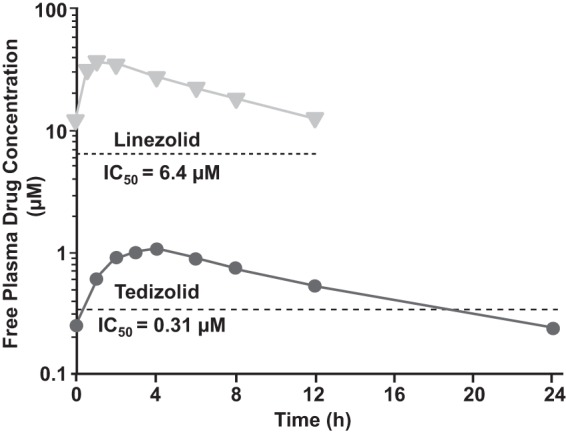
Prolonged treatment with the oxazolidinone linezolid is associated with myelosuppression, lactic acidosis, and neuropathies, toxicities likely caused by impairment of mitochondrial protein synthesis (MPS). To evaluate the potential of the novel oxazolidinone tedizolid to cause similar side effects, nonclinical and pharmacokinetic assessments were conducted. In isolated rat heart mitochondria, tedizolid inhibited MPS more potently than did linezolid (average [± standard error of the mean] 50% inhibitory concentration [IC50] for MPS of 0.31 ± 0.02 μM versus 6.4 ± 1.2 μM). However, a rigorous 9-month rat study comparing placebo and high-dose tedizolid (resulting in steady-state area under the plasma concentration-time curve values about 8-fold greater than those with the standard therapeutic dose in humans) showed no evidence of neuropathy. Additional studies explored why prolonged, high-dose tedizolid did not cause these mitochondriopathic side effects despite potent MPS inhibition by tedizolid. Murine macrophage (J774) cell fractionation studies found no evidence of a stable association of tedizolid with eukaryotic mitochondria. Monte Carlo simulations based on population pharmacokinetic models showed that over the course of a dosing interval using standard therapeutic doses, free plasma concentrations fell below the respective MPS IC50 in 84% of tedizolid-treated patients (for a median duration of 7.94 h) and 38% of linezolid-treated patients (for a median duration of 0 h). Therapeutic doses of tedizolid, but not linezolid, may therefore allow for mitochondrial recovery during antibacterial therapy. The overall results suggest that tedizolid has less potential to cause myelosuppression and neuropathy than that of linezolid during prolonged treatment courses. This, however, remains a hypothesis that must be confirmed in clinical studies.


Figures

FIG 1
FIG 1
Concentration-response effects of tedizolid and linezolid on MPS. Highly coupled rat heart mitochondria were incubated with [35S]methionine in the presence of increasing concentrations of tedizolid (open circles) or linezolid (closed circles). Data are the means (± standard errors of the means) from six independent experiments. IC50 is defined as the concentration of drug causing a 50% reduction of the value for the control (vehicle only), with its value calculated using best-fit hyperbolic decay regression.
FIG 2
FIG 2
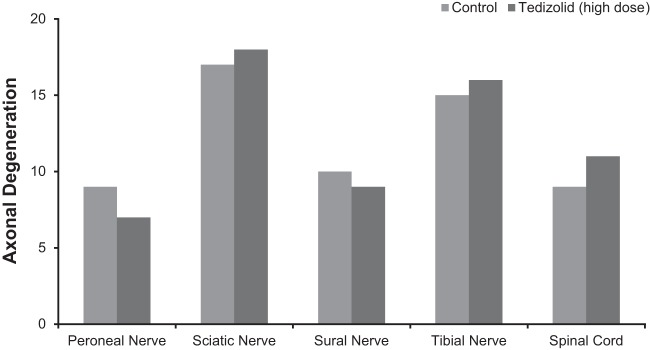
Neuropathology results from a long-term neurotoxicity study comparing control rats (n = 20) to rats administered tedizolid (n = 20) at a dose with a mean total plasma exposure equivalent to approximately 8 times the total AUC exposure achieved with the human therapeutic dose.
FIG 3
FIG 3
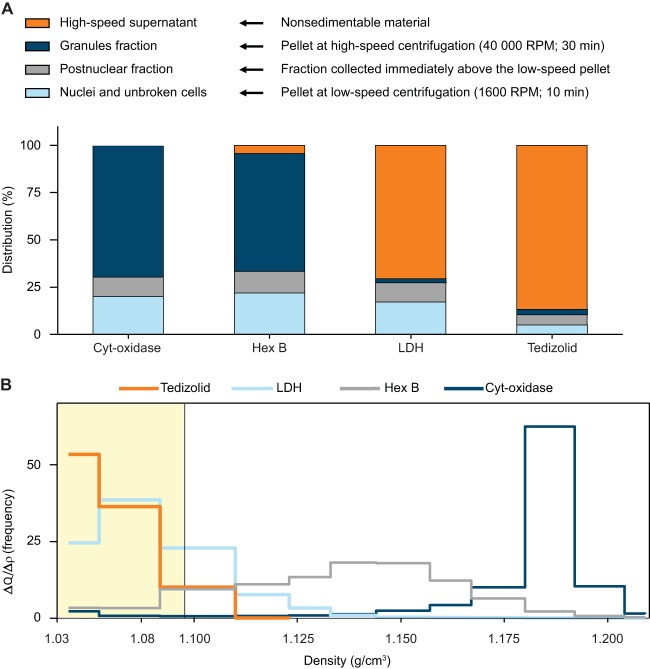
Results of cell fractionation studies conducted by differential centrifugation (A) and isopycnic centrifugation (B). For differential centrifugation, the cell homogenate was subjected to centrifugation at increasing speeds to collect organelles of decreasing size and a final supernatant. Results are shown as the percentage of each constituent recovered in each fraction. For isopycnic centrifugation, a postnuclear supernatant (cell homogenate minus nuclei and unbroken cells) was deposited on top of a linear sucrose gradient, which was centrifuged at high speed to allow subcellular organelles to move to and equilibrate at their buoyant densities. Results are shown as frequency distribution histograms (fractional amount recovered/density increment versus the density span of the gradient) (see the work of Lemaire et al. [37] for details). Cyt-oxidase, cytochrome c oxidase; Hex B, N-acetyl-β-hexosaminidase; LDH, lactate dehydrogenase.
FIG 4
FIG 4
Mean free (unbound) drug plasma exposure concentrations at steady state for therapeutic-dose tedizolid (200 mg once daily; circles) and linezolid (600 mg twice daily; triangles) over the course of the dosing interval, based on published values (25, 41), in relation to the MPS IC50 of each agent.

References

    1. Barnhill AE, Brewer MT, Carlson SA. 2012. Adverse effects of antimicrobials via predictable or idiosyncratic inhibition of host mitochondrial components. Antimicrob Agents Chemother 56:4046–4051. doi: 10.1128/AAC.00678-12. - DOI - PMC - PubMed
    1. Cohen BH, Saneto RP. 2012. Mitochondrial translational inhibitors in the pharmacopeia. Biochim Biophys Acta 1819:1067–1074. doi: 10.1016/j.bbagrm.2012.02.023. - DOI - PubMed
    1. Scatena R. 2012. Mitochondria and drugs. Adv Exp Med Biol 942:329–346. doi: 10.1007/978-94-007-2869-1_15. - DOI - PubMed
    1. Shinabarger D. 1999. Mechanism of action of the oxazolidinone antibacterial agents. Expert Opin Invest Drugs 8:1195–1202. doi: 10.1517/13543784.8.8.1195. - DOI - PubMed
    1. Lin AH, Murray RW, Vidmar TJ, Marotti KR. 1997. The oxazolidinone eperezolid binds to the 50S ribosomal subunit and competes with binding of chloramphenicol and lincomycin. Antimicrob Agents Chemother 41:2127–2131. - PMC - PubMed

Publication types

MeSH terms